


The collapse in WTI prices in March has been a crushing blow to the Permian, the Bakken and other U.S. shale plays that produce light, sweet crude oil. But as bad as sub-$25/bbl WTI prices are — especially for producers whose balance-of-2020 volumes aren’t at least partly hedged at higher prices — consider the record-low, $5/bbl prices facing oil sands producers up north in Alberta. Western Canadian Select, the energy-rich region’s benchmark heavy-crude blend, fell below $10/bbl more than a week ago, and on Tuesday WCS closed at $5.08/bbl. Producers, who already had been dealing with major takeaway constraints, are ratcheting back their output and planned 2020 capex, and slashing the volumes they send out via rail in tank cars. Today, we begin a short blog series on the latest round of bad news hitting Western Canada’s oil patch.
Oil sands producers have a lot in common with George Chuvalo, a boxing legend in Canada. A five-time Canadian heavyweight champion, Chuvalo, now 82 years old, is best known for never being knocked to the mat in his 93 professional bouts, even when he fought the likes of Muhammad Ali (twice), George Foreman and “Smokin’ Joe” Frazier. After his 15-round challenge to Ali’s world heavyweight title in 1966, which Chuvalo lost by decision, the Canadian boxer bragged, “When it was all over, (Ali) was the guy who went to the hospital ... Me? I went dancing with my wife.” (Ali had called Chuvalo “the toughest guy I ever fought.”) Like Chuvalo, producers in the oil sands have been pummeled and knocked against the ropes many times, most recently by pipeline-project delays and dizzyingly steep price discounts, but they have remained standing –– seeing stars, maybe, but still upright, if only barely.
The three oil sands areas in northern Alberta — the giant Athabasca deposits and the smaller Peace River and Cold Lake areas — together cover only ~55,000 square miles (about one-fifth the size of Texas, or of Alberta) but they contain proven reserves equivalent to more than 160 billion barrels of crude oil, according to the International Energy Agency (IEA) and other sources. As the Shale Era has reminded everyone, though, simply having vast hydrocarbon reserves in the ground isn’t enough. Production costs and the cost of delivering product to market need to be competitive if an area is to continue drawing investment — at least over the long-term in the case of areas with higher upfront development costs.

Canadian crude output is rising, requiring new export routes. As traditional pathways face constraints, the U.S. Rockies—especially the Guernsey, WY hub—are emerging as key corridors for moving Canadian heavy crude to downstream markets, including the Gulf Coast.
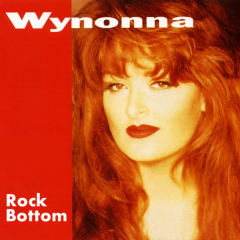
About the song
"Rock Bottom" was written by Buddy Buie and J.R. Cobb, and appears as the second song on Wynonna's second solo studio album, Tell Me Why. The song was released in February 1994 and went to #2 on the Billboard Hot Country Songs Singles chart. Personnel on the record were: Wynonna Judd (lead, backing vocals), Eddie Bayer (drums), Steve Cropper (electric guitar), Steuart Smith (electric guitar), Willie Weeks (bass), Barry Beckett (Hammond B3 organ), Matt Rollings (Wurlitzer electric piano), and Bob Bailey, Kim Fleming and Suzy Willis (backing vocals).
Tell Me Why was recorded at Emerald Sound Studio in Nashville, with Tony Brown producing. It was released in May 1993, and went to #1 the Billboard Top Country Albums chart and #5 on the Billboard Top 200 Albums chart. Five singles were released from the album; all of them were Top 10 hits on the Billboard country music charts. The LP has been certified Platinum by the Recording Industry Association of America.
Wynonna Judd (Christina Claire Ciminella) is an American country music singer. Her solo records are all credited to the single name Wynonna. She rose to fame in the 1980s alongside her mother Naomi in the country music duo, The Judds. The Judds released seven albums and 26 singles, 14 of which were #1 country hits. As a solo artist, Wynonna has released nine studio albums, one live album, four compilation albums and 43 singles. She has won two Billboard Music Awards, four Academy of Country Music Awards, four Grammy Awards and one American Music Award. She still records and tours.




Comments
With the drop in demand for WCS, what will happen with gas liquids producers in BC and Alberta? Will the outcome be: a material drop in production (as diluent demand falls, so will gas liquids demand), or, unchanged (as their supply contracts to yearend will keep them producing gas liquids)?