With a dwindling market for their crude, many U.S. producers are confronting an unavoidable choice: shutting in existing production. Just go out and flip a switch and turn a valve, right? Wrong. Like everything else in the COVID era, shutting in production is complicated. It is the alternative of last resort for producers, whose primary directive is the economic extraction of oil and gas. But with demand for their products crushed, production from some wells no longer makes economic sense. Unfortunately, the process of shutting in wells is charged with contractual, economic and operational issues that the industry is scrambling to deal with. The situation is fraught with uncertainty, and many producers’ futures depend on how decisively they manage the shut-in process. Today, we discuss the urgent need to reduce oil production and the judgments producers will be making as they take wells offline.
Only six months ago, the leading concerns of producers in the Permian, the Bakken and most other U.S. shale plays were related to infrastructure. Would there be enough pipeline takeaway capacity to keep pace with production growth? Would the lack of sufficient gas processing or gas pipeline capacity force a slowdown in crude drilling-and-completion activity? Would new crude export capacity along the Gulf Coast come online fast enough? Those days feel like a distant memory. Nowadays, many U.S. producers are in survival mode. Crude oil prices are in record-low territory as demand has plummeted and storage space at the Cushing, OK, hub and along the Gulf Coast is filling fast.

Canadian crude output is rising, requiring new export routes. As traditional pathways face constraints, the U.S. Rockies—especially the Guernsey, WY hub—are emerging as key corridors for moving Canadian heavy crude to downstream markets, including the Gulf Coast.
As we discussed last week in How Much More Can I Take, the U.S. supply-demand balance is totally out of whack. The impact of COVID-related social distancing measures on transportation fuels has pulled 3.5 MMb/d of U.S. refining demand out of the crude market. That situation in the U.S. and globally has resulted in a glut of crude, which has weighed down prices. The market’s response has been to adjust the other factors affecting supply and demand: imports, exports and production. When those factors are insufficient, the balance gets pushed into inventory. But storage is filling and as it does, the options for producers to deal with surpluses are narrowing.
About the song
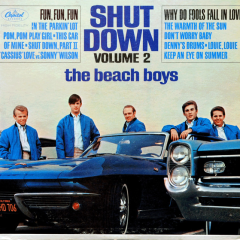
“Shut Down” was written by Brian Wilson and Roger Christian and released as the B-side of The Beach Boys’ single “Surfin’ U.S.A.” in March 1963. The Nik Venet-produced single went to #23 on the Billboard Hot 100 Singles chart. “Shut Down” also appears as the sixth cut on Side One of The Beach Boys’ second studio album, Surfin’ U.S.A., which went to went to #2 on the Billboard Top 200 Albums chart after its release, also in March 1963. Further, the song also appears as the first track on Side Two of The Beach Boys’ collection of car songs album, Little Deuce Coupe, which was released in October 1963. That album went to #4 on the Billboard Top 200 Albums chart.
“Shut Down” describes a race between a 1962 Dodge Dart and a 1963 Corvette Stingray, with the Corvette winning. Roger Christian was brought in as a lyricist with Brian Wilson because of his knowledge about cars. The Dodge is referenced in the song as having a 413 big block Max Wedge engine, with dual four-barrel carburetors. The Corvette is referred to as having a small block 327 engine, with fuel injection. Brian Wilson always owned Corvettes, including at the time this song was written ... so, Corvette for the win! Personnel on the record were: Mike Love (lead vocal, sax), Brian Wilson (backing vocals, bass), David Marks ( rhythm guitar, lead guitar during song fade), Carl Wilson (backing vocals, lead guitar) and Dennis Wilson (backing vocals, drums).
The Beach Boys are an American rock band formed in Hawthorne, CA, in 1961. The band has released 30 studio albums, eight live albums, 55 compilation albums, 23 EPs and 71 singles, and has sold over 100 million records worldwide. The Beach Boys were inducted into the Rock and Roll Hall of Fame in 1988. Their album, Pet Sounds, was inducted into the Grammy Hall of Fame in 1998, and the band was awarded a Grammy Lifetime Achievement Award in 2001. Dennis Wilson died in 1983 and Carl Wilson in 1998. Brian Wilson still records and occasionally tours as a solo artist. Mike Love, Al Jardine, and Bruce Johnston, with touring musicians, still tour as The Beach Boys.