


Permian producers led the U.S. exploration and production (E&P) sector’s remarkable recovery from the financial crisis that was spurred by the oil price crash in late 2014. Dramatically lower costs and higher well productivity led to strong margins even at $50/bbl oil and promised bountiful returns should oil prices move higher. It’s no surprise that investors flocked to the stocks of Permian-focused producers, driving equity valuations, as measured by enterprise value per barrel of oil equivalent (boe) of proved reserves, to multiples three or four times the industry average. Recently, however, there have been growing investor concerns that logistical constraints on shipping crude oil and gas out of the region could restrict cash flows, investment budgets and output growth, and on Friday, Baker Hughes reported that the Permian’s rig count was down (albeit by only four, to 476). Since May 15, stock prices of smaller pure-play Permian producers Concho Resources, Diamondback Energy, Parsley Energy, RSP Permian, and Laredo Petroleum have fallen 10-15%. One of the larger Permian producers has bucked the trend, though: Pioneer Natural Resources. Today, we explore the drivers of Pioneer’s current valuation and analyze the factors that could propel future growth.
As we detailed in our two-part Better blog series, the 44 U.S. E&P companies we track returned to the cusp of profitability in 2017 after $161 billion in losses in the previous two years, despite realized oil prices that were 40% below 2014. These results reflected the impact of a sector transformation that included intense capital discipline, a focus on operational efficiencies and high-grading of portfolios. The high-grading included a growing focus on the Permian Basin, which attracted one-third of total capital investment by these 44 E&Ps in 2017 and a whopping 55% planned for 2018. In (I Got Crude) I Feel Good, we noted that cash flows and profits surged in the first quarter of 2018 with oil prices higher than they’d been for years. Permian-focused producers accounted for seven of the top nine companies in pre-tax operating income per boe of production, driven by steadily declining lifting costs and an average 20%-plus production growth. With oil prices continuing to rise, the outlook for even higher profits in the remainder of 2018 seemed bright.
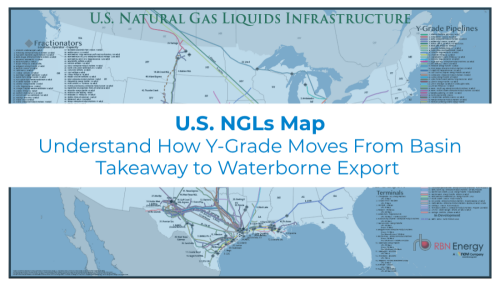
Visualize the infrastructure behind U.S. NGL movement.
The U.S. NGLs Map provides a comprehensive view of the transport, processing, and export networks moving NGLs across the U.S.
But the strong production growth that drove the industry recovery is a wrench in the works for some of the star Permian performers. The problem is that output has outstripped takeaway capacity for crude oil, as we’ve detailed in several blogs, most recently the two-part No Time series, and natural gas (see Blame it on Texas) — and over the next couple of years could do the same to NGLs (see the two-part Cowboys and NGLs blogs). While takeaway relief may be on the way in late 2019 or 2020, many investors seem to have suddenly woken up to the fact that severe transportation constraints could result in devastatingly low regional crude oil and gas prices that will dampen cash flows and profitability. The result has been a decline in the equity valuation of some Permian-focused producers. Pioneer Natural Resources (NYSE: PXD) has stood out from its Permian peers for several reasons that have resulted in sustained investor support, including strong production growth, low costs, and a rock-solid balance sheet. And now, when infrastructure constraints are haunting many Permian producers, Pioneer has the added benefit of firm contracts to transport all of its projected production through 2021 to the Gulf Coast, where it receives advantaged pricing.

About the song
"Surfin Safari" is first track on the The Beach Boys' debut album of the same name, which was released in October 1962. The single, written by Brian Wilson and Mike Love, reached #14 on the Billboard Hot 100 singles chart, while the Surfin' Safari LP rose to #32 on the Billboard 200 albums chart. The album was recorded at Hite Morgan and Capitol Studios in Los Angeles, and was produced by Nick Venet, with a lot of assistance from Brian and Murry Wilson.
The Beach Boys are an American rock and roll band formed in Hawthorne, CA, in 1961. Brothers Brian, Carl, and Dennis Wilson, along with cousin Mike Love and neighbor Al Jardine, formed the group's original lineup. The band has had over 80 songs chart worldwide, 36 of them were U.S. Top 40 hits, and four reached #1. The Beach Boys has have sold over 100 million records worldwide, making them one of the best-selling bands of all time.
The group has won a Grammy Lifetime Achievement Award, and its songs "I Get Around," "In My Room, " "California Girls," "Good Vibrations" — and its Pet Sounds album — have been inducted into the Grammy Hall of Fame. The Beach Boys themselves were inducted into the Rock and Roll Hall of Fame in 1988. A California Historic Landmark marks the location of the now-demolished house where the Wilson brothers grew up and started the band — the house was in the path of what is now the Century Freeway (Interstate 105). Dennis Wilson passed away in 1983, and Carl Wilson in 1998. Brian Wilson still tours occasionally, and Mike Love fronts a Beach Boys touring act, performing Beach Boys hits to this day.







Comments
I resently stopped by the Pioneer Natural Resources facility in Cuero, Tx and was told that Pioneer have put this facility up for sell and have announced intention to sell their South Texas, Raton and West Panhandle assets.. Does this mean that they will focus exclusively on Permian assets?
Yes, they once they divest their remaining non-core assets, they'll be focusing exclusively on the Permian.