Last week Hurricane Harvey roiled the entire energy complex, with NGL markets suffering substantial disruption — curtailed natural gas liquids production from gas processing in the Eagle Ford and other basins, reduced operating rates at Mont Belvieu and other fractionation sites, shuttered LPG and ethane export docks, widespread refinery closures and a virtual shutdown of Gulf Coast petrochemical plants. While little major damage to facilities has been reported and several plants are now restarting, operating conditions continue to be extremely difficult for both the supply and demand sides of the market. Today we continue our look at how high winds and days of torrential rain affected the U.S. energy industry, this time focusing on NGLs.
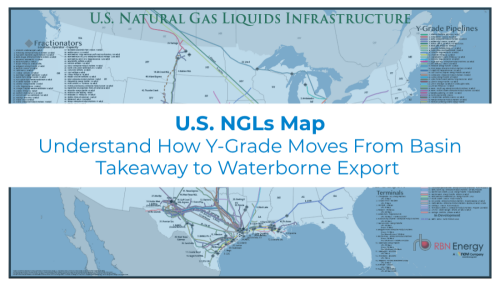
Visualize the infrastructure behind U.S. NGL movement.
The U.S. NGLs Map provides a comprehensive view of the transport, processing, and export networks moving NGLs across the U.S.
In Part 1 of our Hurricane Harvey series we tracked the path of the epic storm and discussed how the energy sector in general — and the crude oil market in particular — prepared for Harvey, hunkered down during it and then began to deal with its consequences. We started by describing the steps taken before the storm made landfall just northeast of Corpus Christi. Offshore platforms in the Gulf of Mexico were evacuated, refineries along the Texas coast were shut down, and ship traffic in and out of Corpus, Houston and other ports was curtailed. At the same time, crude oil storage facilities in the Eagle Ford were emptied out (their contents moved to the Gulf Coast by pipeline) to make room to store barrels locally if necessary; also, a significant portion of Eagle Ford production was shut down. Initially Permian crude oil production remained at near-normal levels, but local storage there was emptied too (the barrels moved by pipe to both Houston and Cushing, OK), again to help absorb any Harvey-related shocks. For a time during the storm, some Houston-area storage continued filling with pipeline barrels, but eventually most of those operations were stopped due to severe flooding. With pipeline deliveries to Houston no longer a viable option, most Permian production had to move either to local refineries, local storage or Cushing. Then, as soon as the rain exited and the skies cleared, post-Harvey damage assessments began and the region’s crude-related infrastructure started returning to normal operation.
The NGL market went through a similar cycle. As Harvey approached the Texas coast (Circle 1 in Figure 1), a number of steam crackers — leading consumers of NGL purity products like ethane, propane and butane — were taken off line. Among the first to be shut down were those along the South Texas coast (just north/northeast of Corpus Christi) where the storm was forecasted to make landfall; these included Formosa Plastics’ steam cracker (and other petrochemical facilities) in Port Comfort, TX, and Occidental Chemical and Mexichem’s jointly owned steam cracker in Ingleside, TX. Ship traffic into and out of the ports along this stretch of coastline slowed to a halt.
About the song
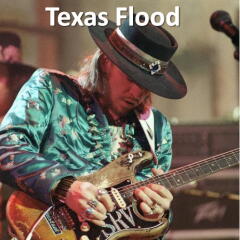
"Texas Flood" was written by Larry Davis and Joseph Wade Scott. It appears as the third song on Stevie Ray Vaughan and Double Trouble's debut album of the same name. The song's co-author, Larry Davis, released a single of "Texas Flood" for Duke records in 1958. It was the first of three blues singles he made for the label. Davis's "Texas Flood" also featured the guitar work of Fenton Robinson.
Texas Flood, the album, was recorded by Stevie Ray Vaughan and Double Trouble in three days at Jackson Browne's personal recording studio in downtown Los Angeles in November 1982. Personnel on the album were: Stevie Ray Vaughan (guitar, vocals), Tommy Shannon (bass), and Chris Layton (drums). The LP was produced by Stevie Ray Vaughan and Double Trouble, with Richard Mullen. It was released in June 1983, and went to #38 on the Billboard Top 200 Albums chart. It has been certified 2X Platinum by the Recording Industry Association of America. Two singles were released from the album.
Stevie Ray Vaughan was an American blues guitarist, singer, songwriter, and record producer from Austin, TX. He was best known as the front man for Double Trouble, and for being one of the main ambassadors of Texas blues guitar. Vaughan released six studio albums, seven live albums, nine compilation albums, four EPs, and 33 singles. He has sold more than 15 million albums in the U.S. alone, and has won six Grammy Awards and five W.C. Handy Awards. He, along with Double Trouble, are members of the Rock and Roll Hall of Fame and the Austin Music Hall of Fame. Vaughan died in a helicopter crash after a concert in August 1990 at the age of 35.