Yet again, the Texas-Louisiana coast is bracing for a hurricane that has the potential to be really bad, not just for the people and homes in the storm’s path, but for the region’s all-important energy sector. Hurricane Laura will be crossing a swath of the Gulf of Mexico dotted with oil and gas production platforms, and is headed for an area chockablock with tank farms, refineries, and steam crackers, as well as export terminals of every stripe: crude oil, refined products, ethane, LPG, and LNG. There’s a good chance there’ll be a lot of disruption to many energy-related activities for at least the balance of this week — and maybe longer — but one of the biggest hits could come to Mont Belvieu, TX, the center of NGL storage and fractionation. Today, we discuss how the storm might affect not only storage at the U.S.’s largest NGL hub, but gas-processing activity hundreds of miles inland.
Laura strengthened into a Category 1 hurricane Tuesday morning, and it’s now expected to be upgraded to a catastrophic Category 4, with sustained winds of at least 130 mph, by the time it makes landfall late tonight or early Thursday morning. As of Tuesday evening, the hurricane’s projected landfall is within the area between San Luis Pass, TX (near Galveston), and Morgan City, LA (about 250 miles to the east); it also is expected to batter inland areas like eastern Houston; Beaumont, TX; and Lafayette, LA. As we said in our introduction, that geography includes a lot of significant energy infrastructure, much of which has the potential to be impacted by hurricane-force winds and flooding, and to be affected by interruptions at other facilities they depend on. We’ve been through this before, of course — many times — and we know the drill. Offshore platforms in the Gulf are evacuated. Shipping lanes within and near the path of the hurricane are shut down. And, as we discussed in our After the Storm blog series on Hurricane Harvey, which dumped as much as 50 inches of rain in southeastern Texas three Augusts ago, refineries and other onshore operations do all they can to protect their personnel and their assets.
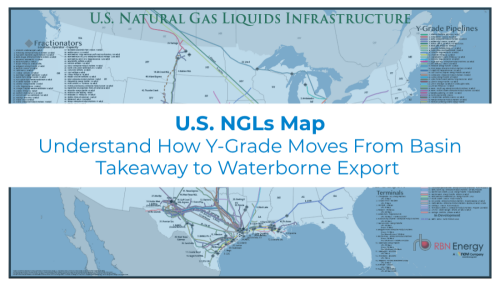
Visualize the infrastructure behind U.S. NGL movement.
The U.S. NGLs Map provides a comprehensive view of the transport, processing, and export networks moving NGLs across the U.S.
Of course, each Gulf Coast hurricane impacts energy infrastructure differently. Generally speaking, though, a major hurricane like Laura will result in most offshore production of oil and gas being shut in; imports of crude oil being curtailed; and a good number of refineries being taken offline. There’s a natural balancing in all that — less crude available for a few days, less crude demanded by refineries — so it’s quite possible that the crude oil side of the market does not get thrown wildly out of whack. (Of course, there may be shortfalls of gasoline, diesel, and other petroleum products.)

About the song
The song "Laura" was written by David Raksin, with lyrics by Johnny Mercer. Raksin wrote the melancholic melody to be used in Otto Preminger's 1944 film of the same name, starring Gene Tierney and Dana Andrews. Raksin had a short time to come up with the music and said he was inspired by a "Dear John" letter he received from his wife on the weekend he wrote the song. The lyrics were written later by Johnny Mercer after the song became popular due to the movie. "Laura" has been recorded by over 400 artists over the years, including Woody Herman, Dave Brubeck, Julie London, Carly Simon, and Frank Sinatra.
Frank Sinatra's version of the song was recorded at Capitol Studio A in Hollywood in April 1957. It appears as the fifth song on Sinatra's 13th studio album, Where Are You?, which was released in September 1957. It was the first Capitol album Frank recorded without the services of Nelson Riddle, opting for the services of Gordon Jenkins instead. Personnel on the record were: Frank Sinatra (vocals), Gordon Jenkins (arranger, conductor).
Frank Sinatra was an American singer and actor. He has sold more than 150 million records worldwide, making him one of the best-selling music artists of all time. Sinatra has released 59 studio albums, two live albums, eight compilation albums, and 297 singles. He starred in 61 motion pictures, had his own television show in the 1950s, and appeared in numerous other television programs. He has won one Academy Award, 11 Grammy Awards, four Golden Globe Awards, and has three stars on the Hollywood Walk of Fame. He is the recipient of the Peabody Award, Cecil B. DeMille Award, Kennedy Center Medal of Honor Award, Presidential Medal of Freedom, and NAACP Lifetime Achievement Award. Sinatra has an asteroid named after him, and every year on his birthday, the Empire State Building in New York lights up with blue lights in honor of "Ol' Blue Eyes," Sinatra's nickname. He died in Los Angeles in May 1998 at the age of 82.