In the five years since the U.S. flipped from a net LPG importer to net LPG exporter, the vast majority of those exports have gone out from Gulf Coast marine terminals. That makes perfect sense. After all, Mont Belvieu, TX is North America’s main fractionation and storage center—most of the natural gas liquids produced in the U.S. are piped there to be fractionated into propane, butane and other “purity products.” But what’s also true is that a growing share of NGLs are produced and fractionated in the Northeast, that increasing export volumes are moving out of Sunoco Logistics Partners’ Marcus Hook, PA marine terminal, and that NGL pipeline capacity from the “wet” Marcellus and Utica production areas to Marcus Hook is about to increase significantly. Today we continue our review of the LPG export data with a look at propane and butane exports from East Coast marine terminals.
In Part 1 of this series on LPG exports, we discussed the fact that the Shale Revolution—and, more specifically, rapid growth in the production of NGLs in 2010-11—quickly reduced the U.S.’s dependence on imported propane, butane and other NGLs. By 2012, the U.S. was a net exporter of LPG—and a very big exporter at that. (We define LPG as two members of the NGL family: propane and butane; see Part 1 for more on the products included as LPGs.) Last year, roughly half of all LPG from U.S. gas processing plants was exported, with the vast majority loaded onto ships for delivery to overseas markets (as opposed to being piped or transported by truck or rail to Canada or Mexico). All these exports are now having an outsized impact on pipeline flows, inventories and prices. Consequently, it is increasingly important to keep close tabs not only on export volumes but on which export terminals are handling all these volumes, and where the LPG is heading. RBN follows these exports using data from the Automatic Identification System (AIS) devices now required on virtually all oceangoing ships. This satellite and land-receiver data is virtually real time, and thus we can determine (based on the LPG-carrying capacity of each ship) how much LPG is being exported out of each individual U.S. terminal, and the ultimate destinations of the shipments. We examine that data to get an understanding of what is happening with international LPG product flows. That’s the data that is posted in our NGL Voyager Report, which RBN publishes twice each month, and which examines NGL prices, price differentials, transportation rates, arbitrage values, major sources of domestic demand (petrochemicals) and other relevant market factors.
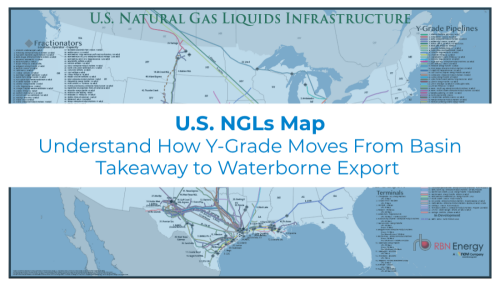
Visualize the infrastructure behind U.S. NGL movement.
The U.S. NGLs Map provides a comprehensive view of the transport, processing, and export networks moving NGLs across the U.S.
In Part 1 we showed that by 2016 net exports of LPG had risen to an average of 850 Mb/d, more than five times 2012’s export pace. Additionally, more than 90% of the LPG exported from the U.S. as a whole last year (and so far in 2017) has been shipped from Gulf Coast export terminals. But that is getting ready to change as the ETP/Sunoco Logistics Marcus Hook marine terminal near Philadelphia takes on a much bigger role.
The Marcus Hook Industrial Complex (the terminal’s formal name) currently receives LPG and ethane via Sunoco Logistics’ 70-Mb/d Mariner East 1 pipeline from Houston, PA (in the heart of the NGL-rich wet Marcellus region in western Pennsylvania). The terminal has been a factor in the Marcellus/Utica LPG market for the past two years or so, but nothing like what is on the horizon. The company currently is building the 275 Mb/d Mariner East 2 pipeline (from Scio, OH to Houston, PA and from there to Marcus Hook) that is expected to come online as soon as the third quarter of this year. Mariner East 2 itself is expandable to 450 Mb/d, and Sunoco Logistics has indicated that it may install a parallel pipe (dubbed Mariner East 2X) capable of transporting another 250 Mb/d, bringing the total potential of the Mariner East system to a whopping 770 Mb/d (70 + 450 +250).
In addition to the volumes received at Marcus Hook on Sunoco’s Mariner East system, LPG can also be transported to Marcus Hook via Enterprise Products Partners’ Products Pipeline System (better known as TEPPCO), which runs from Texas’s Gulf Coast to various points in the Northeast, including Marcus Hook. In the olden days (pre-shale), most of the LPG on TEPPCO was sourced from the Gulf Coast, but these days most of the LPG that moves east/northeast on TEPPCO into PADD 1 (the Northeast) comes from Utica production areas—that LPG can serve both domestic markets in the Northeast as well as the export market via Marcus Hook.
Marcus Hook includes terminaling and storage assets, and has the capacity to store and send out not only LPG but ethane. The terminal currently has about 3 MMbbl of NGL storage capacity on-site, including 2 MMbbl of existing underground storage (granite caverns, in place for decades under the refinery that was formerly on the site), a 500-Mbbl propane tank and a 300-Mbbl ethane tank. New propane, butane and ethane tanks to total another ~2 MMbbl are under construction and expected to be completed by the third quarter of 2017. (Sunoco Logistics has said that there is space to add still more LPG and ethane storage capacity at the site, should it be needed.) The Marcus Hook terminal has the capacity to load LPG onto Very Large Gas Carriers (VLGCs, which can move between 375 Mbbl and 550 Mbbl, depending on the model) or onto smaller Handysize LPG carriers or medium-size carriers (see Come On, Move Your Propane, Do the Conga).
As Figure 1 shows, LPG exports from Marcus Hook (blue bar segments) averaged ~40 Mb/d in the past six months or so, and ranged from 18 Mb/d (in November 2016) to 66 Mb/d (in June 2016). The NGL Voyager Report tracks LPG’s by purity product as well—in the past six months virtually all of the LPG exported through Marcus Hook was propane.

About the song
“Come On Down to My Boat” was a 1967 hit single for Every Mother’s Son written by Wes Farrell and Jerry Goldstein. The tune peaked at #6 on the Billboard Hot 100 in May 1967. The group was a one hit wonder, and disbanded in 1968.