The number of floating storage and regasification units in operation has nearly doubled in the last few years, but that’s hardly a shock given the growth in the global LNG market. What might be a surprise is how a number of these specialty vessels are being utilized and what it could mean for the shipowners and the wider LNG market. In today’s RBN blog, we look at specific projects to gauge the progress made in the FSRU space, the recent slowdown in orders, some of the challenges the sector faces, and the trends emerging for new and converted FSRUs.
Floating storage and regasification units (FSRUs) are LNG tankers fitted with special equipment that enables them to receive, store, and regasify (or vaporize) LNG.
We’ve blogged about FSRUs on several occasions, including a market outlook published a few years ago in Take Me to the River. At the time, there were about two dozen FSRUs with plenty of new projects under discussion, and we projected that there would be more than 40, possibly even 50, such units by 2020. How well have these expectations been met? There will be 44 FSRUs in the world fleet by the end of 2021, pretty much in line with our earlier expectations.

Visualize the infrastructure behind U.S. NGL movement.
The U.S. NGLs Map provides a comprehensive view of the transport, processing, and export networks moving NGLs across the U.S.
Of the vessels due for delivery in 2021, four will be newbuilds and three are conversions of existing LNG carriers (LNGCs). Notably, Chinese shipbuilder Hudong Zhongwha has made its first vessel delivery in the form of the newbuild Transgas Power for Greek owner Dynagas, with a second vessel, Transgas Force, due for delivery in 2022.
But newbuild orders have slowed lately and Japan’s Mitsui OSK Lines (MOL) has switched an FSRU order with South Korea’s DSME to a conventional LNGC. Also, Maran Gas opted to bareboat charter — a lease that does not include the crew — its newbuild FSRU vessel to Excelerate for five years, which will take up station in Pakistan as the Excelerate Sequoia.
About the song
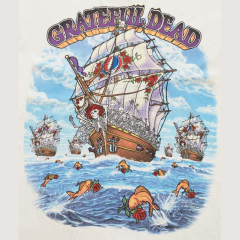
“Ship of Fools” was written by Jerry Garcia and Robert Hunter, and appears as the fourth song on Side 2 of the Grateful Dead's seventh studio album, From the Mars Hotel. The song was first premiered live at Winterland in San Francisco in February 1974. It contains one of Jerry Garcia's personal favorite guitar solos in the outro of the song. Personnel on the record were: Jerry Garcia (lead guitar, lead vocals), Bob Weir (rhythm guitar, vocals), Phil Lesh (bass, vocals), Bill Kreutzmann (drums), Keith Godchaux (keyboards, vocals), and Donna Godchaux (vocals).
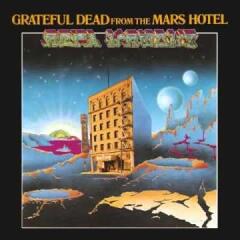
From the Mars Hotel was recorded during April 1974 at CBS Studios in San Francisco and produced by the Grateful Dead. Released in June 1974, the album went to #16 on the Billboard 200 Albums chart. The real Mars Hotel, as depicted on the LP's cover by Kelley/Mouse, was a flophouse that Jack Kerouac had briefly lived in. Located at 192 Fourth Street in San Francisco, it has since been demolished.
The Grateful Dead were an American rock band formed in Palo Alto, California, in 1965 by Jerry Garcia, Bob Weir, Phil Lesh, Ron "Pigpen" McKernan, and Bill Kreutzmann. Thirteen members passed through the band since its formation. They have released 13 studio albums, 10 live albums, 10 compilation albums, 27 singles, 74 retrospective live albums, 36 Dick's Picks albums, and 41 Dave's Picks albums. They have sold more than 35 million records worldwide. The band have a Grammy Lifetime Achievement Award and was inducted into the Rock and Roll Hall of Fame in 1994. Original member Ron “Pigpen” McKernan died in March 1973, and Jerry Garcia in August 1995. After Garcia's death, the remaining members of the band decided to disband. Since that time there have been reunions and various side projects by surviving band members.