There’s no doubt about it: The Biden administration’s decision to pause approval of LNG export licenses poses a new threat to a number of projects thought to be nearing a final investment decision (FID). The questions brought on by the move are profound: how big of a problem is this for U.S. developers, how does the timeout affect the projects now in limbo, and — over the longer term — what does the added uncertainty regarding incremental LNG exports mean for U.S. crude oil and natural gas production and what does it mean for the global energy landscape? In today’s RBN blog, we discuss the factors that led to the administration’s announcement — and the case to be made that expanded LNG exports are in the U.S.’s economic and strategic interest.
The U.S.’s mammoth reserves of natural gas, combined with strong global demand for LNG, have spurred a sharp rise in LNG export volumes over the past few years. As recently as December, an average of about 14 Bcf/d of LNG — or around 14% of the dry gas produced in the U.S. each day — is being liquefied and shipped overseas, almost all of it from export terminals along the Gulf Coast. And, with several new LNG export projects under construction, we expect those volumes to nearly double over the next four years.

The replay of our Fall 2026 School of Energy (September 9 & 10, Houston) is now available online!
Learn from RBN experts, participate in hands-on Excel modeling, connect with industry peers, and gain a stronger understanding of today's interconnected energy markets.
As we said last spring in Life in the Fast Lane, the extraordinary growth in U.S. LNG export capacity has been facilitated by a mostly predictable federal permitting process. It may sometimes have been slower than developers would have liked, but LNG export projects that entered the federal permitting process with both the Federal Energy Regulatory Commission (FERC) and the Department of Energy (DOE) were generally granted their project authorizations and export licenses. And once they had them, they had been able to hold onto them via extensions — until lately, that is.
Before we delve into the Biden administration’s latest move, which may set back or even derail a number of multibillion-dollar LNG export projects on the drawing boards, we should provide a little background on the permitting and development process. Every project that plans to export U.S. natural gas as LNG — meaning not only projects in the U.S. but any project in Mexico or Canada that plans to source feedgas from the U.S. — requires an export license from the DOE. The export licenses come in two flavors, one for Free Trade Agreement (FTA) countries and one for non-Free Trade Agreement (non-FTA) countries, and typically allow for exports to continue through 2050. Projects need both licenses to export competitively — they are usually granted in that order (FTA first, then non-FTA) — and both typically come after a project has already received its FERC authorization. (Figure 1 shows the FTA and Non-FTA countries that imported U.S. LNG in 2023 — light-blue- and gold-shaded countries, respectively.)
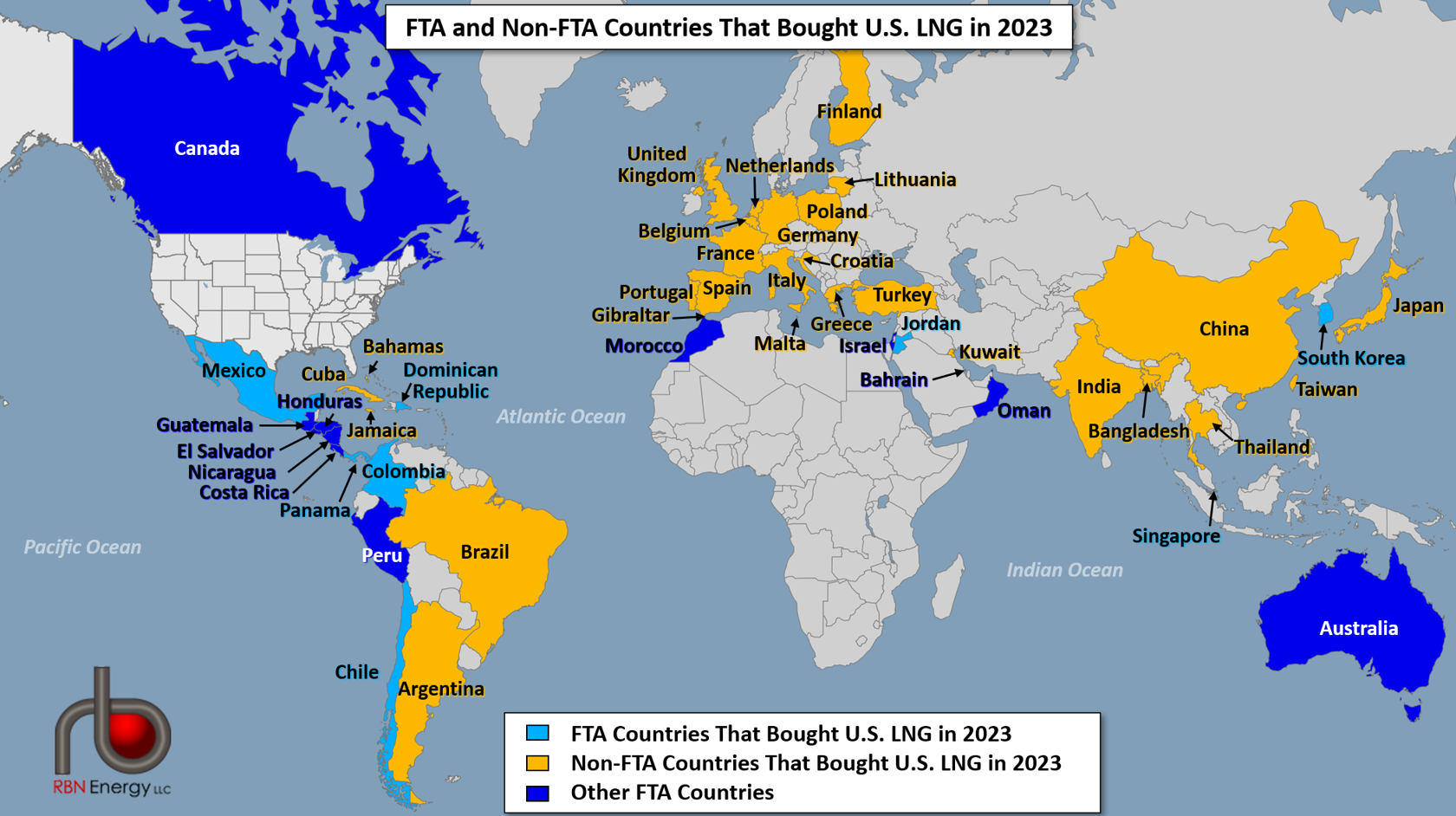
Figure 1. FTA and Non-FTA Countries That Buy U.S. LNG. Source: RBN’s LNG Voyager

About the song
“Take Five” was written by Paul Desmond and appears as the third track on side one of The Dave Brubeck Quartet’s 13th studio album, Time Out. The quartet’s drummer, Joe Morello, suggested doing the song in the unusual tempo of 5/4. It was originally released as a single in September 1959, but it wasn’t until it was re-released in May 1961 that it became the biggest-selling jazz single of all time, going to #5 on the Billboard Easy Listening and #25 on the Billboard Hot 100 Single charts. Every beatnik coffeehouse in the world featured the song on its jukebox. Personnel on the record were: Dave Brubeck (piano), Paul Desmond (alto saxophone), Joe Morello (drums), and Gene Wright (acoustic bass).
Time Out was recorded in the summer of 1959 at Columbia 30th Street Studio in New York City. Produced by Ted Macero, it was released in December 1959. Pianist and bandleader Brubeck used the album as a format for exploring different tempos and styles that he had observed Turkish street musicians utilizing. Initially receiving negative reviews upon its release, the album went on to become the first jazz album to sell more than one million copies. It went to #2 on the Billboard 200 Albums chart and has been certified 2x Platinum by the Recording Industry Association of America. The Library of Congress selected the album for preservation in the National Recording Registry. In 2009 it was inducted into the Grammy Hall of Fame. Three singles were released from the LP.
Dave Brubeck was an American jazz pianist and composer, known as a proponent of West Coast cool jazz and for utilizing unusual time signatures and tonalities in his music. He released 118 albums as a bandleader in his lifetime. He is a member of the Downbeat Hall of Fame, has a Grammy Lifetime Achievement Award, and has received a National Medal of Arts and Kennedy Center Honors. Brubeck died in Norwalk, CT, in December 2012 at the age of 91.