


It’s been heard in many a pub: “Liquor may not be the answer, but it’s worth a shot.” You could make the same argument for hydrogen. While many question whether it will ever make economic sense to use hydrogen as a supplement to — or replacement for — natural gas on a large scale, others insist that hydrogen has a great future as a climate-friendly fuel, assuming it receives sufficient developmental support from government and ESG-minded industry. As it turns out, an early test of hydrogen’s potential is coming from the liquor industry itself, or more specifically, the maker of a renowned single-malt scotch on the Isle of Islay, off Scotland’s western coast. In today’s RBN blog, we discuss the distiller’s hydrogen production and combustion project and the broader plan by members of the Scotch Whisky Association and Scotland itself to achieve net-zero carbon emissions within a generation, largely through the expanded use of hydrogen.
Not everyone likes the energy transition, and it may not happen nearly as fast as some hope, but the world is in the early stages of a shift to lower-carbon energy sources that is likely to have a massive impact on the oil and gas industry. Given this expectation, we’ve been blogging with increasing frequency about the low- or zero-carbon energy alternatives being implemented and explored. We’re doing this not only to discuss the challenges inherent in switching from energy sources that have driven extraordinary economic growth over the past 100 years but to highlight the opportunities that the energy transition may present to savvy companies within the oil and gas sector who, after all, know a thing or two about efficiently producing large volumes of energy commodities and transporting them to where they are needed.
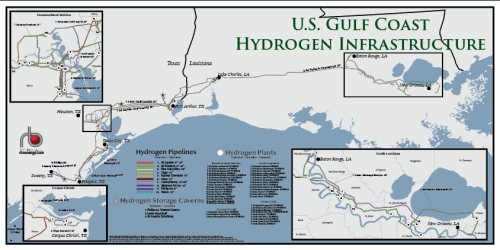
RBN’s U.S. Gulf Coast Hydrogen Infrastructure Map lays out the pipelines and merchant hydrogen plants that make up the gulf coast market, providing an unprecedented snapshot of the region’s hydrogen infrastructure network.
Hydrogen has been front-and-center in all this, in part because, if it’s produced via renewables-powered electrolysis or via steam methane reforming (SMR) with carbon capture and sequestration (CCS), it can serve as a low-carbon supplement or even substitute for more traditional hydrocarbon-based fuels. We won’t go into the nitty-gritty of hydrogen production this time around — we’ve covered it plenty in the past if you need to get up to speed. We started off with a three-part hydrogen primer (see our Help! blog series), and also reviewed hydrogen production pathways (You Can Make It If You Try), the logistical structure of the U.S. hydrogen market (Been Around a Long Time), and one of the biggest planned hydrogen projects to date (Tangled Up in Blue).
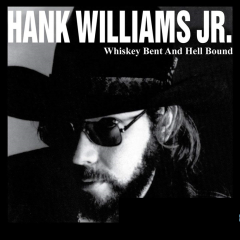
About the song
“Whiskey Bent and Hell Bound” was written by Hank Williams Jr. and appears as the first song on side one of William's 30th studio album of the same name. Released as a single in September 1979, the record went to #2 on the Billboard Hot Country Songs Singles chart. Williams wrote the song while hanging out with the Allman Brothers Band. Personnel on the record were: Hank Williams Jr. (lead vocals, acoustic guitar), James Burton, Rock Killough (acoustic guitar), James Burton, Reggie Young (electric guitar), Joe Osborn (bass), Larrie London (drums, percussion), David Briggs, Larry Knechtel (keyboards), Ralph Mooney (steel guitar), and Buddy Sphicer (fiddle).
The album Whiskey Bent and Hell Bound was produced by Jimmy Bowen, and released in November 1979. It went to #5 on the Billboard Top Country Albums chart. It was certified Platinum by the Recording Industry Association of America and was William's first Platinum album. Two singles were released from the LP.
Hank Williams Jr. (Randall Hank Williams), also known as Bocephus, is an American singer, songwriter, and musician. His music is a mash-up of Southern rock, country, and blues. He has released 56 studio albums, 25 compilation albums, and 109 singles. He has won four Emmy Awards, eight ACM Awards, seven CMA Awards, and two Grammy Awards and is a member of the Nashville Songwriters Hall of Fame. Williams was inducted into the Country Music Hall of Fame in 2020. He continues to record and perform live.




Comments