We can’t conjure up a more old-school, more intrinsically American industry than whiskey-making, or more iconic whiskey names than Jack Daniel’s and Jim Beam — the latter, of course, being a bourbon, a particular type of whiskey. The recipes for both “Jack” and “Jim” have remained unchanged for generations and their distillers in Tennessee and Kentucky, respectively, are traditionalists to their core. That doesn’t mean, though, that they’re unaware of the need to reduce their greenhouse gas (GHG) emissions — or are blind to the opportunities that decarbonization may present. Now, as we discuss in today’s RBN blog, both Jack Daniel’s and Jim Beam are all-in on producing renewable natural gas (RNG) from spent grains.

Sure, whiskey’s roots can be traced back to medieval monks in Ireland and Scotland — and there’s a lot to be said for Scotch whisky, whose producers are Whiskey Bent and (Hydrogen) Bound — but whiskey (spelled with an “e” in the U.S.) is, in many ways, as American as baseball, hot dogs and apple pie. Heck, George Washington ran a whiskey distillery at Mount Vernon, and in 1795 (during Washington’s second term as U.S. president) Jacob Beam — an early settler of Kentucky — sold his first barrel of Old Jake Beam Sour Mash, using his father’s corn-whiskey recipe. The product’s name was later changed to Old Tub Bourbon and finally, in 1943, to Jim Beam Kentucky Straight Bourbon Whiskey. As for Jack Daniel’s Old No. 7 Tennessee Whiskey (the classic variety), its story “only” goes back to 1866, when Jasper “Jack” Daniel, working with the Reverend Dan Call and a formerly enslaved man named Nathan “Nearest” Green (who later became head distiller), established the Jack Daniel Distillery in Lynchburg, TN. (No. 7 was the number assigned to the distillery’s government registration.)
Before we dive into the Jack Daniel’s and Jim Beam RNG projects, we need to define a few things. First up is alcohol. Whiskey is a spirit distilled from a fermented mix of grains, including barley, corn, rye or wheat. Bourbon is a whiskey that meets a series of specific requirements: (1) it must be made in America (per a 1964 U.S. law); (2) the distillery’s grain bill (similar to a refinery’s crude slate) must be at least 51% corn; (3) it must be distilled at no more than 160 proof (80% alcohol) and must enter the barrel at no more than 125 proof (62.5% alcohol); and (4) it must be aged in new, charred-oak barrels. Jim Beam is up to snuff on all these and, as it turns out, so is Jack Daniel’s, but Jack technically isn’t a bourbon because it goes through an extra step after it’s distilled and before it’s “barreled” — namely, over a 3-to-5-day period it’s filtered through (or steeped in) a 10-foot-tall vat filled with charcoal chips to remove impurities and “mellow” the whiskey. (This is known as “the Lincoln County Process.”)

About the song
“Whiskey Rock-A-Roller” was written by Ed King, Billy Powell, and Ronnie Van Zant. It appears as the fourth song on side two of Lynyrd Skynyrd’s third studio album, Nuthin’ Fancy. In his intro to the live version of the song on the LP, One More from the Road, Van Zant says: “I had a stupid writer ask me ... ‘What are you man, what are you really?’ So, I decided to write a song, this is really what I am,” and then proceeds to rip into “Whiskey Rock-A-Roller,” with its chorus of “Women, whiskey and miles of traveling is all I understand.” Many consider Van Zant’s lyrics of the common man in rock and roll to be similar to those of Merle Haggard’s in country music. Lynyrd Skynyrd has covered Haggard’s “Honky Tonk Night Time Man” in concert. Personnel on the record were: Ronnie Van Zant (vocals); Ed King, Gary Rossington and Allen Collins (guitars); Billy Powell (piano), Leon Wilkeson (bass), and Artimus Pyle (drums, percussion).
Nuthin’ Fancy was recorded between August 1974 and January 1975 at Studio One in Doraville, GA, and Webb IV Studios in Atlanta, with Al Kooper producing. Released in March 1975, the album went to #9 on the Billboard 200 Albums chart and has been certified Platinum by the Recording Industry Association of America. Ed King would leave the band after this record, and it would be the last album with Al Kooper as their producer. One single was released from the LP.
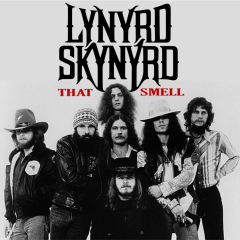
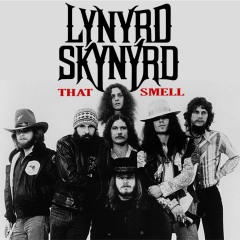
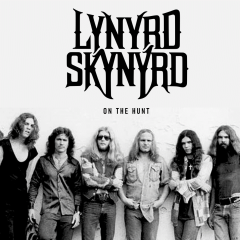
Lynyrd Skynyrd is an American rock band formed in Jacksonville, FL, in 1964 under the name My Backyard, with Ronnie Van Zant, Gary Rossington, Allen Collins, Larry Junstrom, and Bob Burns. The band changed their name to Lynyrd Skynyrd in 1969 — the name was inspired by their high school gym coach Leonard Skinner, who had hassled the boys about their hair length while attending school. Drummer Bob Burns was replaced by Artimus Pyle in 1974 and Ed King, who left the band in 1975, was later replaced by Steve Gaines. The band’s career was halted in October 1977 when a plane in which they were traveling crashed, killing singer Van Zant along with bandmates Steve and Cassie Gaines, and seriously injuring the rest of the group. They regathered in 1987 with Ronnie Van Zant’s brother Johnny taking over on lead vocals and have been playing as a band since. Twenty-seven members have passed through the group since its formation. They have released 14 studio albums, six live albums, 23 compilation albums, and 30 singles. The band was inducted into the Rock and Roll Hall of Fame in 2006. They continue to tour and will begin the Sharp Dressed Simple Man Tour with ZZ Top this summer.