
A combination of new natural gas takeaway capacity out of the Permian, rising feedgas demand from LNG export terminals and stronger gas prices at the Waha Hub will support a steady increase in associated gas production in West Texas and southeastern New Mexico through the rest of the 2020s. But while several gas processing plants are being planned in the Delaware and Midland basins, a critically important question looms: Will there be enough capacity to process the coming tsunami of incremental gas? In today’s RBN blog, we continue our examination of the fast-changing Permian gas market with a look at production growth vs. processing capacity.
In Part 1 of this blog series, we said that while the Permian is now producing more than 22 Bcf/d of residue natural gas — one-fifth of total U.S. production — producers have had to deal with a persistent shortfall in gas takeaway capacity and negative (sometimes very negative) prompt-month and cash prices at Waha. We added, however, that there’s good reason to believe the situation will soon be improving. A massive tranche of new takeaway capacity will be coming online over the next few months, ending the shortfall for many years to come, and gas demand from LNG exporters and power generators will ramp up fast.
RBN’s monthly Arrow Model report, which tracks and forecasts shifting gas pipeline flows in Texas and Louisiana, expects that Waha basis — the difference between gas prices at Henry Hub and Waha — will shift from an average discount of $3.52/MMBtu this year to $1.28/MMBtu in 2027 and $0.70/MMBtu in 2028. Even if the Henry Hub price averages around $3.50/MMBtu over the next few years, as the forward curve indicates, Permian producers (even those without locked-in takeaway capacity) will get an uplift for their gas sales.
With worries about gas takeaway and weak Waha prices fading away, producers are more likely to expand their drilling-and-completion activity in “gassier” parts of the Permian, many of which offer some of the most oil-saturated rock in the entire shale play. That impending shift creates an infrastructure challenge of its own, namely the need to develop new capacity to process the increasing volumes of associated gas from Permian wells.
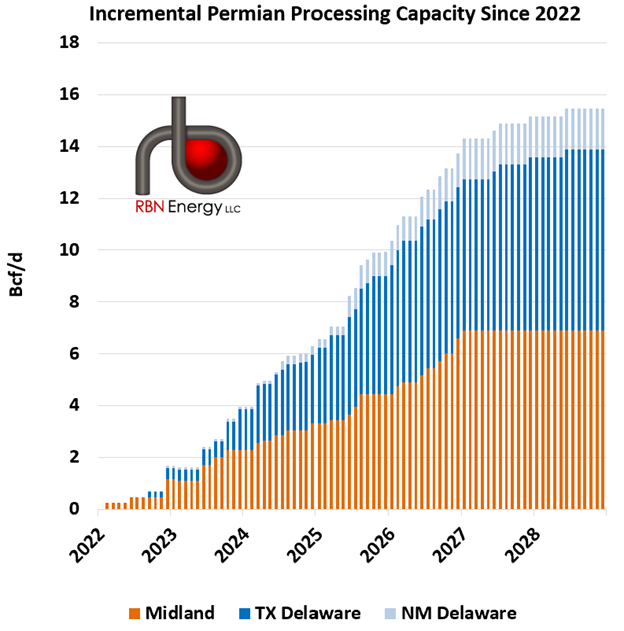
Figure 1. Incremental Permian Processing Capacity Since 2022. Source: RBN

About the song
“Long Time Comin’” was written by John Hiatt and appears as the first song on Hiatt’s 22nd studio album, Terms of My Surrender. The slow-blues song reflects on aging and finding grace and peace for a weary soul. Personnel on the record were: John Hiatt (lead vocals, acoustic guitar), Doug Lancio (electric guitar), Nathan Gehri (bass), Jon Coleman (keyboards), Kenneth Blevins (drums, percussion), and Brandon Young (backing vocals).
Terms of My Surrender was recorded in 2014 at Studio G in East Nashville and produced by Doug Lancio. The album was released in July 2014 and went to #4 on the Billboard Americana/Folk Albums chart and #47 on the Billboard 200 Albums chart. The LP was recorded live in a couple of takes with Hiatt’s backing band, The Combo.
John Hiatt is an American singer/songwriter. He began his musical career in his hometown of Indianapolis, playing clubs around the city when he was a teenager. He moved to Nashville when he was 18 and scored a job as a staff songwriter with Tree-Music Publishing. He signed a record deal with Epic Records in 1973 and released his first single, “We Make Spirit,” on the label. Later that year, Three Dog Night had a #16 hit on the charts with Hiatt’s song “Sure as I'm Sitting Here.” He has released 24 studio albums, two live albums, and 31 singles. In 2008, he received the Americana Music Lifetime Achievement Award for Songwriting. Hiatt still records and performs live. He will begin a European tour in June.
"About the Song" -- written by Mickey McMahan , RBN Director of Musicology