


In the next few days, U.S. Energy Secretary Jennifer Granholm will hold an emergency meeting with leading energy executives to discuss steps E&Ps and refiners could take to increase crude oil production, refinery capacity and the production of gasoline, diesel and jet fuel, all with the aim of reducing prices. The prelude to the get-together was less than ideal, though. In a June 14 letter to the top brass of four integrated oil and gas giants and three large refiners, President Biden criticized them for “historically high refinery profit margins” and for shutting down refining capacity before and then during the pandemic. In addition to rejoinders from the companies, the American Petroleum Institute (API) and the American Fuel & Petrochemical Manufacturers (AFPM) defended their actions, discussed the complexity of refined products markets, and asserted that the Biden administration’s statements and policies have actually discouraged investment in refining and oil and gas production. Is there a middle ground here? In today’s RBN blog, we look at the high-level correspondence and discuss how at least some compromises might be possible.

It should be acknowledged up front that both the administration and energy industry executives have constituencies to speak up for — and answer to. President Biden owes his electoral victory at least in part to the far-left wing of his party, which insists on aggressive action on climate-related issues, and he seems personally committed to expanding and accelerating the climate-action pace set by then-President Obama a few years ago. President Biden also is facing a general public increasingly upset — enraged, in many cases — about the high cost of gasoline and diesel. Energy execs have a number of constituencies too, including investors and, as we’ve discussed in a number of blogs, management’s focus — after hard lessons learned from many boom-and-bust cycles — has been on financial discipline, only-modest investment in incremental production and capacity, and returning cash to shareholders via dividends and share buybacks. E&Ps and refiners also face increasing pressure from many institutional investors and others to diversify into renewable energy, hydrogen, and carbon capture.
In his letter to the leaders of ExxonMobil, Chevron, Shell, BP, Valero Energy, Phillips 66 and Marathon Petroleum last week, President Biden said that his administration has taken a number of steps to ease the crude oil supply/demand imbalance and hold down motor fuel prices, including the largest-ever release from the Strategic Petroleum Reserve and the expanded use of E15 (gasoline with 15% ethanol) to stretch overall gasoline supplies, as well as the possible use of the Defense Production Act to bolster the production of refined products. He added, however, that “(t)he lack of refining capacity — and resulting unprecedented refinery profit margins — are blunting the impact” of the SPR releases and other measures his administration has implemented to address “Vladimir Putin’s Price Hike.” Biden said he “understand(s) that many factors contributed to the business decisions to reduce refinery capacity” by more than 800 Mb/d in 2020, “(b)ut in a time of war, refinery profits well above normal being passed directly onto American families are not acceptable.”
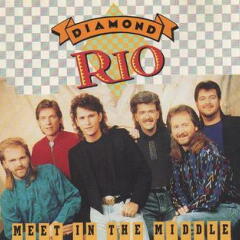
About the song
“Meet in the Middle” was written by Don Pfrimmer, Chapin Hartford, and Jim Foster. It appears as the first song on Diamond Rio’s debut album, Diamond Rio. Released as the first single from the album in February 1991, it went to #1 on the Billboard Hot Country Songs Singles chart, making Diamond Rio the first country music band to have its debut single reach #1. Personnel on the record were: Marty Roe (lead vocals, acoustic guitar), Jimmy Olander (lead guitar, banjo), Gene Johnson (mandolin, backing vocals), Dana Williams (bass, baritone guitar, backing vocals), Dan Truman (keyboards), and Brian Prout (drums).
The album Diamond Rio is the first studio album by the band of the same name. Recorded at Midtown Tone & Volume, Digital Studios, and Recording Arts in Nashville in 1990-91, the LP was produced by Tim Dubois and Monty Powell. Released in May 1991, the album went to #13 on the Billboard Country Albums chart and #83 on the Billboard 200 Albums chart. It has been certified Platinum by the Recording Industry Association of America. Five charting singles were released from the LP.
Diamond Rio is an American country music band founded in Nashville in 1982. They started out as a musical attraction at the Opryland USA theme park in Nashville, and were originally known as the Grizzly River Boys, then the Tennessee River Boys, before changing their name to Diamond Rio after signing with Arista Nashville in 1990. They have released 10 studio albums, one live album, six compilation albums and 36 singles. The band is unique in Nashville as they have played their own instruments on their records throughout their career, without relying on studio musicians. Diamond Rio has won four Academy of Country Music Awards, three Country Music Association Awards, and one Grammy Award. Featuring the same original members, the band continues to record and is currently on tour, playing weekend gigs throughout the U.S. through October.







Comments
This is a fine article with a number of very good arguments concerning government impediments and industry recommendations, but talk of waiving the Jones Act is not one of them. Not only is there an ample supply of suitable US flag vessels, foreign flag vessels are in tight supply as evidenced by current rates. US flag vessels are integral to our national defense, besides supporting American workers and paying US taxes. No blanket waivers should ever be provided.