Many may have nits to pick with the Bipartisan Infrastructure Law and the Inflation Reduction Act (IRA) — some may not like one or both at all — but it would be hard to argue with the view that they provide generous financial support for the production of clean hydrogen and the capture and sequestration of carbon dioxide (CO2). And now, with a clearer understanding of the tax credits that will be available going forward, companies active in the clean hydrogen and carbon capture and sequestration (CCS) spaces are scrambling to advance large-scale projects that would benefit from the federal government’s largesse. That includes blue methanol plants, which produce a super-low-carbon version of the petrochemical intermediate and shipping fuel by capturing and sequestering most of the CO2 that is generated during production. In today’s RBN blog, we look at the blue methanol projects taking shape along the Gulf Coast.
Efforts to decarbonize the U.S. economy have come in a variety of flavors. Build more wind farms and solar facilities. Improve energy efficiency. Encourage the manufacture of electric vehicles and the development of charging stations. And don’t forget hydrogen — or, more specifically, clean hydrogen produced either by running water through a renewables- or nuclear-powered electrolyzer (typically referred to as “green” and ”pink” hydrogen, respectively) or running natural gas through steam methane reformers (SMRs) or auto thermal reformers (ATRs) and capturing and sequestering the CO2 generated by the reforming process. The hydrogen produced via the latter process, generally characterized as “blue,” isn’t carbon-free like green hydrogen, but the CCS process can keep as much as 96% of the CO2 generated out of the atmosphere, so most view blue hydrogen production as a big step forward from an emissions perspective.
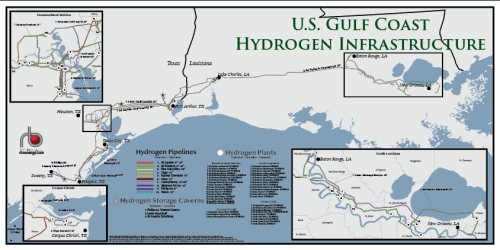
RBN’s U.S. Gulf Coast Hydrogen Infrastructure Map lays out the pipelines and merchant hydrogen plants that make up the gulf coast market, providing an unprecedented snapshot of the region’s hydrogen infrastructure network.
As we said in our recent Drill Down Reports on U.S. hydrogen hub proposals and CCS, the federal government now provides potentially lucrative financial incentives for investing in clean hydrogen production (green, pink and blue), CCS projects and, in effect, the production of clean-hydrogen-based ammonia and methanol (more on these in a moment). Among other things, last year’s Bipartisan Infrastructure Law set aside up to $8 billion to support the development of several regional clean hydrogen hubs, while this year’s IRA provided (1) a new clean hydrogen production tax credit (PTC) and (2) an expansion of the existing investment tax credit (ITC) for energy projects to include hydrogen-related projects. The PTC, also known as a Section 45V tax credit, applies to the first 10 years of production from a “qualified clean hydrogen” facility and provides a tax credit equal to 60 cents/kilogram (kg) of clean hydrogen produced times a factor of between 0.2 and 1, depending on the lifecycle greenhouse gases (GHGs) generated by the project. That credit is then multiplied by 5 if the project’s developer pays “prevailing wages” — generally meaning union-scale pay — and offers a qualifying apprenticeship program for construction, maintenance and repair work. The ITC, in turn, provides a tax credit for the energy portion of the project’s cost basis.

About the song
“Don’t It Make My Brown Eyes Blue” was written by Richard Leigh and appears as the first song on side one of Crystal Gayle’s fourth studio album, We Must Believe in Magic. Released as the first single from the album in June 1977, the song went to #1 on the Billboard Hot Country Songs chart and #2 on the Billboard Hot 100 Singles chart. Songwriter Richard Leigh had been the writer for all three of Gayle’s Top 10 country hits. All the tracks on the record, including Gayle’s vocals, were done in one take. Only the string section was added later in an overdub. Personnel on the record were: Crystal Gayle (vocal), Pig Robbins (acoustic piano), Charles Cochran (Wurlitzer electric piano, string arrangement), Joe Allen (bass), and Kenny Malone (drums).
We Must Believe in Magic was recorded between October 1976 and May 1977 at Jack’s Tracks in Nashville, with Allen Reynolds producing. Released in June 1977, the album went to #2 on the Billboard Country Albums chart and #12 on the Billboard 200 Albums chart. It has been certified Platinum by the Recording Industry Association of America. The album has the distinction of being the first Platinum album recorded by a female artist in country music. “Don’t It Make My Brown Eyes Blue” was the only single released from the LP.
Crystal Gayle (Brenda Gail Webb) is an American country music singer and the younger sister of Loretta Lynn, who passed away in October. Gayle began her professional career as a backup singer in Lynn’s band. Lynn helped Gayle secure her first recording contract with Decca Records in 1970. After lining up a new deal with record producer Allen Reynolds at United Artist Records, Gayle shifted her direction to a more pop style. This resulted in her first hit record, “Wrong Road Again,” in 1975. Gayle has released 25 studio albums, one live album, one soundtrack album, 17 compilation albums, and 68 singles. She has won five ACM Awards, one American Music Award, two CMA Awards, and one Grammy Award. Inducted as a member of the Grand Ole Opry in 2017, Gayle still records and tours and will begin playing weekend engagements beginning in January 2023.