After a long decline, crude oil production on Alaska’s North Slope is poised to increase, and it’s possible that by the early 2030s production could return to levels not seen since the turn of the century. It’s an exciting development for the 49th state, but where will all that oil go? With refining capacity on the decline in California, which has typically handled a lot of Alaska North Slope (ANS) crude, it’s not an easy answer. In today’s RBN blog, we’ll discuss the locations where ANS oil production could land — one of the many essential topics covered in our upcoming Future of Fuels report.
As we discussed in our first blog in this mini-series, Holding Out for a Hero, ANS crude oil production has been sliding for decades but is poised to rebound because of two long-planned projects — Pikka and Willow — which are slated to start in 2026 and 2029, respectively, and begin a new ramp up in Alaskan oil production. Although existing fields will continue to experience natural declines, new projects such as ConocoPhillips’s recently started Nuna drill site (which will add 20 Mb/d) will begin to boost volumes slightly this year. As a result, we expect that 2024 will be the nadir for Alaskan production (at least for the next two decades). The much larger Pikka project, due to start in early 2026, will push production to 490 Mb/d by 2028 (a gain of more than 20% from current levels). With the even larger Willow project starting up in 2029, we project Alaskan production will reach 660 Mb/d by 2032 as Willow ramps up to full operation.

The vast majority of ANS crude is transported south from Prudhoe Bay on the Trans-Alaska Pipeline System (TAPS) to Valdez, a port on the southern coast of Alaska. Small volumes are processed at two small refineries (owned by ConocoPhillips and Hilcorp) in Prudhoe Bay — combined capacity 24 Mb/d — that produce fuels for consumption in the oil fields, and some crude is removed from TAPS at Fairbanks to supply Petro Star’s 24-Mb/d refinery there. At Valdez, crude is either piped to Petro Star’s local refinery (capacity 60 Mb/d) or loaded onto tankers on an irregular basis for passage to a variety of customers, including Alaska's largest refinery (Marathon Petroleum’s 72-Mb/d Kenai facility) and refineries in Hawaii and Asia (mostly China). And — most important by far — refineries in Washington state and California receive about 80% of the ANS barrels.
In recent years, refineries in California have been shutting down — a well-discussed topic in the RBN blogosphere — because of the declining economic environment for petroleum refining in the state, a situation substantially caused by California’s ambitious efforts to decarbonize its economy. [That’s another topic we’ve discussed at great length, most recently in I Asked For Water (She Brought Me Gasoline).] Weak refining margins, rising regulatory compliance costs, softening demand for gasoline and the push for lower-carbon alternatives like batteries and renewable diesel have each contributed to a steady erosion in California’s refining capacity over the past few years.

About the song
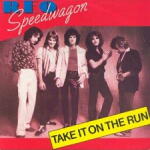
“Take It on the Run” was written by Gary Richrath and appears as the fifth song on side one of REO Speedwagon’s ninth studio album, Hi Infidelity. The power ballad features blistering guitar solos, which makes sense since the song was written by Richrath — REO’s lead guitarist. Released as a single in March 1981, it went to #5 on the Billboard Hot 100 Singles chart and has been certified Gold by the Recording Industry Association of America (RIAA). Personnel on the record were: Kevin Cronin (lead, backing vocals, acoustic guitar), Gary Richrath (lead guitar), Bruce Hall (bass), Neil Doughty (keyboards), Alan Gratzer (drums), and Tom Kelly (backing vocals).
The album, Hi Infidelity, was recorded between June and October 1980 at Crystal Studios and Kendun Recorders in Los Angeles. Produced by Kevin Beamish, Kevin Cronin, Alan Gratzer and Gary Richrath, it was released in November 1980 and went to #1 on the Billboard 200 Albums chart. It has been certified Diamond by the RIAA. Four singles were released from the LP.
REO Speedwagon (REO) was an American rock band formed in 1967 in Champaign, IL, originally as a cover band. Original members Neil Doughty and Alan Gratzer are the only members to roll through the changes of 22 members passing through the band for 55 years of the band's 57-year run until their breakup in January 2025. REO released their first studio album in 1971. They released 16 studio albums, 10 live albums, 22 compilation albums and 24 singles. They have sold over 40 million records worldwide. Longtime lead guitarist Gary Richrath died in 2015. Singer Kevin Cronin continues to tour as a solo artist.