


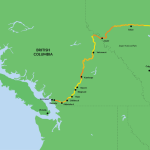
Since the long-awaited Trans Mountain Pipeline Expansion (TMX) began service in early May, sales of crude cargoes loading at its Westridge docks near Vancouver, BC, have expanded from direct deals between buyers and sellers (bilateral) to brokered ones. Calgary-based energy brokerage Modern Commodities concluded a deal last week for Alberta’s heavy, high-sulfur Cold Lake crude for loading in the third decade of June in a deal priced at roughly $8/bbl under WTI CMA FOB Westridge. (Note: A decade basically refers to one of the three 10-day clips that form a typical month: 1-10, 11-20 and 21-30). It’s unclear who the buyer and seller were for the 400-Mbbl cargo which could sail to U.S. West Coast or Asian markets.
Featured Articles
- Analyst Insight
Hello World! TMX Granted Final Regulatory Approval to Begin Flowing Oil to Canada’s West Coast
After a 12 year odyssey and C$34 billion, TMX is now officially open for business!


- Blog
Give It Up - PetroChina's Decision to Give Up TMX Commitment Puts Focus on Demand, Logistics
PetroChina’s recent decision to offload its 20-year commitment to use the Trans Mountain Pipeline expansion (TMX) might seem like a bit of a head-scratcher on the surface, especially since Asian buyers have been expected to take advantage of the increased access to Western Canadian crude oil that TMX provides. But when you factor in the known challenges of utilizing the new pipeline and the reduced demand for crude oil in China, PetroChina’s decision to sell its commitment to Canadian Natural Resources Limited (CNRL) starts to make sense. In today’s RBN blog, we look at the challenges buyers face in using the TMX system despite its obvious perks.


- Blog
Both Sides Now - Has the Trans Mountain Expansion Shifted Western Canada’s Crude Oil Exports?
After a decade-long odyssey and a cost-per-mile that must make public-sector accountants in Ottawa wince, the Canadian government-owned Trans Mountain Expansion Project (TMX) — which nearly tripled the capacity of the original Trans Mountain Pipeline (TMP) from Alberta to the British Columbia (BC) coast — finally came into service in May 2024. As one of Canada’s most anticipated energy infrastructure projects in many years, the 590-Mb/d TMX pipeline — built alongside the long-standing 300-Mb/d TMP — was widely touted by its advocates as a surefire way to boost exports of Western Canadian crude and reduce the nation’s near-complete reliance on exporting crude oil to — and through — its primary customer, the U.S. In today’s RBN blog, we discuss some of the surprising (and not so surprising) market developments since the expansion project started.
