PetroChina’s recent decision to offload its 20-year commitment to use the Trans Mountain Pipeline expansion (TMX) might seem like a bit of a head-scratcher on the surface, especially since Asian buyers have been expected to take advantage of the increased access to Western Canadian crude oil that TMX provides. But when you factor in the known challenges of utilizing the new pipeline and the reduced demand for crude oil in China, PetroChina’s decision to sell its commitment to Canadian Natural Resources Limited (CNRL) starts to make sense. In today’s RBN blog, we look at the challenges buyers face in using the TMX system despite its obvious perks.

The Crude Oil Billboard keeps readers at the forefront of the U.S. crude oil market by offering access to data and information moments after its release. Say goodbye to PDF reports that come out after the market has already moved on.
The TMX project was long marketed as a faster and more direct way to send Western Canadian crude to Asia, reducing the need to ship barrels by pipeline thousands of miles to the U.S. Gulf Coast (USGC) to be loaded onto a tanker. The 590-Mb/d TMX pipeline (light-purple line in Figure 1 below) was designed to ship mainly heavy crude from Edmonton, AB, to British Columbia and follows the same route as its older sibling, the 300-Mb/d Trans Mountain Pipeline (TMP; dark-purple line), which moves a variety of light crudes and products. The Westridge terminal near Burnaby, BC, with three new berths, has the capacity to export 630 Mb/d of crude but is limited to Aframax-class tankers, among the industry’s smallest. (More on that in a bit.)
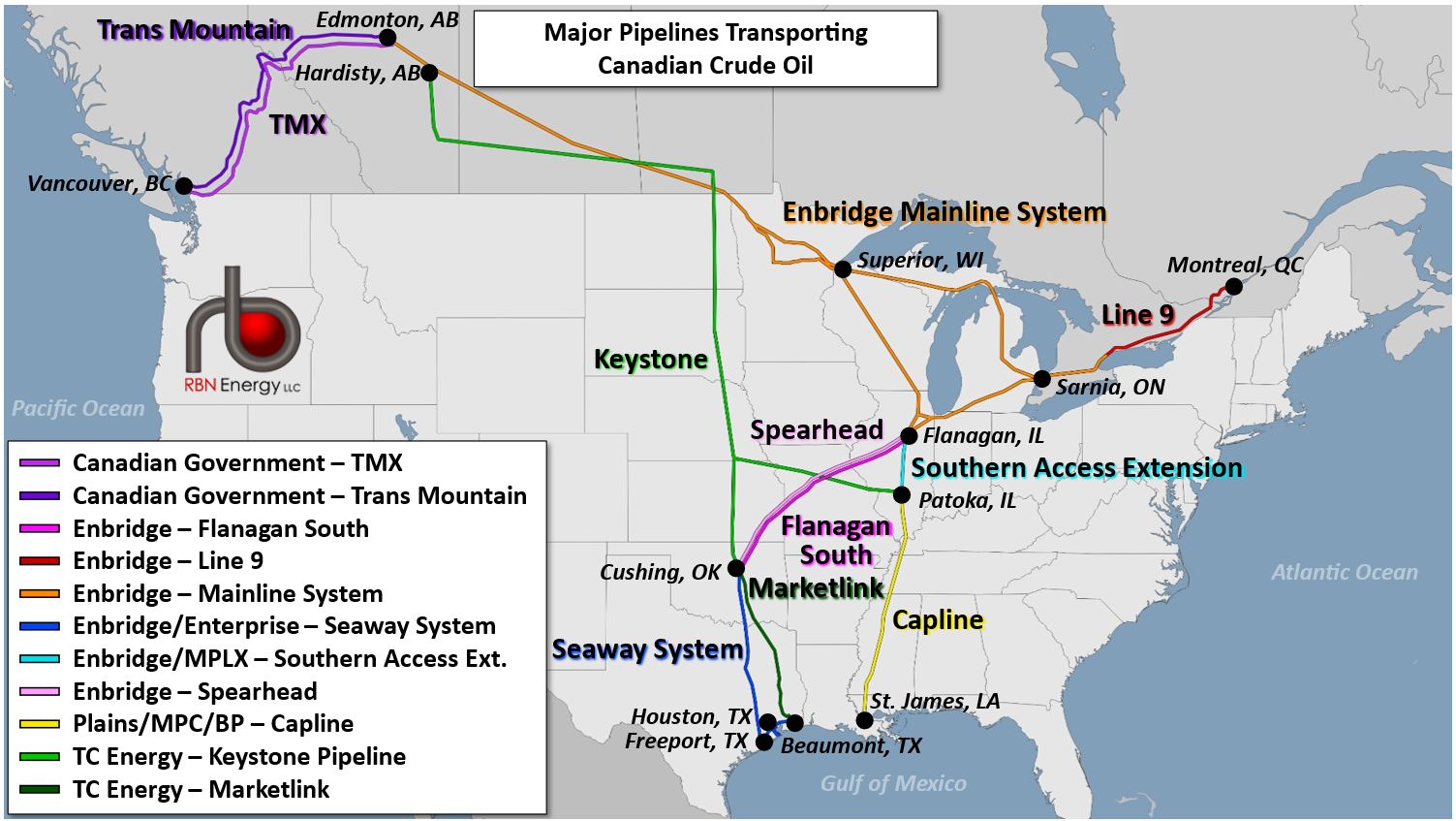
Figure 1. Major Pipelines Transporting Canadian Crude Oil. Source: RBN
Throughout its construction, the TMX project was beset with problems and cost overruns (see On The Hunt). The ballooning budgets ultimately led to higher tariffs for TMX users, and many of the 11 committed shippers — a combination of refiners and producers — had signed take-or-pay contracts and filed challenges before the Canada Energy Regulator (CER). These contracts accounted for 80% of TMX’s capacity, with the remainder available for spot shippers. In December 2023, the CER approved the higher preliminary interim tolls, which were roughly double the estimate five years ago by operator Trans Mountain Corp. The CER will have a full hearing regarding the interim tolls in May 2025.

About the song
“Give It Up” was written by Harry Wayne Casey and Deborah Carter and appears as the third song on side one of KC and the Sunshine Band’s ninth studio album, All in a Night’s Work. It was released as a single in America in August 1982 on Epic Records but failed to chart. It went to #1 on the UK Singles chart in August 1983. When re-released in the U.S. on Meca Records in March 1984, the single went to #18 on the Billboard Hot 100 Singles chart. Personnel on the record were: KC (Harry Wayne Casey) (lead, backing vocals, keyboards), Gary King (keyboards, guitar, bass, backing vocals), Steve Gordon, James Magnole (guitars), Richard Finch (drums, percussion), Fermin Goytisolo, Jimmy Horne (percussion), Gary Hebig (sax), Bill Reichenbach Jr. (trombone), Larry Hall, Jerry Hey (trumpet), Christine Nield (flute), and Deborah Carter, Beverly Champion, Denise King, Teri DeSanio (backing vocals).
All in a Night’s Work was recorded between October 1981 and March 1982 at Sunshine Sound in Miami and George Massenberg Studios in Los Angeles. Produced by Harry Wayne Casey and Richard Finch, the album was released in August 1982 and went to #18 on the Billboard 200 Albums chart. One single was released from the LP.
KC and the Sunshine Band is an American disco and funk band founded in 1973 in Hialeah, FL, by Harry Wayne Casey (aka KC). They have released 15 studio albums, two live albums, 12 compilation albums and 49 singles. Twenty-six members have passed through the band since its inception. They continue to tour, fronted by KC, and will appear at various U.S. venues through January 2025.