
After a decade-long odyssey and a cost-per-mile that must make public-sector accountants in Ottawa wince, the Canadian government-owned Trans Mountain Expansion Project (TMX) — which nearly tripled the capacity of the original Trans Mountain Pipeline (TMP) from Alberta to the British Columbia (BC) coast — finally came into service in May 2024. As one of Canada’s most anticipated energy infrastructure projects in many years, the 590-Mb/d TMX pipeline — built alongside the long-standing 300-Mb/d TMP — was widely touted by its advocates as a surefire way to boost exports of Western Canadian crude and reduce the nation’s near-complete reliance on exporting crude oil to — and through — its primary customer, the U.S. In today’s RBN blog, we discuss some of the surprising (and not so surprising) market developments since the expansion project started.

To truly understand Cushing — what it does and how it works — you need to know the hub’s assets and how they fit together. RBN’s Cushing Crude Oil Playbook provides the first one-stop, comprehensive guide to the hub’s assets.
Given such a long development timeline, it is no surprise that we have discussed TMX numerous times. More recent blog examples include such topics as construction delays (see So Far Away), tolling and tankering challenges (see the two-part You’ve Got Another Thing Comin’), and just in the past couple of months, changes in the mix of committed shippers that send their crude oil down the newly expanded conduit (see Give It Up).
By way of a brief refresher, TMX (light-orange line in Figure 1 below) was proposed by Kinder Morgan in December 2013 as a 590-Mb/d pipeline that would parallel the path of the original 715-mile (1,150-kilometer), 300-Mb/d TMP (dark-orange line) that was constructed in 1953 across the rugged, mountainous terrain that separates Alberta from the BC coastline. At the time, the original cost estimate for the expansion was pegged by Kinder Morgan at C$7.4 billion (US$5.7 billion). Fast forward a decade, and after immense legal and environmental challenges and wrangling, including Kinder Morgan’s sale of the combined TMP/TMX project to the Canadian federal government in May 2018 for C$4.5 billion (US$3.1 billion) the pipeline was eventually completed and brought into service in May 2024. The most recent price tag to get the pipeline to completion and operation has been estimated from regulatory filings to be in the range of C$34 billion (US$24 billion) — 4.6 times the original estimate, with a cost-per-mile of about C$48 million (US$33 million).
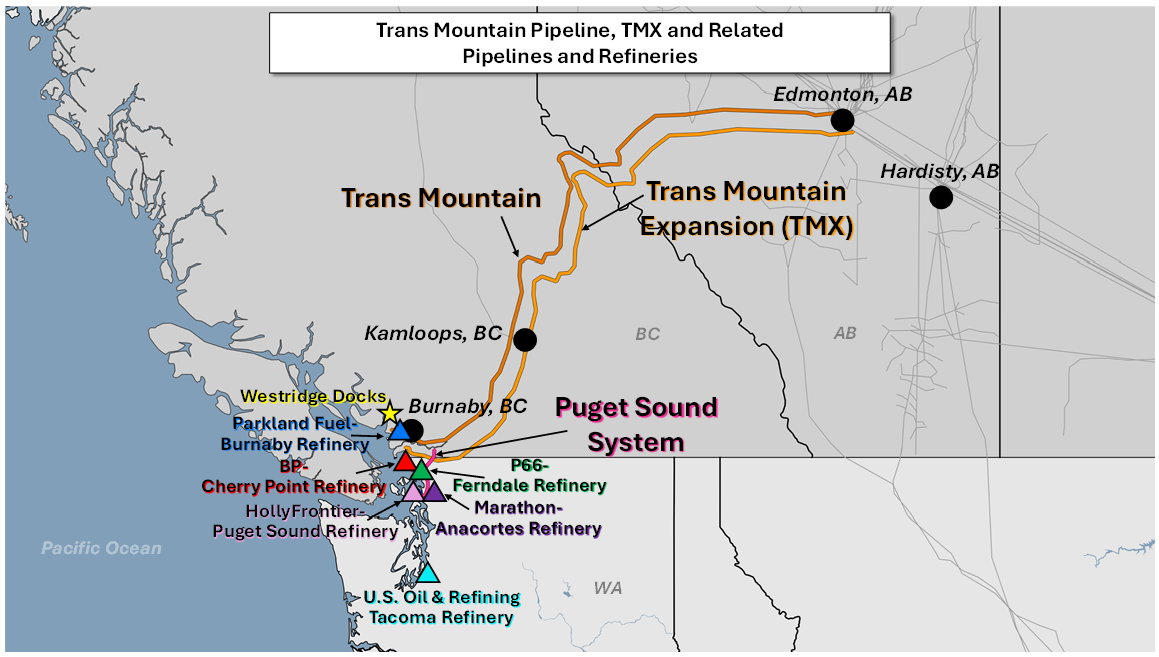
Figure 1. Trans Mountain Pipeline, TMX and Related Pipelines and Refineries. Source: RBN

About the song
“Both Sides Now” was written by Joni Mitchell and appears as the fifth song on side two of her second studio album, Clouds. The song was first released as a single by folk singer Dave Van Ronk under the title “Clouds” in 1967. Judy Collins released it as a single in 1967 from her Wildflowers album, where it went to #8 on the Billboard Hot 100 Singles chart. With the success of the single, Wildflowers was certified Gold by the Recording Industry Association of America. It won Collins her first Grammy Award for Best Folk Performance. Personnel on the Joni Mitchell recording were: Joni Mitchell (vocal, guitar), and Stephen Stills (bass).
Clouds was recorded in early 1969 at A&M Studios in Hollywood with Joni Mitchell and Paul Rothchild producing. The album's cover portrait was painted by Mitchell. Released in May 1969, the album went to #31 on the Billboard 200 Albums chart and has been certified Gold by the RIAA. It won a Grammy Award for Best Folk Performance in 1969.
Joni Mitchell (Roberta Joan Mitchell) is a Canadian American singer, songwriter, multi-instrumentalist and painter. She started her career in her late teens playing and singing at coffee houses and bars in Toronto. Folk singer Tom Rush had met Mitchell while performing in Toronto and recorded her song “Urge for Going,” which became a country hit for singer George Hamilton IV. David Crosby heard her singing in a club in Florida and convinced her to move to Los Angeles, where he introduced her to his friends in the music business. She has released 19 studio albums, six live albums, 19 compilation albums, an EP, and 33 singles. She has sold more than 10 million records worldwide. She has won 11 Grammy Awards, a Grammy Lifetime Achievement Award, a Billboard Century Award, a Gershwin Prize, a Polar Music Prize, is a member of the Canadian Music Hall of Fame, Canadian Songwriters Hall of Fame, and the Rock and Roll Hall of Fame. Mitchell still occasionally performs live.