


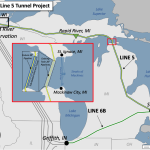
Enbridge was back in Federal court Thursday morning (2/8) defending the ability to operate its embattled Line 5. Line 5 transports 540 Mb/d of crude and NGLs from Superior, WI through the upper peninsula of Michigan, and across the Straits of Mackinac before heading south east to it’s ultimate destination in Marysville, MI. The crude supplies refineries in Toledo, OH as well as Southwestern Ontario, while the NGL stream is fractionated into purity NGL products in Sarnia, ON. Additionaly, two de-propanization units (green inverted triangles on map), one in Superior, Wisconsin and one in Rapid River, MI along the northern portion of the pipeline aid in supplying local propane demand. Line 5 propane is critical to the Michigan residential heating market. Michigan has the highest residential propane demand in the U.S. with 8% of homes, approximately 315,000 relying on propane. According to Enbridge, Line 5 serves 55% of propane consumed in Michigan.
Featured Articles


I've Got to Have You - Enbridge's Line 5 Faces New Scrutiny
The Dakota Access Pipeline isn’t the only interstate liquids pipe facing an uncertain future. The fate of Enbridge’s Line 5, which batches either light crude oil or a propane/butanes mix from Superior, WI, through Michigan and into Ontario, also hangs in the balance as the company renews its battle with Michigan’s top elected officials to keep the 67-year-old pipeline open and its effort win regulatory approval to replace the pipe’s most important water crossing. Line 5 supporters say that closing the 540-Mb/d pipeline would slash supplies to residential and commercial propane consumers in the Great Lakes State, steam crackers in Ontario, and refineries and gasoline blenders in three states and two Canadian provinces. Critics of Line 5 counter that there are plenty of supply alternatives. Today we discuss the pipeline, what it transports, and who it serves, as well as challenges it faces.


I've Got to Have You, Part 2 - The Crude Oil and LPG Supply Roles of Enbridge's Line 5
Pipelines are lifelines to refineries, steam crackers, and other consumers of energy commodities, and even the hint that a major pipeline may be shut down raises big-time concerns. For evidence, look no further than Enbridge’s Line 5, which batches light crude oil and a propane/normal-butane mix across Michigan’s upper and lower peninsulas and to points beyond. One of Line 5’s two pipes under the Straits of Mackinac is temporarily out of service, halving the 540-Mb/d pipeline’s throughput, and Michigan’s attorney general continues to pursue a lawsuit that, if successful, could be Line 5’s death knell. Enbridge also is facing a fight on its plan to replace the twin underwater pipes with a new, safer “tunnel” alternative. All of which raises the question, what would be the market effects if Line 5 is permanently closed? Today, we conclude a miniseries on one of the Upper Midwest’s most important liquids pipelines.

Down To The Waterline - Michigan Gives Line 5 a Nudge, But Pipeline Still Ensnared by Controversy
After a roughly three-year wait for a critical state permit, Enbridge’s Great Lakes Tunnel and Pipe Replacement project for its Line 5 pipeline across the Straits of Mackinac in Michigan has taken a step forward. The Army Corps of Engineers’ permits for the tunnel project would seem to be the only major obstacle standing in the way of construction, but there may well be more challenges ahead. Like a few other oil and gas projects — namely, Mountain Valley Pipeline (MVP) and Dakota Access Pipeline (DAPL) — Line 5 has become entangled in controversy, including local opposition worried that a spill would irreparably damage their surroundings and spoil the state’s natural resources. In today’s RBN blog, we take a closer look at the Line 5 project, its next steps, and the opposition it continues to encounter.
