


Fresh on the heels of expanding its Beaumont, TX, refinery into the largest in the country, ExxonMobil announced in January that it had finished yet another project at its century-old Baton Rouge complex in Louisiana. The Baton Rouge Refinery Integrated Competitiveness (BRRIC) project took roughly three years to complete and did not add crude refining capacity, unlike the Beaumont project. Instead, the goal of the $240 million investment was to modernize the crude oil processing plant — the state’s largest — increasing access to competitive crudes and growing markets for its fuels as well as curbing the refinery’s environmental impact. In today’s RBN blog, we take a closer look at the BRRIC project and what it means for the Baton Rouge refinery.

The Future of Fuels bi-annual report by RBN's Refined Fuels Analytics provides an in-depth analysis of the U.S. and global refinery industries, focusing on crude oil and fuel market dynamics, supply and demand, alternative fuels, refinery capacities, and price forecasts to help stakeholders navigate the evolving energy landscape.
Before we get into the details of the project, let’s take a quick look at the history of the Baton Rouge refinery (see icon in Figure 1 below), which is on the east bank of the Mississippi River. Standard Oil Company of Louisiana (which was a subsidiary of Standard Oil Company of New Jersey, or today’s ExxonMobil) brought the plant online nearly 114 years ago after less than a year of construction. The refinery’s capacity started out at about 1.8 Mb/d and is now a whopping 523 Mb/d. It’s also far more complex, with downstream units like cokers and catalytic crackers that break down the gunky stuff (like heavy residual feedstocks) that come out of the main refining process, yielding more consumer products, from lubricants to transportation fuels (see our Baby Break It Down series for more about the refining process). The facility also has desulfurizers and hydrotreaters that strip out sulfur and make products more environmentally friendly. The riverfront site also hosts a chemical complex that produces resins and chemicals used to make everyday items like plastic milk jugs, lightweight appliance and car parts, paint, adhesives, plastic films, synthetic rubber, and disposable diapers.
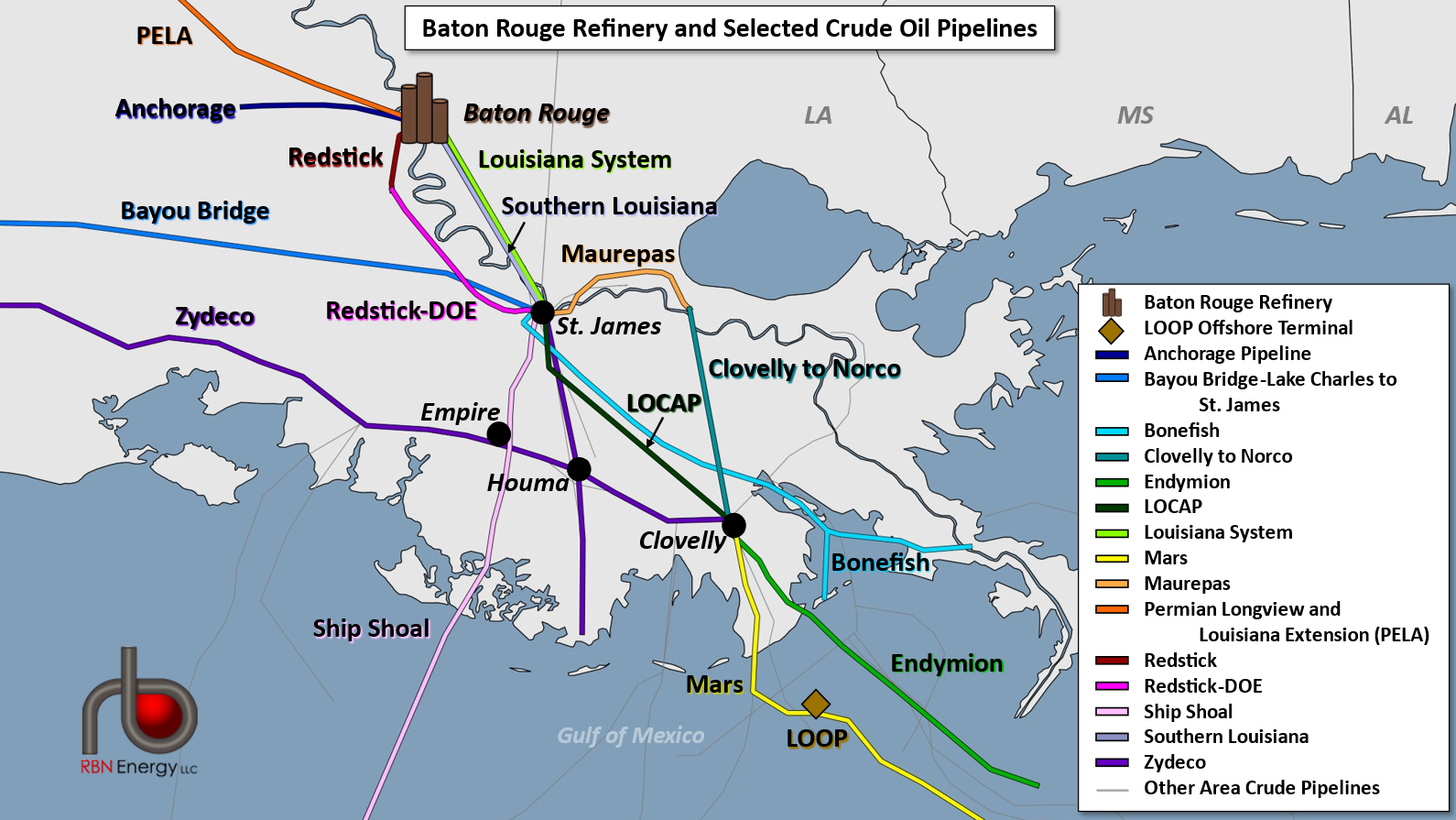
Figure 1. Baton Rouge Refinery and Selected Crude Oil Pipelines. Source: RBN
About the song
“Another Brick in the Wall” was written by Roger Waters and appears as a three-part composition on Pink Floyd’s 11th studio album, the rock opera The Wall. Part 2 of the song trilogy appears as the fifth song on Side 1, Disc 1, of the album. It was released as a single in November 1979 and went to #2 on the Billboard Hot 100 Singles chart. It has been certified platinum by the Recording Industry Association of America. The song is a protest against corporal punishment and abusive methods used in school. Producer Bob Ezrin came up with the idea of using elements of disco and adding a children’s choir to the song. Personnel on the record were: Roger Waters (lead vocal, bass), David Gilmour (lead vocal, guitar), Richard Wright (Hammond B-3 organ, Prophet-5 synthesizer), Nick Mason (drums), and Islington Green School students (children's choir voices).
The Wall was recorded between December 1978-November 1979 at Britannia Row in London, Super Bear in Nice, Miraval in Correns, CBS 30th Street in New York City, and Producers Workshop and Cherokee in Los Angeles. It was produced by Bob Ezrin, David Gilmour, Roger Waters, and James Guthrie. Released in November 1979, it went to #1 on the Billboard 200 Albums chart and has been certified 23x platinum by the RIAA. Three singles were released from the LP.
Pink Floyd is an English rock band formed in London in 1965 by Syd Barrett, Roger Waters, Richard Wright, and Nick Mason. David Gilmour joined the band in 1967 and Syd Barrett left the band in 1968. They have released 15 studio albums, six live albums, 12 compilation albums, three EPs, and 27 singles. They have sold more than 250 million records worldwide. They were inducted into the Rock and Roll Hall of Fame in 1996 and the UK Music Hall of Fame in 2005. Syd Barrett died in 2006 and Richard Wright in 2008. Although the band has never officially broken up, their last studio album was released in 2014. In 2022 Gilmour and Mason united as Pink Floyd to record and release the single “Hey, Hey, Rise Up!” to protest the Russian invasion of Ukraine. All three remaining members of the band continue to have successful careers as solo artists and the Pink Floyd catalog continues to sell in high figures.




Comments
Thank you for the update on Baton Rouge today. Good to hear about the successful investment into US refining.
Minor note/clarification: Bayou Bridge can deliver heavy Canadian crudes to St James off of both the TC Keystone and Enbridge Flanagan South systems. This is just another route Baton Rouge could use for supply of heavy.
In reply to Heavy Canadian Crude to St James by Dave Nelson
Thanks, Dave!