


Conversations about decarbonization and the energy transition often turn to the transportation sector, which accounted for about 27% of U.S. greenhouse gas (GHG) emissions in 2020. Electric vehicles typically dominate these talks, but alternative fuels like renewable diesel (RD) and sustainable aviation fuel (SAF) also come up, not only because of their lower emissions but also because they are considered “drop-in” replacements for conventional diesel and jet fuel. Policies at the state and national level have already encouraged some production growth, but a tax credit established as part of the recently enacted Inflation Reduction Act (IRA) provides a major incentive for cleaner fuels. In today’s RBN blog, we look at the new 45Z Clean Fuel Production Credit (CFPC), how it will impact the production of RD and SAF, and why facilities that can produce fuels with the lowest carbon intensity (CI) stand to benefit the most.
The IRA, which we wrote about in Name Game and was signed into law August 16, includes several of President Biden’s biggest clean energy priorities. A promise to reduce fossil-fuel usage and GHG emissions and promote the development of a clean-energy industry was a key part of Biden’s 2020 campaign and he took several actions shortly after taking office, but passage of the IRA is by far the most significant development. To date, the main incentive for RD producers has been the federal Blender’s Tax Credit (BTC). The BTC was established under Section 40A of the Internal Revenue Code and provides a tax credit of $1/gal for biodiesel or RD included in a “qualified biodiesel mixture” that is either used or sold as a fuel. RD, like biodiesel, is a biomass-based fuel that can be burned in diesel engines or used as heating oil for homes. Those federal tax credits, along with policies like California’s Low Carbon Fuel Standard (LCFS), have played key roles in the development of alternative transportation fuels like RD and SAF (see our Come Clean series). The BTC was set to expire at the end of 2022, but the IRA’s passage has extended its life by two years, with RD now eligible for the credit until the end of 2024.
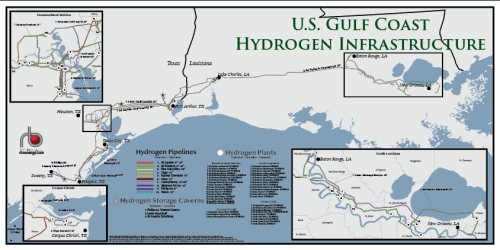
RBN’s U.S. Gulf Coast Hydrogen Infrastructure Map lays out the pipelines and merchant hydrogen plants that make up the gulf coast market, providing an unprecedented snapshot of the region’s hydrogen infrastructure network.
The IRA also creates a new section of the tax code — 40B — to extend the BTC to SAF, which is considered to be one of the most promising options to reduce GHG emissions in the aviation sector, where electrification is challenging due to battery weight. To claim the credit for SAF, a producer will need to certify that the fuel’s lifecycle GHG emissions are reduced by at least 50%. The SAF credit will be equal to $1.25/gal plus an additional $0.01 for each percentage of lifecycle emissions reduction that exceeds 50%. (If the emissions are reduced by 100%, the SAF credit would be $1.75/gal.) That means that producers of low-CI SAF, such as Fidelis New Energy, whose planned GigaSystem project we detailed in Part 1 of this blog, will have a significant advantage over market competitors unable to match those CI scores. But as we said, the BTC only runs through 2024 and the tax credit taking its place will swing the advantage even more in the favor of low-CI fuel producers.
About the song
“Thunderstruck” was written by Angus and Malcom Young and appears as the first cut on side one of AC/DC’s 12th studio album, The Razors Edge. Released as a single in September 1990, the song went to #5 on the Billboard Mainstream Rock Singles chart and has been certified Platinum by the Recording Industry Association of America (RIAA). Angus Young has stated that the song started with his riff and was developed with his brother Malcom for the rhythm part of the song. The tune –– whose key lines include “I looked ’round and knew there was no turning back” –– has been featured in several films and is used prominently at Dallas Cowboys football and Oklahoma City Thunder basketball games. Personnel on the record were: Brian Johnson (lead vocals), Angus Young (lead guitar), Malcom Young (rhythm guitar, backing vocals), Cliff Williams (bass, backing vocals), and Chris Slade (drums, percussion).
The Razors Edge was recorded during 1990 at Windmill Lane in Dublin and Little Mountain Sound in Vancouver, with Bruce Fairbairn producing. Released in September 1990, it went to #2 on the Billboard 200 Albums chart and has been certified 5x Platinum by the RIAA. Four singles were released from the LP.
AC/DC is an Australian rock band formed in Sydney in 1973 by brothers Angus and Malcom Young. They have released 18 studio albums, three live albums, two soundtrack albums, one EP and 48 singles and have sold more than 200 million records worldwide. Twenty members have passed through the band's ranks since its beginning, AC/DC was inducted into the Rock and Roll Hall of Fame in 2003. Singer Bon Scott died in 1980 and guitarist Malcom Young died in 2017. There has been no official statement on the future of AC/DC since the November 2020 release of the Power Up album, which was dedicated to Malcom Young.





Comments
Want to clarify understanding of the calculation of the Clean Fuel Production Credit.
First, to get units the same as used by CARB for the LCFS, 50 kgCO2e/MMBtu is equal to 47.39 gCO2e/MJ, I believe.
Under the GREET model for some RNG projects utilizing anaerobic digestion at dairy farms, the CI for some of these projects are as low as -400 gCO2e/MJ.
Should it therefore be assumed these projects will get a CFPC of ~$9.44/gallon, assuming the RNG is finally used as CNG for road transport? [(47.39-(-400))/47.39=9.44 emission factor; 9.44 emission factor * $1.00 = $9.44/gallon]
Is that real? I feel like I am missing something here...
In reply to CFPC for RNG by Chad Schramek
Thanks for your question and for taking the time to read today's blog.
We are not tax experts, but I've not found anything definitive about RNG/CNG eligibility, so it could qualify under 45Z, which does not appear to have any wording that would specifically rule it out.
A CI score of around minus 400 would generate a credit of around $9/gal under the formula.