Pretty much everywhere you look, there’s a focus on decarbonizing the global economy, and a lot of those discussions start with the transportation sector. It generated 27% of U.S. greenhouse gas (GHG) emissions in 2020, putting it at the top of the list, just ahead of power generation and industrial production; combined, the three sectors account for more than three-quarters of the nation’s GHG emissions. For personal transportation, most of the attention has been on electric vehicles (EVs), but since the commercial transportation sector is largely powered by diesel and jet fuel, the push for decarbonization in trucking, air travel, and shipping has largely focused on ways to produce alternative fuels that reduce GHGs. Among those are ultra-low-carbon fuels called electrofuels, also referred to as eFuels, synthetic fuels, or Power-to-Liquids (PtL). In today’s RBN blog, we explain what eFuels are and how they compare to other alternatives, how they are produced, and what opportunity there might be to make a dent in the consumption of traditional transportation fuels.
We explored many alternative fuels and the government policies that support them, such as California’s Low Carbon Fuel Standard (LCFS), in our seven-part Come Clean series. These alternatives include ethanol, a biofuel found in virtually all of the gasoline purchased in the U.S.; biodiesel, another biofuel that is produced from a variety of feedstocks, including corn oil, soybean oil, animal fats, and used cooking oil; renewable diesel (RD), a biomass-based fuel that can be used in diesel engines or as home heating oil; and sustainable aviation fuel (SAF), which is also made from renewable feedstocks and is a substitute for jet fuel.
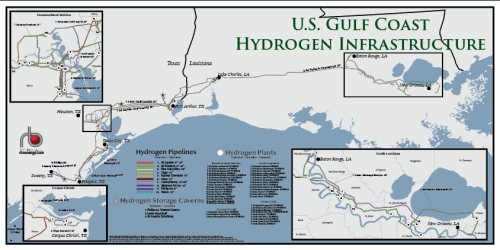
RBN’s U.S. Gulf Coast Hydrogen Infrastructure Map lays out the pipelines and merchant hydrogen plants that make up the gulf coast market, providing an unprecedented snapshot of the region’s hydrogen infrastructure network.
While producing alternative fuels may help make the transportation sector greener, it’s important to remember that their production is driven by the significant financial incentives in place to produce fuels with a low carbon intensity (CI), either through California’s LCFS or the federal Clean Fuel Production Credit (CFPC) — also known as 45Z — which was created as part of the Inflation Reduction Act (IRA). There are two components to the new credit (which does not come into effect until 2025), a base credit and an emissions factor, the latter of which takes into account a fuel’s lifecycle GHG emissions rate, which is comparable to its CI score. In essence, the lower a fuel’s emissions rate, the higher the credit. As we noted in our Thunderstruck series, producers of RD and SAF stand to benefit from the IRA’s passage. The IRA also creates some complications for production processes that include captured carbon dioxide (CO2; more on that in a bit).

About the song
“Just a Little Bit Better” was written by Kenny Young, who released a single of it under his name in October 1964. Songwriter Young’s best-known song was “Under the Boardwalk,” a 1964 hit for The Drifters, which he co-wrote with Artie Resnick. Herman’s Hermits released their version of the song as a single in September 1965. It went to #7 on the Billboard Hot 100 Singles chart. It was recorded in July 1965 at De Lane Lea Studios in London and produced by Mickie Most. The song appears as the first song on side two of The Best of Herman’s Hermits LP, released in 1965, and on their 1966 EP, A Must to Avoid. Personnel on the record were: Peter Noone (lead vocals), Derek “Lek” Leckenby (lead guitar), Keith Hopwood (rhythm guitar, backing vocals), Karl Green (bass, backing vocals), and Barry Whitwam (drums).
Herman’s Hermits are an English pop group formed in Manchester, England, in 1964 and fronted by vocalist Peter Noone. Noone was only 15 when he joined the group and was already known in the UK as a featured actor on the popular British television soap opera Coronation Street. The band’s name came from a resemblance between Noone and the character Sherman on the Rocky and Bullwinkle cartoon show. Sherman was shortened to Herman. They were discovered by Manager Harvey Lisberg, who hooked them up with hit-making record producer Mickie Most in London. Most used session musicians on a lot of the records he produced (including future Led Zeppelin members Jimmy Page and John Paul Jones), but Herman’s Hermits played on all of their hit records. They had 11 Top 140 hits under Most’s tutelage. They have released eight studio albums, 10 compilation albums, seven EPs, and 29 singles. The group has appeared in four motion pictures, two of which were promotional vehicles for the band. Nine members have passed through the group since its formation. Peter Noone still does concert dates with a group billed as “Herman’s Hermits starring Peter Noone.” He is currently booked for weekend concert dates in the U.S. going into the summer of 2023.