


Crude oil production from the Western Canadian Sedimentary Basin (WCSB) continues to grow, and most of that growth is expected to be heavy crude oil, so pipeline companies are working on expanding capacity to move more of those barrels into the U.S. However, as most U.S. Midwest (PADD 2) refiners are already taking nearly as much WCSB heavy crude as they can, the incremental barrels coming into the U.S. will need to find their way to the Gulf Coast (PADD 3). A few projects are in the works that would move those barrels into PADD 2 waystation hubs such as Cushing, OK, and Patoka, IL, but will there be enough room on the four major pipelines — the Four Sticks noted in today’s title — that move barrels out of those two hubs to the Gulf Coast? That’s what we’ll look at in today’s RBN blog.
In Part 1 of our recent Turn Me Loose blog series we discussed the past drivers of WCSB crude oil production growth, which averaged about 170 Mb/d annually over the past 15 years, and grew by nearly 190 Mb/d last year, dwarfing WCSB demand growth that averaged 10-15 Mb/d annually. Our current forecasts are for a slower pace of production growth over the next five years — the major oil sands producers seem to be taking a wait-and-see approach while Canada’s federal and provincial governments negotiate new frameworks for greenhouse gas (GHG) emissions and abatements — but those plans will likely accelerate once policies have been clarified. The Alberta government wants the province’s oil production to double over time to around 8 MMb/d, and there’s plenty of resource to develop.
In Part 5, we looked at all the potential pipeline projects to move more barrels out of the WCSB, including about 980 Mb/d of new capacity into the U.S. that is either underway or proposed:
- Enbridge has defined plans to add about 430 Mb/d of capacity into the U.S. from its Mainline and Express systems and sees additional expansion potential.
- South Bow Corp. and Bridger Pipeline LLC have separate but apparently linked proposals for about 550 Mb/d of new capacity from Alberta to Guernsey, WY; from there, those barrels would need to move further downstream, to Cushing or elsewhere. (For more, see our 80+ page report Roundabout! Canada-To-Rockies Crude Flows Reshaping PADD 4 & Guernsey Market and subsequent webcast presentation.)
Additionally, more pipeline capacity to British Columbia on Canada’s west coast is in the works. The Canadian government is looking to expand capacity of the Trans Mountain Pipeline System — which added a new 590-Mb/d pipeline, the Trans Mountain Expansion (TMX), in 2024 — by another 300 Mb/d. Plans are to expand TMX by about 90 Mb/d using drag-reducing agents (DRAs) and another 210 Mb/d by adding pumping capacity and 19 miles of new pipeline. The Alberta and Canadian governments are also working to encourage private companies to build a greenfield pipeline from Alberta to the west coast. Recent history with TMX has shown that building new pipeline to the BC coast can be extremely time-consuming and expensive.
Enbridge is moving forward on three WCSB egress projects that involve its Mainline (yellow line in Figure 1 below) and Express-Platte (orange line) systems: its Mainline Optimization 1 (MLO1) and Southern Illinois Connector projects were sanctioned late last year, while Enbridge hopes to sanction its second Mainline Optimization project (MLO2) by midyear. These projects would collectively add 430 Mb/d of pipeline capacity from the WCSB into the U.S. Enbridge has already disclosed plans to increase volumes into Cushing by about 170 Mb/d (+100 Mb/d via an expansion of Flanagan South, purple line; +70 Mb/d by utilization of spare capacity on Spearhead, pink line) and increase volumes into Patoka by about 30 Mb/d (Express-Platte expansion and 56-mile extension to Patoka), but we suspect the remaining 230 Mb/d would need to make its way south to the Gulf Coast.
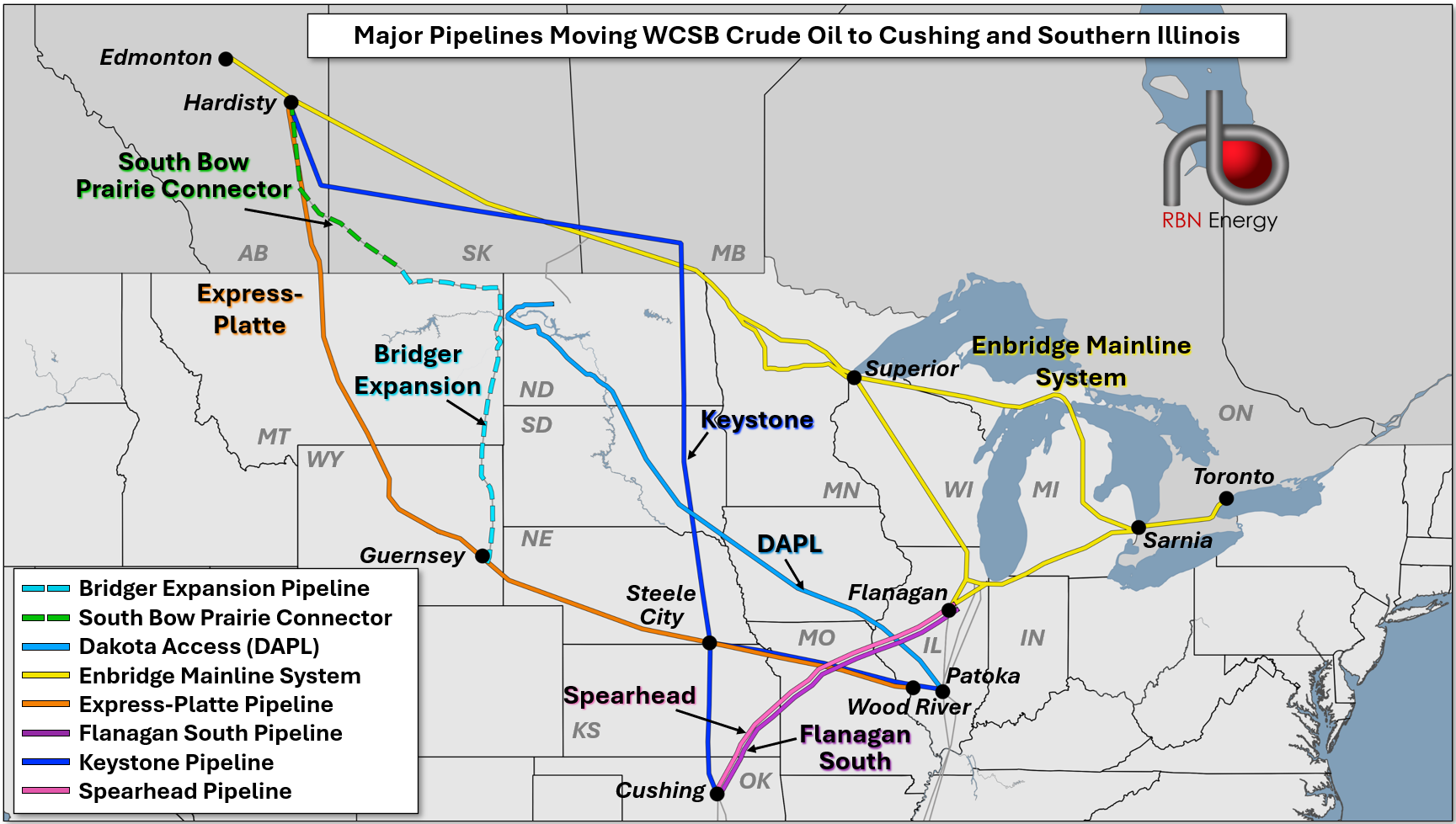
Figure 1. Major Pipelines Moving WCSB Crude Oil to Cushing and Southern Illinois. Source. RBN
Gulf Coast Crude Oil Shipping Costs to Asia and Europe Soar, Then Crash Back to Earth
From early February to late March, shipping costs for crude tankers departing the U.S. Gulf Coast rose sharply across all vessel classes and destinations as global trade flows adjusted to the disruption of Middle East supply.
About the song
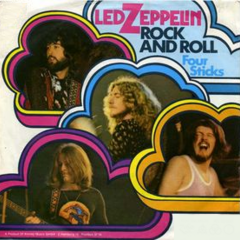
“Four Sticks” was written by Jimmy Page and Robert Plant and appears as the third song on side two of Led Zeppelin’s fourth studio album, commonly referred to as Led Zeppelin IV. The song title is a reference to drummer John Bonham using two sticks in each hand while recording it. The song's time signature is a mix of 5/8 and 6/8 and is so complex that the band only performed it live once. It was released as the B-side to the single “Rock and Roll” in February 1972 and went to #47 on the Billboard Hot 100 Singles chart. John Bonham's drum intro to “Rock and Roll” was directly borrowed from Little Richard’s drummer, Charles Conner’s, intro to Richard’s hit record “Keep a Knockin’.” Personnel on the record were: Robert Plant (vocals), John Bonham (drums), Jimmy Page (guitars) and John Paul Jones (bass, synthesizer).
Led Zeppelin IV was recorded on the Rolling Stones Mobile Studio at Headley Grange, Hampshire, and Island in London from December 1970 through February 1971. Produced by Jimmy Page, it was released in November 1971 and went to #2 on the Billboard 200 Albums chart. It has been certified 24X Platinum by the Recording Industry Association of America. The album included “Stairway to Heaven,” which would become a signature song for Led Zeppelin. Two singles were released from the LP.
Led Zeppelin was an English rock band formed in London in 1968 by Jimmy Page, Robert Plant, John Paul Jones and John Bonham. The name was suggested by The Who’s drummer, Keith Moon, who thought the band might go over like a lead balloon. They recorded and mixed their debut album in nine days at Olympic Studios in London, produced and funded by Jimmy Page. They released their eponymous debut album on Atlantic Records in January 1969. They released nine studio albums, four live albums, an EP, 10 compilation albums and 19 singles. They have sold more than 300 million records worldwide, making them one of the most successful rock bands in the world. They have won a Grammy Award, two Ivor Novello Awards, a Polar Music Prize, received Kennedy Center Honors, and are members of the Rock and Roll Hall of Fame and the UK Music Hall of Fame. The band broke up after the death of drummer John Bonham in December 1980. They did a reunion show with Bonham’s son, Jason, on drums in December 2007 at the O2 Arena in London to honor Atlantic Records’ Ahmet Ertegun. The concert was released on an album and video titled Celebration Day. The surviving members of the band have all had successful solo careers. Robert Plant will begin an international tour in May.
"About the Song" -- written by Mickey McMahan , RBN Director of Musicology






Comments
Another route, more of a stream versus a stick, is the proposed Ducere Marine Terminal that has been designed and permitted to load 450,000 barrels a day from the Enbridge Mainline at Lockport Junction to barges sailing down the Inland Waterway to refinery docks in Louisiana and Mississippi.