As crude oil production continues to grow in the Western Canadian Sedimentary Basin (WCSB), more pipeline capacity will be needed to move it to market. The startup of the 590-Mb/d Trans Mountain Expansion (TMX) in May 2024 temporarily created a period of surplus takeaway capacity, but that is shrinking and more will soon be needed, as WCSB crude production typically grows by 100 to 200 Mb/d annually, and there is no shortage of resource to develop. Thankfully, some new capacity is on its way in 2026 and 2027, and much more is being planned. In today’s RBN blog, we go through all the projects in the works.
In Part 1 of this series, we discussed the drivers behind WCSB crude oil production nearly doubling from 2010 to 2025, as well as its seasonal trends. In Part 2, we reviewed the major pipeline projects that expanded capacity to move barrels out of the WCSB up to this point, how the timing of those projects matched up with supply growth, and current export pipeline capacity. In Part 3, we examined how WCSB crude oil price discounts are impacted by pipeline scarcity and production seasonality. And in Part 4, we looked at where WCSB crude oil goes, how it gets there, and how its end markets have evolved over time.
Once again, we’ll start this blog off by orienting ourselves with a map that shows the key existing pipelines that move crude oil out of the WCSB, which include:
- Enbridge’s 3.22-MMb/d Mainline system (light-pink lines in Figure 1)
- The Canadian government’s 890-Mb/d Trans Mountain Pipeline System (TMPS; purple line at top left)
- South Bow’s 610-Mb/d Keystone Pipeline System (medium-blue line in middle)
- Enbridge’s Express-Platte Pipeline System (dark-pink line; 310 Mb/d of export capacity)
- Inter Pipeline’s ~98-Mb/d Bow River/Milk River pipeline system (light-green lines near top left)
- Plains’ ~20 Mb/d Rangeland/Aurora pipeline system (dark-green lines near top left)
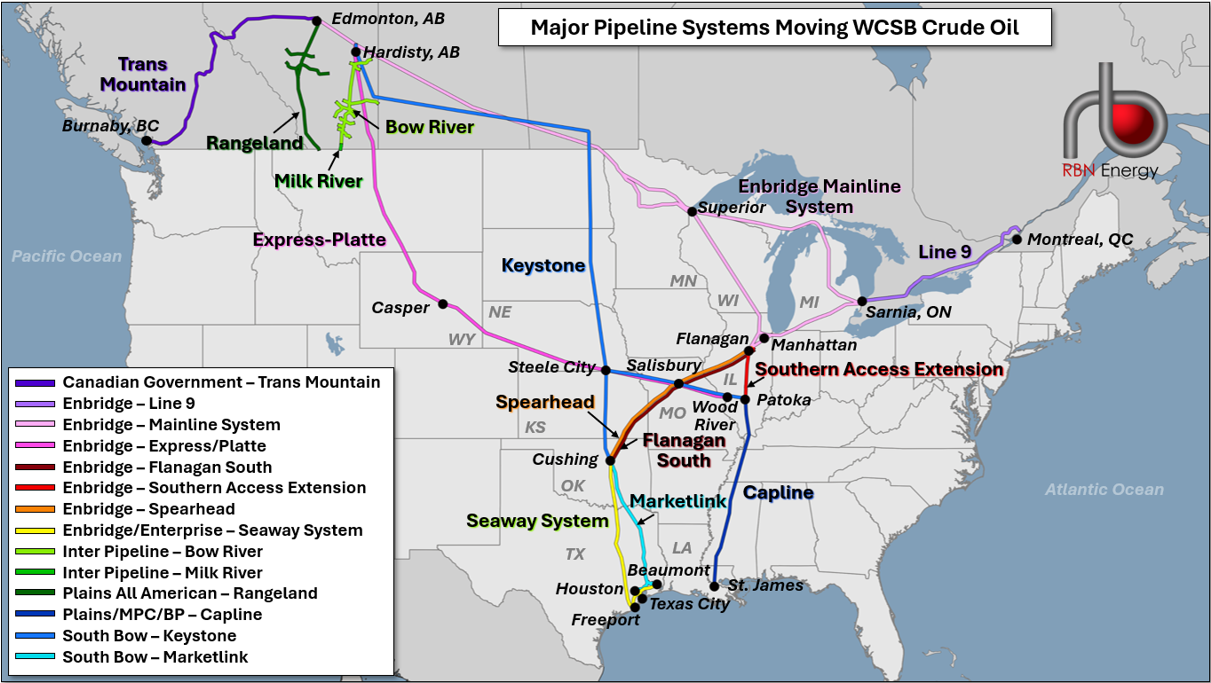
Figure 1. Major Pipeline Systems Moving WCSB Crude Oil. Source: RBN

About the song
“Turn Me Loose” was written by Paul Dean and Mike Reno and appears as the second song on side one of Loverboy’s eponymous debut studio album. The song is built around a bass riff and features crunchy guitar by Paul Dean and the plaintive vocals of Mike Reno. Released as the first single from the album in February 1981, it went to #6 on the Billboard Pop Rock Tracks chart and #35 on the Billboard Hot 100 Singles. Personnel on the record were: Mike Reno (lead vocals), Paul Dean (guitars, backing vocals), Scott Smith (bass), Doug Johnson (keyboards), Matt Frenette (drums), and Nancy Nash and Katie Kissoon (backing vocals).
The album, Loverboy, was recorded in 1979-80 at Little Mountain Sound in Vancouver and produced by Bruce Fairbairn. Released in the U.S. in November 1980, it went to #13 on the Billboard 200 Albums chart and has been certified 2X Platinum by the Recording Industry Association of America. Three singles were released from the LP.
Loverboy is a Canadian hard rock band formed in Calgary, AB, in 1979. After opening shows for major rock acts in Canada, the group was signed to a record deal with Columbia Records Canada in 1979 and released their debut album, Loverboy, in the U.S. in November 1980. They have released nine studio albums, four live albums, 16 compilation albums, and 29 singles and have sold more than 15 million records worldwide. Seven members have passed through the band since its formation. Bassist Scott Smith was presumed dead after a large wave swept him off his boat near San Francisco in November 2000 at 45. (His body has never been recovered.) Bassist Jim Clench died in November 2010 in Montreal at 61. After a hiatus from 1989 to 1991, Loverboy continues to tour and will be appearing at various venues in the U.S. beginning in June.
"About the Song" -- written by Mickey McMahan , RBN Director of Musicology