Energy Transfer’s Mariner East pipeline system was supposed to help resolve a growing problem for producers in the “wet” Marcellus and Utica plays — namely, the need to transport increasing volumes of LPG out of the Northeast, especially during the warmer months, when in-region demand for LPG is low. The pipeline system also was meant to spur LPG and ethane exports out of Energy Transfer’s Marcus Hook marine terminal near Philadelphia. So how are things going? Well, the now five-year-old, 70-Mb/d Mariner East 1 pipeline, designed to transport ethane and propane, has been offline ever since a sinkhole exposed a part of the pipe late last month. The 275-Mb/d Mariner East 2 pipe is finally in operation and enabling a lot more LPG to move to Marcus Hook, but for now it can only run at about 60% of its capacity. And last Friday, a key Pennsylvania regulator suspended its review of outstanding water permit applications for the remaining piece of ME-2 and the parallel 250-Mb/d ME-2 Expansion project, and threw into doubt how long it might take to finish the Mariner East system and ramp it up to full capacity. Today, we begin a series on recent Mariner East developments and explain how, despite the mixed bag of Mariner East news in recent weeks, the situation is not as bad as it may seem.
One of the big success stories of the Shale Era has been the rapid expansion of natural gas and NGL production in the Northeast. Just a few years ago, the region depended heavily on piped-in gas and piped-, railed- or shipped-in LPG. As we’ve discussed in more blogs than we can count — and in our Dog Days Are Over? Drill Down Report last fall — the rapid run-up in Marcellus/Utica gas production through the 2010s initially displaced gas that had been piped into the Northeast from the Gulf Coast, western Canada and elsewhere. Then, as gas production growth continued in Pennsylvania, Ohio and West Virginia, existing pipelines into the Northeast were reversed to allow gas to flow out, and big new pipes like Rover and NEXUS were completed to take additional gas away from the Marcellus/Utica.
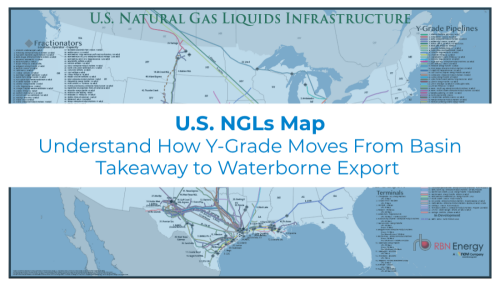
Visualize the infrastructure behind U.S. NGL movement.
The U.S. NGLs Map provides a comprehensive view of the transport, processing, and export networks moving NGLs across the U.S.
Producers’ desire to wring as much revenue as they could from their Northeast wells led many of them to focus on areas rich in natural gas liquids (NGLs) that could be separated out at gas processing plants and divvied up at fractionation plants into NGL “purity products” like ethane, propane, normal butane, isobutane and natural gasoline. Ethane could be sold as a petrochemical feedstock, while propane is generally used for heating, butanes are used in gasoline blending during the winter months, and natural gasoline is used for gasoline blending year-round or as diluent. The only questions were, how do you get all those purity products to their end users, and what do you do with all the LPG — propane and normal butane — you produce during the warmer months of the year, when heating and blending demand are low. There was no easy answer. Ethane — the lightest of the purity products, and one whose only real use (besides being "rejected" into natural gas for its Btu value) is as an ethylene-plant feedstock — can only be transported by pressurized pipeline or, once you get it to a marine dock, by specialized gas carriers. As for LPG, it needs to be transported by pressurized pipeline, or in specially designed rail cars or trucks; again, like ethane, once LPG is dockside, it can be loaded onto specialized ships.
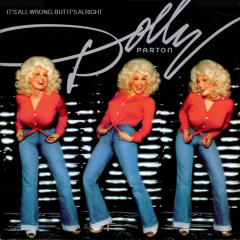
About the song
"It's All Wrong, But It's Alright," written and recorded by Dolly Parton, was a track on Dolly’s 1978 album, Here You Come Again, and went on to become her seventh #1 hit single. The song was released as a double A-sided single, backed with "Two Doors Down." Here You Come Again, produced by Gary Klein and recorded at Sound Lab Studios in Los Angeles, would go to #1 on Billboard's Hot Country Albums chart, and #20 on the Billboard Top 200 Albums list. It was Parton's 20th solo album and her first to be certified Platinum by the Recording Industry Association of America. Here You Come Again won a Grammy Award for Best Country Vocal Performance by a Female in 1979. Parton wrote four of the 10 songs on the LP.
Dolly Parton is an American singer, songwriter, multi-instrumentalist, record producer, actress and author. Twenty-five of her songs have reached #1 on the Billboard country music charts, a record number for a female artist that she shares with Reba McEntire. Dolly also has had 41 Top 10 country albums, a record for any country artist. She has released 47 solo albums, 17 albums with other artists, and 127 singles. She has appeared in 12 movies and numerous television shows, including 218 episodes of The Porter Wagoner Show, which she co-hosted. Parton has received 10 Country Music Association Awards, nine Grammy Awards, seven American Country Music Awards, seven American Country Music Awards and three American Music Awards. Dolly also has received a National Medal of Arts and a Kennedy Center Honor, and is a member of the Country Music Hall of Fame. She still acts, records, and tours to this date — and she participated in a tribute to Dolly and her songs at the Grammys earlier this month.