The U.S. started exporting ethane by ship less than three years ago, first out of Energy Transfer’s Marcus Hook terminal near Philadelphia and then from Enterprise Products Partners’ Morgan’s Point facility along the Houston Ship Channel. Good news for NGL producers, right? Well yes, sort of. Because while waterborne export volumes rose through 2016, 2017 and the first seven months of last year, they’ve been flat-to-declining ever since, with further ethane-export growth hampered primarily by a lack of international demand. That demand may soon be ratcheting up — mostly in China, but also in Europe — but it won’t happen overnight. Today, we discuss ethane export trends, the Morgan’s Point and Marcus Hook marine facilities, and plans for new ethane export capacity tied directly to new overseas ethane crackers.
U.S. NGL production, NGL fractionation, and the market for NGL purity products (ethane, propane, normal butane, isobutane and natural gasoline) have been frequent topics in the RBN blogosphere the past few months. Back in September, in Hotel Fractionation, we discussed how, with the production of mixed NGLs (aka y-grade) soaring, fractionators at the NGL hub in Mont Belvieu, TX — and elsewhere in Texas and in Louisiana — are running at or near capacity, and that a scramble is on to build new fractionation capacity. Then, in Seasons Change (in December), we looked at what caused most purity-product prices to dive in October and November (one factor was the sharp decline in crude oil prices). And, in our four-part series, Between Mont Belvieu and the Deep Blue Sea, we examined rising U.S. exports of propane and normal butane — the two purity products generally referred to as LPG — and the LPG export facilities in place and being planned to handle those rising volumes.
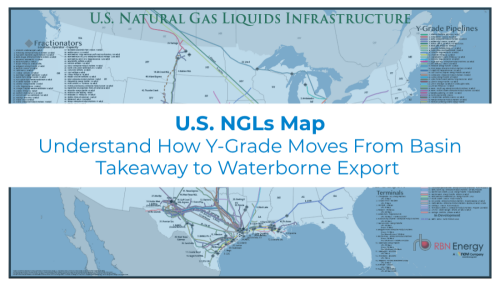
Visualize the infrastructure behind U.S. NGL movement.
The U.S. NGLs Map provides a comprehensive view of the transport, processing, and export networks moving NGLs across the U.S.
Today, we shift to ethane exports and ethane export terminals. As regular readers of our blogs know, ethane is unique in that it can either be (1) extracted from y-grade (through fractionation) like its purity-product brethren and sold to petrochemical plants, where it is “cracked” to produce ethylene; or (2) “rejected” into the natural gas stream at the gas processing plant and sold (at the price of gas) for its Btu value. Which of these routes any particular molecule of ethane takes depends on a number of things — for example, the price of natural gas versus the price of purity ethane; demand for ethane from ethylene plants (also known as steam crackers), and the availability of NGL pipeline capacity between the production area and fractionation hubs. But, overall, the run-up in U.S. NGL production during the Shale Era spurred the development of a number of new U.S. steam crackers (most of them along the Gulf Coast) and interest from overseas steam crackers in exporting U.S.-sourced ethane to their facilities.
About the song
“Send It to Me,” written by Mick Jagger and Keith Richards, is the third track on side one of The Rolling Stones' Emotional Rescue album. The LP, produced by The Glimmer Twins (as Jagger and Richards sometimes referred to themselves), was mostly recorded at Compass Point Studios in Nassau, Bahamas, and released in June 1980. "Send It to Me" is a reggae-influenced tune that started out as a 12-minute song with many verses, before being edited down to its 3:43 album time. Recording on this song started in June 1979 at Pathé Marconi Studios in Paris, and was finished at Electric Lady Studios in New York City in June 1980. In addition to The Stones, Sugar Blue plays harmonica on this cut, and reggae singer Max Romeo adds percussion to the track. "Send It to Me" appears as the B-side to the single release of "She's So Cold," which went to # 9 on Billboard’s Disco Top 100 chart, and #26 on the Billboard Hot 100 list. The band has never performed the song live.
Emotional Rescue went to #1 on the Billboard Top 200 Albums chart and was twice certified Platinum by the Recording Industry Association of America. The Rolling Stones are a British rock band formed in London in 1962. They have released 30 studio albums, 26 live albums, 25 compilation albums, and 120 singles to date. They have sold more than 240 million albums worldwide. The band has won eight NME Awards, four Grammy Awards, four Billboard Awards, and three MTV Video Music Awards. The Stones have been inducted into the Rock and Roll Hall of Fame and the Grammy Hall of Fame; they still record and tour.