The combination of rising condensate demand as new splitter capacity came online and falling conde supply resulted in just what you’d expect — higher conde prices. Worse yet for the companies that made throughput commitments for those new splitters, the once-favorable price differentials between conde and light-crude benchmarks West Texas Intermediate (WTI) and Louisiana Light Sweet (LLS) have been turned on their heads, and a number of splitters are operating at far less than capacity. Today, we continue our look at the roller-coaster world of conde, this time focusing on conde prices and differentials, and on the forces that may change the conde market once again.
Crude oil and condensate are categorized by their API gravity (API standing for American Petroleum Institute), which is a measurement scale (in degrees) of a petroleum liquid’s specific gravity — the lighter or less dense the crude, the higher its API gravity number (see our Drill Down Report, Blinded by the Lights). Superlight crude oil and condensate (or, as it’s commonly called, conde) is at the far end of the crude-oil spectrum, with an API gravity of 50 to 55 degrees for superlight and more that 55 degrees for conde (according to the gravity breakdown used by the Energy Information Administration, or EIA, in its Crude Oil and Lease Condensate Production by API Gravity data series). As we said in Part 1 of this blog series, superlight crude and conde can either be refined, exported or blended with heavier crudes — or (for conde) run through a splitter. A splitter uses atmospheric distillation to separate conde into its component fractions to produce intermediate, semi-finished blend stocks like naphthas and distillates that are processed further at refineries.
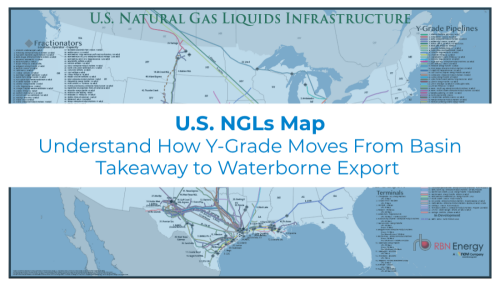
Visualize the infrastructure behind U.S. NGL movement.
The U.S. NGLs Map provides a comprehensive view of the transport, processing, and export networks moving NGLs across the U.S.
Superlight crude and condensate are produced in a number of U.S. shale plays, including the Permian, SCOOP/STACK and the Niobrara/Denver-Julesburg (DJ) Basin, but high-API-gravity crude is most closely associated with the Eagle Ford region in South Texas, where at one point as much as 45% of the crude produced had an API gravity of 50 or more. As we said in Part 2, U.S. production of superlight and conde rose steadily from 2010 to early 2015 to a peak of about 1.1 MMb/d (about 800 Mb/d of that from the Eagle Ford), but then fell by more than a third to about 700 Mb/d in 2017, with Eagle Ford production of 50-API-or-higher crude falling by half (to about 400 Mb/d).
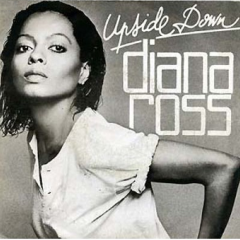
About the song
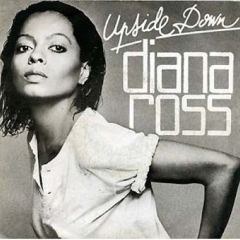
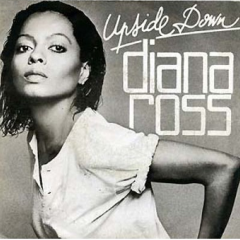
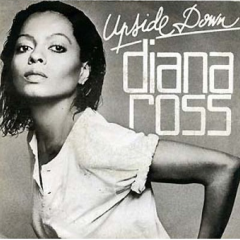
“Upside Down” was written by Nile Rodgers and Bernard Edwards (Chic) and appears as the first song on side one of Diana Ross’s 11th studio album, diana. Released as the first single from the album, the song went to #1 on the Billboard Hot 100, Disco, and Soul Singles charts. It has been certified Gold by the Recording Industry Association of America. Personnel on the record were: Diana Ross (lead vocals), Bernard Edwards (bass), Nile Rodgers (guitar), Tony Thompson (drums), Andy Barrett (piano), Raymond Jones (keyboards), and Alfa Anderson, Fonzi Thornton, Luci Martin, Michelle Cobbs (backing vocals).
Recorded between December 1979 and March 1980 at the Power Station in New York, diana was produced by Bernard Edwards and Nile Rodgers. Ross and her production team had a falling out over the mixes, and she and Russ Terrana rerecorded her vocals and remixed the album at Electric Lady in New York, and Motown/Hitsville USA studio in Hollywood. The album was released in May 1980 and went to #1 on the Billboard Top R&B/Hip-Hop Albums, and #2 on the Billboard 200 Albums charts. It has been certified Platinum by the RIAA. Three charting singles were released from the LP.
Diana Ross is an American singer, songwriter and actress from Detroit. Ross rose to fame as the lead vocalist for The Supremes, Motown’s most successful act in the ’60s. She left The Supremes in 1970 to embark on a solo career that continues to this day. As a solo artist, she has released 25 studio albums, five live albums, 30 compilation albums, one EP, four soundtrack albums, and 91 singles. As an actress, Ross has starred in five motion pictures and been featured in 35 television shows. She has won seven American Music Awards, one Grammy Award, one Golden Globe Award, and one Tony Award. She has been awarded a Lifetime Achievement Grammy Award, a Presidential Medal of Honor, a Kennedy Center Honor, and has a star on the Hollywood Walk of Fame. She still records and tours, and released her 25th studio album, Thank You, in November 2021.