The second wave of North American LNG export projects is officially underway. LNG Canada took final investment decision (FID) last October and would be the first large-scale LNG export facility in Canada. Golden Pass followed in February, marking the beginning of the next round of LNG export build on the U.S. Gulf Coast. Sabine Pass Train 6 is expected to get the green light any day, and at least eight more projects are targeting FID this year. But how likely are these projects to go ahead? And what exactly does it take for a project to reach that financial milestone? Today, we begin a two-part blog series on the factors affecting U.S. and Canadian LNG export projects’ prospects for taking FID and our view on the projects making progress towards joining the second wave of LNG exports.
One of the ripple effects of the Shale Revolution has been the rush to export LNG. Seven U.S. liquefaction trains across three terminals — two at brownfield sites and one at a greenfield site — are now operational (green diamonds in Figure 1), and more than a dozen others are “FID-ed” and on their way toward completion (blue and orange diamonds). But those are just the ones that have garnered the capital backing and commitment to get built. In addition, there are nearly two dozen more liquefaction projects lined up to, well, catch the export wave (see our Coming Up series). But as surfers know, multiple factors have to align in order to find that perfect swell; the same goes for LNG export projects, and not all of the announced projects will make it. So, what makes a liquefaction project truly viable in a highly competitive environment?
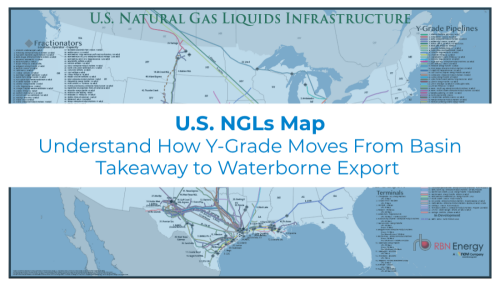
Visualize the infrastructure behind U.S. NGL movement.
The U.S. NGLs Map provides a comprehensive view of the transport, processing, and export networks moving NGLs across the U.S.
Well, there’s not just one way to get there — different projects take different approaches to development and the dependencies and investment criteria for greenlighting a project may vary, but there are some common milestones that underlie developers’ decisions to commit to building these multibillion-dollar projects. Understanding these criteria can help us evaluate a project’s prospects — an exercise we regularly undertake in our LNG Voyager Quarterly report, where we track all of the announced North American LNG export projects and assess the status and timing of a potential FID. (We’ll explain our “tier system” and our view on which projects are more likely to proceed later on.) Developers are generally moving the ball forward on two or three main fronts in the period leading up to a project’s FID: regulatory approvals, commercial agreements with offtakers for liquefaction train capacity and — in cases where the developer is responsible for securing feedgas — lining up gas supply and related pipeline capacity to the liquefaction site. Next, we provide a high-level summary of the typical milestones and the factors affecting progress on each.
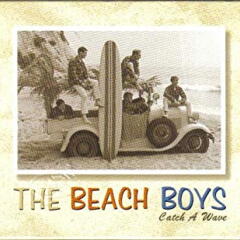
About the song
“Catch a Wave” was written by Brian Wilson and Mike Love, and appears as the second cut on the Beach Boys’ third album, Surfer Girl. The song was recorded at Western Studios in Los Angeles in July 1963, and released in September of the same year. Surfer Girl is the first album on which Beach Boy Brian Wilson was given full production credit — he maintained the producer's role for the band for a few more years, and many hit records.
An interesting side note about “Catch a Wave” is that Beach Boy friends Jan & Dean had Brian Wilson rework the song with new lyrics by Roger Christian. They released it as the Jan & Dean single “Sidewalk Surfin’,” which went to #25 on the Billboard Hot 100 chart in October 1964.
The Surfer Girl LP went to #7 on the Billboard Top 200 Albums chart. The album cover photo is an outtake from the Beach Boys’ first album, with the boys holding the same surfboard and wearing the same Pendleton shirts and wheat jeans, minus the tiki-trimmed Ford Model A pickup truck. Personnel on the record were: Brian Wilson (lead and harmony vocals, bass, piano, organ, and hand claps), Carl Wilson (lead guitar, harmony vocals, and hand claps), Dennis Wilson (drums, lead and harmony vocals, and hand claps), Mike Love (lead and harmony vocals, saxophone, and hand claps), Al Jardine (harmony vocals, bass, and hand claps), David Marks (rhythm guitar, and hand claps), and Maureen Love (harp).
The Beach Boys are an American rock band formed in Hawthorne, CA, in 1961. They have released 29 studio albums and nine archival albums. The band has sold over 100 million records worldwide to date, and has won two Grammy Awards; three of their songs are in the Grammy Hall of Fame. The Beach Boys were inducted into the Rock and Roll Hall of Fame in 1988. Brian Wilson still records and tours to this date. Mike Love fronts a touring version of the Beach Boys that is currently touring the U.S.