Natural gas producers are probably turning green with envy: Processed condensate exports out of the US Gulf are strong and getting stronger. Since the Department of Commerce threw the doors open to the export of lightly processed condensate, new loading points have emerged, new target markets have been found, and more companies have become involved. Today we describe how attention is now turning from regulatory and logistical issues to the challenge of finding buyers.
The volume of very light crude oil with an API Gravity above 50 degrees being produced from U.S. shale plays such as the Eagle Ford and more recently the Permian, has expanded beyond the level of domestic demand (see Condensate City). We have described the loosening of export regulations implemented by the Department of Commerce Bureau of Industry and Security (BIS) since June 2014, to allow lease condensate produced at the wellhead to be exported provided that it is first processed through a distillation tower and is kept segregated on its journey to export marine docks (see Ticket To Export). Last week we detailed the expansion of Plains All American (PAA) and Enterprise Products Partners (EPD) infrastructure to transport processed condensate from the Permian and Eagle Ford Basins to Corpus Christi and Houston (see When Are You Gonna Come Down).
Maturing Market
Initial exports of Eagle Ford condensate in the summer of 2014 (mostly to Asia) did not necessarily make economic sense because the prices paid were not attractive to shippers once freight costs were factored in. (see No Particular Place to Go). The first few cargoes could be chalked up to the need to prove that “it can be done” – that the logistics work, and that the quality of the material is adequate. That proof-of-concept phase is over. Four cargoes of condensate shipped between the first of the year and the end of February 2015. In March, another five cargoes loaded in the US Gulf, followed quickly by three cargoes in the first few days of April. Clearly Eagle Ford condensate is successfully competing with condensate range material in global markets.
A couple of early issues arose with processed condensate exports. First some traders alleged that buyers had concerns about the lack of consistency in the quality of the product being shipped. However, this does not seem to be depressing the appetite of end users. In fact, many of the cargoes are going to the same buyer. Another early issue was access to an export dock – an issue complicated by the need to segregate processed condensate (see Enterprise Condensate Routes to Market). Cargoes were being exported exclusively from the EPD dock in Texas City and then from what used to be the Oiltanking Houston terminal that is also now owned by EPD (see Starship Enterprise). This limitation to global market access led to some grumbling. The Wall Street Journal reported that BP complained to the Federal Trade Commission that EPD was abusing its position in the port of Houston and Texas City. EPD brushed off the complaints, telling analysts that companies wanting a service should pay for it, according to Reuters. Since then, an export cargo has loaded at the Texas International Terminal in the Galveston Ship Channel, and another one at the dock jointly owned by NuStar and Martin Midstream in Corpus Christi. The condensate likely came out of Martin Midstream’s tanks because NuStar does not have separate tankage for condensate at that location.
Other operators in Corpus Christi, most notably Plains, are gearing up to handle condensate as well, offering shippers more choice. Flint Hills (part of Koch Industries) and Occidental Petroleum (Oxy) are in an even better position to handle condensate exports because their Ingleside docks at Corpus are outside the congested port channel area and can accommodate bigger ships with a deeper draught.
Diversification of Discharge Destinations
Table #1 shows ClipperData numbers for condensate exports by load port and discharge country so far (June 2014 through March 2015). Texas City has the largest throughput – close to 8MMBbl. The stealth player among export ports has been Brownsville on the Gulf Coast Texas/Mexico border with close to 3 MMBbl loaded – more than Houston or Corpus. The emergence of the Transmontaigne (part of NGL Energy Partners) terminal in Brownsville as an export port for condensate took many by surprise. The facility is a rail-to-ship transloading point – meaning that processed condensate has to be shipped there by rail. As the number of export loading docks grows, so does the range of destination markets. Brownsville exports, for example, went exclusively to Fos in southern France, but the last ship to load there is now waiting to discharge off the coast of England opposite Rotterdam (Netherlands). Of the first five cargoes loaded in the US, one went to the Dutch port. Since then, Rotterdam has become the second largest receipt point for Eagle Ford Condensate after Fos (see right hand column in Table #1).
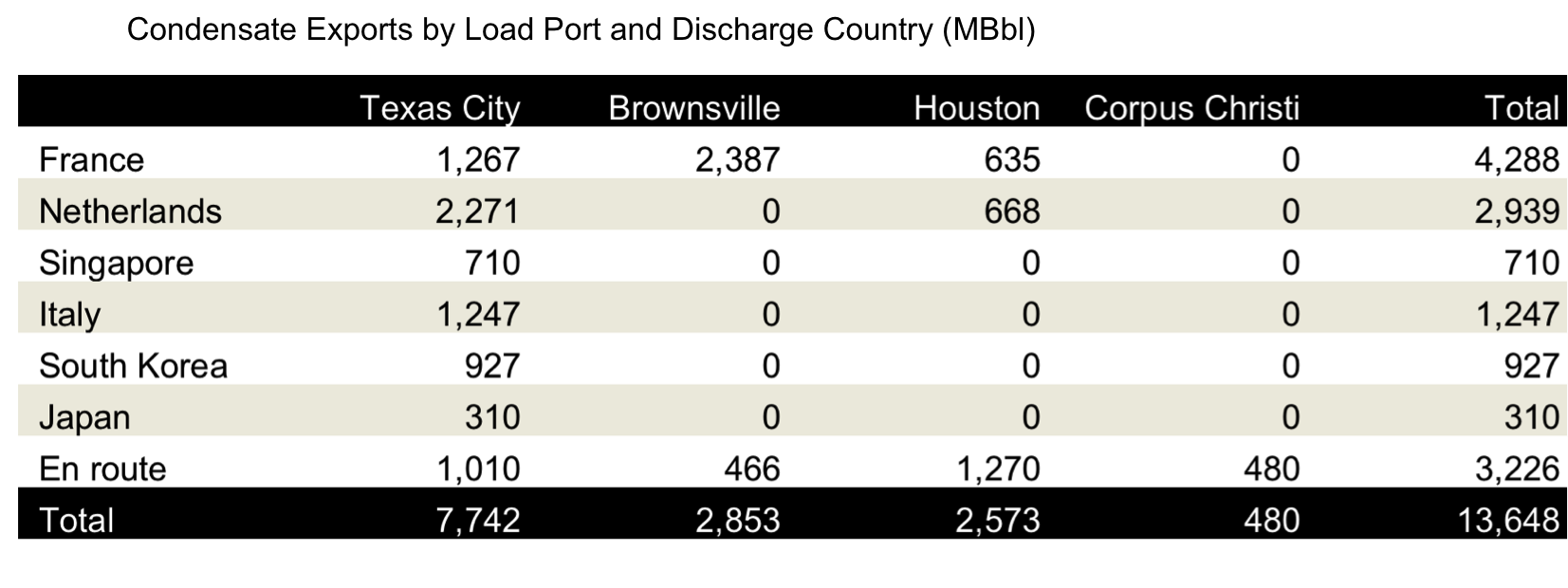
Table #1, Source ClipperData

About the song
“Just Dropped In (To See What Condition My Condition Was In)” was written by Mickey Newberry and appears as the second song on side one of The First Edition’s debut album, The First Edition. The song was first recorded by Jerry Lee Lewis and appears on his 1969 album, Soul My Way. With lyrics such as: “I tripped on a cloud and fell eight miles high,” the song seems to be about an LSD experience, with a reference to a Byrds song about the same subject matter. It made an appearance in an infamous scene with Jeff Bridges in the 1998 motion picture, The Big Lebowski. The First Edition’s arrangement of the song is completely unique, featuring several key modulations, an a cappella chorus of “yeah, yeah, oh yeah,” psychedelic fuzz-drenched guitar, and a vibraphone. To check out what a badass band The First Edition was, check out the live version of the tune they performed on Kenny Rogers & The First Edition’s television series, Rollin’ on the River, produced in 1971. Released as a single in January 1971, it went to #5 on the Billboard Hot 100 Singles chart. It would be Kenny Rogers’s first Top 10 hit. Personnel on the record were: Kenny Rogers (lead vocal, bass), Terry Williams (lead guitar, backing vocals), Mike Settle (rhythm guitar, backing vocals), Thelma Lou Camacho (backing vocals), Mickey Jones (drums), Glen Campbell (fuzz-tremolo guitar, backwards guitar intro), and Mike Deasy (acoustic lead guitar).
The album, The First Edition, was recorded during the summer of 1967 and released in November 1967. The Mike Post-produced LP went to #118 on the Billboard 200 Albums chart. Kenny Rogers sang lead on two songs on the record. After the success of “Just Dropped In,” Rogers became the lead singer of the group and they were renamed Kenny Rogers & The First Edition. Two singles were released from the LP.
Kenny Rogers and The First Edition were an American rock band formed in Los Angeles in 1967 by Kenny Rogers, Terry Williams, Mike Settle, Thelma Lou Camacho and Mickey Jones. Their music incorporated a unique blend of rock, country, and psychedelic pop and featured lush vocal harmonies. They released 12 studio albums, one live album, one soundtrack album, one compilation album, and 22 singles. They had four Top 20 hit singles. Ten members passed through the group until they officially broke up in 1976. Kenny Rogers went on to a successful solo career. Drummer Mickey Jones went on to a successful career as a character actor, appearing in 57 motion pictures and 37 television shows. Jones died in February 2018. Kenny Rogers died in March 2020.