


Crude oil production is expected to be slowing down in U.S. shale basins in the wake of lower oil prices and drastic cuts in the number of working rigs. Most forecasts for future growth are far more conservative now. Yet new midstream pipeline projects continue to emerge. The latest proposal in the Bakken would add a minimum of 220 Mb/d of takeaway capacity sometime after 2018. At that point, between rail and pipeline, North Dakota takeaway capacity will be more than double RBN’s Growth Scenario production forecast – suggesting new pipelines will need to attract defectors from existing routes to market. Today we examine the rationale behind the proposed TransCanada Upland pipeline.
Last week we described plans by Enterprise Products Partners (EPD) to build a new 540 Mb/d pipeline out of the Permian basin from Midland to Sealy, TX (see Watching The Defections – Permian). Although the EPD pipeline has signed up shipper support, those shippers are likely to be defectors from existing pipeline projects, because the incremental capacity does not appear to be justified by forecast production estimates. This time we turn to the Williston Basin in North Dakota where another pipeline project appears to exceed market requirements. TransCanada has filed applications with the U.S. State Department, Canada’s National Energy Board (NEB) and the North Dakota Public Service Commission for the necessary permits to build a 285 mile pipeline northeast from Williston, ND to a 1 MMBbl tank farm at Moosomin, in southern Saskatchewan near the border with Manitoba (see thick red line on the map in Figure #1). At Moosomin, the Upland pipeline would connect to TransCanada’s 1.1 MMb/d Energy East pipeline (green and gold lines on the map) – also currently seeking NEB approval – running east from Hardisty, Alberta to Montreal, Quebec and St. John, New Brunswick (see What Becomes of the Empty Pipelines for more on Energy East). The Upland pipeline is designed to transport 220 Mb/d (expandable to 300 Mb/d) of Bakken light crude via Energy East to refineries in Eastern Canada and potentially to U.S. East Coast refineries. The approval process for the Upland pipeline is certain to be complicated because it crosses the U.S. border into Canada and therefore requires the same State Department scrutiny that the much delayed TransCanada Keystone XL pipeline from Hardisty to Steele City, NE is still waiting for. If all the approvals move ahead according to plan – for both Upland and the larger Energy East project, TransCanada expects both to be online by 2020.
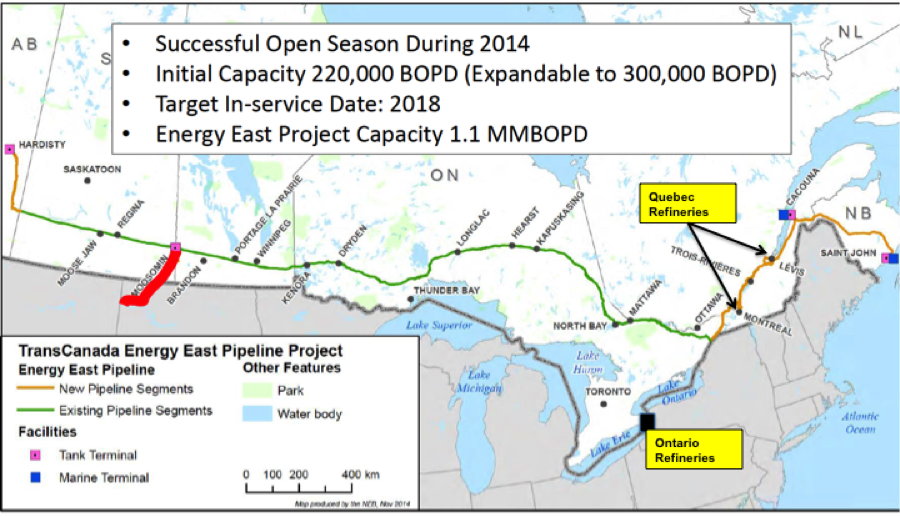
Figure #1; Source: North Dakota Pipeline Authority Presentation, RBN Energy
We’ll look first at the target market for the Upland pipeline. The idea of exporting crude from North Dakota into Canada is not new. [Note: even though U.S. regulations ban the export of crude – Canada is an exception to that rule and such movements are routinely approved.] There have been regular crude shipments across the border into Saskatchewan by truck and rail as part of the scramble to get Bakken production to market in the absence of adequate pipeline capacity – particularly in 2012-13. A good deal of that Bakken crude crossing into Canada by rail comes back into the U.S. to be shipped by barge from Albany, NY to refineries on the East Coast (see East Coast Delivery Terminals). However it turns out the big pick up in U.S. crude exports to Canada over the past two years has not been from Bakken production 200 miles away, but rather has come in the shape of shipments of Eagle Ford crude by tanker from the Gulf Coast to refineries in Eastern Canada. Data from the Energy Information Administration (EIA) shows exports to Canada more than doubling from an average of 133 Mb/d in 2013 to 323 Mb/d in 2014 with 60 % of 2014 volumes originating from the Gulf Coast and only 27% from the Midwest (i.e. North Dakota). Those shipments of crude up the East Coast by tanker have proven more economic than alternatives such as rail shipments from North Dakota – in part because they do not use more expensive “Jones Act” vessels that are required for shipments between U.S. ports (see The Sea and Mr. Jones).
Last year in our “Take A Pipe On The East Side” series we detailed 9 refineries in eastern Canada with combined capacity of 1.3 MMb/d (since reduced to 8 by the closure of the 80 Mb/d Nova refinery in Sarnia). These refineries mostly process light crude that largely comes from Canadian offshore Atlantic seaboard production and imports – including increasing shipments from the U.S. Four of the 8 refineries (660 Mb/d capacity) are in Ontario and so (as you can see in Figure #1), the Energy East pipeline route passes far to the north of them. The remaining four refineries (837 Mb/d) belong to Valero (265 Mb/d Jean-Gaulin in Lévis, Quebec), Suncor (137 Mb/d Montreal, Quebec), Irving Oil (320 Mb/d Saint John, New Brunswick) and Silver Range Financial Partners (115 Mb/d, Come-By-Chance, Newfoundland) and they are the apparent target market for Bakken shippers using the proposed Upland pipeline. Beyond those refineries, the Energy East pipeline offers Bakken shippers access to tide water at the proposed deep water port in Saint John, New Brunswick. From there, crude could be shipped by tanker down the Atlantic seaboard to U.S. East Coast refineries in New Jersey and Philadelphia. There is also a possibility to reverse the 410 Mb/d Portland and Montreal pipeline to ship crude to Maine but attempts to do that so far have met with local opposition (see Feeding Crude to Quebec Refineries).

About the song
“Watching the Detectives” was the first U.K. hit single for Elvis Costello and the Attractions in 1977





Comments
The Newfoundland refinery that you mentioned in your blog continues to be located in the Town of Come-By-Chance.
To help you find it, follow Highway 80 south from Heart's Desire, pass though Dildo, to Come-By-Chance. It's only 116 km (72 miles).
Nova Scotia is the name of another Canadian Province.