


Bakken crude-by-rail (CBR) volumes are down this year and pipeline shipments are increasing as production levels off in the wake of last year’s price crash. The trend is encouraged by lower price differentials between domestic and international crude as well as new pipelines coming online. Since 2012 a combination of rail and pipeline has given Bakken producers ample crude takeaway capacity but pipelines alone have not had sufficient capacity on their own. However, with production slowing down, pipeline capacity is catching up and by 2017 there should be enough pipelines to carry all North Dakota’s crude to market. Today we start a two part series asking whether pipelines can replace CBR from North Dakota.
We’ve covered the transportation of Bakken crude out of the prolific Williston Basin in North Dakota quite extensively in the RBN Blogosphere. Back in 2012 Bakken production quickly outstripped available pipeline capacity – much of which had to be shared with crude from Western Canada. The result - that we now look back on as a familiar story in the shale era – was pipeline congestion and price discounting while producers tried to figure out alternative routes to market. As described in our Crude Loves Rock’n’Rail series in the first quarter of 2013 the solution was to build a plethora of CBR load terminals in the Bakken - transforming a famine of pipelines into a feast of rail. As long as the price differentials between discounted domestic crude stranded in the Midwest and coastal crude priced at higher international prices stayed wide enough – rail was an ideal option for Bakken producers – especially to the East and West Coasts where there is no pipeline capacity (see On The Rails Again). As soon as price differentials – especially between domestic benchmark West Texas Intermediate (WTI) and international benchmark Brent – narrowed then barrels shifted back to pipelines to take advantage of their cheaper tariff rates. Yet significant crude volumes continued to be transported to market from North Dakota by rail because pipeline capacity could not handle the demand. More recently we have described the planning and build out of a series of new pipelines out of North Dakota that (if they are all built) should increase capacity enough to provide space for all the barrels currently travelling to market from North Dakota by rail (see Watching the Defections – Energy East). In this blog we speculate as to when that day might come and whether it is likely.
The chart in Figure #1 shows the changing balance between rail (blue line) and pipeline (red line) percentages of crude carried out of the Williston Basin since February 2012 (against the left axis). The data is from the North Dakota Pipeline Authority (NDPA) that publishes monthly estimates of the balance between crude takeaway modes in percentage terms – based on crude production from the Williston Basin as a whole. We also included the monthly Williston Basin production history as a reference (grey shaded area against the right axis) – that comes from the Energy Information Administration’s (EIA) Drilling Productivity Report (see Every Rig You Take). There are two big takeaways from this chart. The first is that crude production – and therefore the amount of crude that needs to be transported out of North Dakota is growing throughout the period – although that growth has leveled off this year in response to falling crude prices and lower drilling rates. The second big takeaway is the change in the relative positions of rail and pipeline takeaway percentages over the period. Pipelines (red line) started out in the lead back in February 2012 at 56% but fell rapidly after that to 23% in May 2013 before beginning a gradual recovery in December 2013 back to 41% in May 2015 (the latest data). Rail started out at 28% in 2012 but zoomed up to 75% by April 2013 – falling back to 61% in August 2013 when crude differentials narrowed before recovering to 73% in December 2013. Since then rail percentages have been on a steady decline – leveling off some at about 60% in the second half of 2014 but falling again so far this year to 52% in May (2015) – their lowest level since October 2012. This year through May the trend of increased pipeline and lower rail is quite pronounced as the two lines converge on the chart.
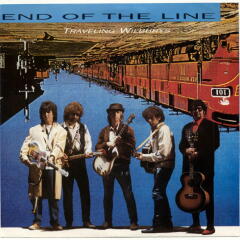
About the song
"End of the Line" was written by George Harrison, along with fellow Traveling Wilburys Bob Dylan, Tom Petty, Jeff Lynne and Roy Orbison. It was the final cut on their debut album, Traveling Wilburys Vol. 1, and the second single from the album, released in January 1989. Personnel on the record were: George Harrison (lead and backing vocals, acoustic and electric guitars, slide guitar), Tom Petty (lead and backing vocals, bass, acoustic guitar), Jeff Lynne (lead and backing vocals, acoustic and electric guitars), Roy Orbison (lead and backing vocals, acoustic guitar), Bob Dylan (lead and backing vocals) and Jim Keltner (drums). The video for "End of the Line" featured the Wilburys traveling on a train, with Roy Orbison's guitar shown rocking in a chair during his vocal parts as a tribute to Orbison, who died suddenly in December 1988, before the video was made.
Traveling Wilburys Vol. 1 was the debut album of American/British supergroup the Traveling Wilburys. Formed in Los Angeles in April 1988, the group included George Harrison, Bob Dylan, Tom Petty, Roy Orbison, and Jeff Lynne. Produced by Otis Wilbury (Jeff Lynne) and Nelson Wilbury (George Harrison), the album was recorded in the spring of 1988 at Dave Stewart Studios and Lucky Studios in Los Angeles, and Harrison's FPSHOT studio at Friar Park in England. It was released in October 1988, and went to #3 on the Billboard Top 200 Albums chart. The album won a Grammy Award for Best Rock Performance by a Duo or Group. The surviving members of the Traveling Wilburys made a second album — humorously entitled Traveling Wilburys Vol. 3 — which they released in October 1990. It went to #9 on the Billboard Top 200 Albums chart. No follow-up albums were released after this one, and the Traveling Wilburys never toured as a group. George Harrison passed away in 2001, and Tom Petty in 2017. A box-set collection of the two albums, including a DVD, was released by the Harrison estate in 2007. Bob Dylan still records and tours as a solo artist, as does Jeff Lynne with Jeff Lynne's ELO, a successor to the old Electric Light Orchestra, which Lynne had helped to form in 1970.




Comments
Won't oil that needs to go to either West/East coast need to use rail to get to their destinations? That's always been the argument for why SOME rail terminals will not be completely deserted. None of the proposed pipeline projects mentioned here go to either coast, correct?
In reply to West/East Coast Shipments by Scott Hubbell
The answer pre-empts the next episode - but Sandpiper pipeline will increase possibility of crude flows into Eastern Canada and Energy East will allow crude to reach the East Coast of Canada (and from there to the U.S. East Coast). Once you get direct pipeline competition with rail then rail movements are too expensive.