While crude oil producers in the prolific Permian Basin are living out a Shale Revolution, the Midcontinent region of the U.S. is having a Refining Renaissance. Crude takeaway constraints, mainly due to insufficient pipeline capacity, are driving the prices of crude in Western Canada and West Texas to attractive lows against the WTI NYMEX benchmark for crude at the Cushing, OK, hub. Cheaper oil can contribute to bigger margins for refiners, who are supplying increasing volumes into a retail market that’s selling gasoline at the highest prices in four years. What will happen if the refiners don’t rein in their runs? Today, we’ll explore the implications of record-high run rates in the U.S. refining industry.

Canadian crude output is rising, requiring new export routes. As traditional pathways face constraints, the U.S. Rockies—especially the Guernsey, WY hub—are emerging as key corridors for moving Canadian heavy crude to downstream markets, including the Gulf Coast.
Refiners will push themselves to the limit if they can access cheap crude — and right now Canada’s got a lot of it. As we outlined in What Does It Take?, the Canadian glut is primarily due to capacity constraints, which drive values lower. On the whole, the Canadians’ shipping woes are a long-term problem. There’s ongoing environmentalist backlash against plans to build new pipelines, and railroads are hesitant to work with oil companies unless multi-year contracts are signed. In spite of their reluctance, Canadian crude-by-rail is moving out of the country at the highest rate ever — Canada’s National Energy Board reported a record-high 199 Mb/d of railed crude exports for May.
Weaker Western Canadian Select (WCS) crude prices were temporarily eased by an outage at the 360-Mb/d Syncrude Canada upgrader in northeastern Alberta. The outage, caused by a power failure, started on June 20, and the facility has been gradually returning to normal service since July 24; it is expected to become fully operational in mid-September. The interruption also forced refiners to turn to alternative feedstock options, which has contributed to Cushing stockpiles dropping to nearly four-year lows. Figure 1 shows crude inventory levels in Cushing — also known as the “Pipeline Crossroads of the World” — over the past four years. Total oil storage at Cushing has dropped to the lowest level since October 2014.
About the song
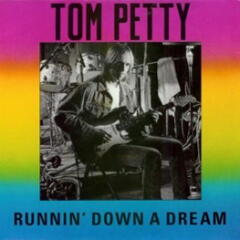
“Runnin’ Down a Dream” was written by Tom Petty, Mike Campbell and Jeff Lynne. It appears on Tom Petty’s first solo album, Full Moon Fever. It was released as a single in July 1989 and went to #1 on the Billboard Album Rock Tracks chart and #23 on the Billboard Hot 100. “Runnin’ Down a Dream” was also used in the video game “Grand Theft Auto: San Andreas” and has been used as the theme song for NASCAR on NBC.
Full Moon Fever was recorded at M.C. Studios (Mike Campbell’s garage studio), Sound City Studios, Rumbo Studios, Sunset Sound Studios, Devonshire Studios and Conway Studios in Los Angeles. It was produced by Tom Petty, Mike Campbell and Jeff Lynne, and was released on April 24, 1989. Tom Petty said Full Moon Fever was the most enjoyable record of his career. It reached #3 on the U.S. Billboard 200 Albums chart and went on to go platinum five times. The personnel on the record were: Tom Petty (lead and backing vocals, guitars, keyboards, and tambourine), Mike Campbell (lead guitar, bass, mandolin, slide guitar, Dobro, and keyboards), Jeff Lynne (bass, guitar, piano, synth, keyboards and backing vocals), and Phil Jones (drum and percussion). George Harrison, Jim Keltner, Benmont Tench, Howie Epstein, and Roy Orbison made guest appearances on the album.
Tom Petty was an American singer-songwriter, multi-instrumentalist and record producer. He was best known as the lead singer of Tom Petty & the Heartbreakers, the band that formed in 1976 from the ashes of his Gainesville, FL, band, Mudcrutch. He was also a co-founder of the Traveling Wilburys. During his career, he released three solo albums, 13 with the Heartbreakers, two with Mudcrutch, and two with the Traveling Wilburys. In 1996, Tom Petty received the UCLA Gershwin Award for Lifetime Musical Achievement and an ASCAP Golden Note Award. Tom Petty & the Heartbreakers received a star on the Hollywood Walk of Fame in 1999 and were inducted into the Rock and Roll Hall of Fame in 2001. They also received three Grammy Awards, three MTV Video Music Awards, and a Billboard Magazine Century Award. Tom Petty died at the age of 66 in Santa Monica, CA, in October 2017. He has sold over 30 million records worldwide.