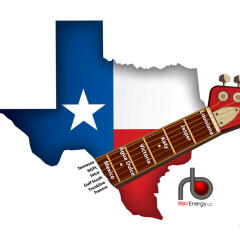
South Texas—and its primary trading hub, Agua Dulce—is emerging as the fulcrum for U.S. natural gas producers and growing demand markets on the Texas Gulf Coast and across the border in Mexico. Between the Freeport and Corpus Christi LNG export projects and cross-border pipeline projects to Mexico, nearly 4.0 Bcf/d of export capacity is being developed in South Texas over the next few years. Meanwhile, U.S. producers as far north as the Marcellus/Utica are jockeying to capture this new demand. Large investments are being made to expand and reverse traditional pipeline flows across the Texas-Louisiana border to get gas all the way down to South Texas and the Texas-Mexico border. But will enough capacity be available when the demand shows up? Today, we break down the natural gas supply/demand picture in South Texas and what it will take to balance the market there as exports ramp up.
In recent months, we’ve written in the RBN blogosphere and more extensively in our “I Saw Miles and Miles of Texas” Drill Down series about rising natural gas demand along the Texas Gulf Coast and across the border in Mexico and the resulting changes to the U.S. supply, demand, flow and pricing dynamic––not to mention the substantial overhaul of the long-haul pipeline infrastructure required in the eastern half of the country to accommodate it. The emerging export demand is expected to be one of the biggest drivers of natural gas production growth over the next several years and is already propelling massive investment in natural gas infrastructure, including wholesale reversals of legacy pipelines in the U.S. But, as we’ve detailed in Part 1, Part 2, and Part 3 of the Drill Down series, this transition is facing substantial challenges, with the potential to create a good deal of volatility along the way.
Much of the emerging export demand in the next few years will arise at the “end of the line” near the southern-most tip of Texas. But nearby production from the Eagle Ford Shale has been in decline over the past couple of years. While Northeast producers are eager to fill the void, actually getting the gas there is a challenge. Simply put, that’s a long way down for gas to move, especially on pipeline infrastructure originally designed to move gas south to north. Thus, Northeast producers’ aspirations of capturing a significant portion of the new demand will hinge on the availability of pipeline capacity to South Texas.

About the song
“What It Takes,” written by Steven Tyler, Joe Perry and Desmond Child, is a power ballad from the Aerosmith album Pump. The song went to #1 on the Billboard Mainstream Rock Tracks chart and #9 on the Billboard Hot 100 after its release in December 1989.
Pump was Aerosmith's 10th studio album. Released in September 1989, the LP was recorded earlier that year at Rik Tinory Productions in Boston and Little Mountain Sound in Vancouver, with Bruce Fairbairn producing. Six singles were released from the record, with three going to #1 on the Billboard Mainstream Rock Tracks chart, and three making it to the Top 10 on the Billboard 100. The single “Janie's Got a Gun” won Aerosmith its first Grammy Award. Personnel on the record were: Steven Tyler (lead vocals, guitar, keyboards, harmonica), Joe Perry (guitar, slide guitar, backing vocals), Brad Whitford (guitar), Tom Hamilton (bass, backing vocals) and Joey Kramer (drums).
Aerosmith is an American rock band formed in Boston in 1970. The group, which has been inducted into the Rock and Roll Hall of Fame, has made 15 studio albums, six live albums, 12 compilation albums, two EPs and 76 singles. Aerosmith has won six American Music Awards, four Billboard Awards, four Grammy Awards and 10 MTV Video Music Awards. The band has sold more than 150 million records worldwide and still records and tours, with its 2022 tour set to begin in Lisbon, Portugal, on June 1.