The uncertainties around solar power are well understood — when the sun doesn’t shine as much as expected, power grids that rely heavily on that generation must turn elsewhere to meet consumer demand. And while a shortfall in solar generation can be challenging to navigate, the difference between actual and forecast levels is typically only a few percentage points and power grids are usually ready and able to make up any difference. But what happens when the sun is largely obscured by the moon for several hours across a wide swath of the country? In today’s RBN blog, we’ll discuss the impact of the October 14 partial eclipse, preview the path of the April 8 total eclipse, and outline the steps being taken to ensure that power grids are ready for it.

Figure 1. Types of Solar Eclipses. Source: American Astronomical Society
The replay of our Fall 2026 School of Energy (September 9 & 10, Houston) is now available online!
Learn from RBN experts, participate in hands-on Excel modeling, connect with industry peers, and gain a stronger understanding of today's interconnected energy markets.
Before we get too far into any discussions about the April eclipse’s impact on solar generation and the power grid, let’s review some basic definitions. A solar eclipse occurs when the moon passes between the sun and the Earth, casting a shadow on the Earth that either fully or partially blocks the sun’s light in some areas. During an annular solar eclipse (far right in Figure 1 above), like the one last October (see Total Eclipse of the Heart), the moon is not big enough to cover the entire sun. This happens when the moon is farthest away from the Earth. The sun’s outer edge remains visible and forms a “ring of fire” in the sky, although most sunlight will be blocked in the eclipse’s path. During a total solar eclipse (far left), like the one happening April 8, the moon completely covers the sun. This takes place when the moon’s orbit is closest to the Earth. A total solar eclipse is only visible if you are in the path where the moon casts its darkest shadow. (If you are outside the eclipse’s path on April 8, the sun will only be partially obscured.) A partial solar eclipse (middle) occurs when the moon obscures a portion of the sun. (There is also a hybrid solar eclipse, which occurs when the same eclipse changes from annular to total — or the reverse — along its path. It’s the rarest type of eclipse.)
About the song
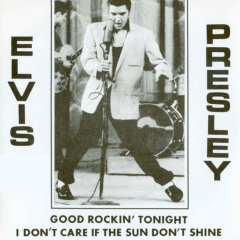
“I Don’t Care if the Sun Don’t Shine” was written by Mack David (the older brother of American lyricist and songwriter Hal David). It appears as the B-side of the Sun single by Elvis Presley featuring “Good Rocking Tonight” on the A-side. The song was recorded and produced by Sam Phillips at Sun Studio on September 10, 1954, and released as a single on Sun Records on September 25, 1954, which shows how much faith Sun Records head Sam Phillips had in the power of Elvis from the beginning. Mack David wrote the song for the 1950 Disney animated feature Cinderella but it didn’t make the final edit for the film. Patti Page released a single of the song on Mercury Records in 1950 that made it to #8 on the Top Ten, her first hit record. Her version of the song later appeared in the film Priscilla, Queen of the Desert. Dean Martin recorded it for Scared Stiff, a 1950 comedy film he co-starred in with Jerry Lewis. (Elvis was a big fan of Dean Martin.) Elvis’s version appears as the third song on side one of the album, Elvis, The Sun Sessions. Released in March 1976 by RCA Records, it went to #2 on the Billboard Country Albums chart. Personnel on the Presley version were: Elvis Presley (vocals, acoustic guitar), Scotty Moore (electric guitar), Bill Black (acoustic bass), and Buddy Cunningham from The Blue Moon Boys (cardboard box).
Elvis Presley was an American rock and roll singer and actor. Referred to by many as “The King of Rock and Roll,” he was an iconic figure who changed the culture of popular music in his time. He released 22 studio albums, eight live albums, 13 compilation albums, 18 soundtrack albums, 29 EPs and 141 singles and has sold more than 500 million records worldwide. Elvis also starred in 31 feature films and five concert films. He is a member of the Rock and Roll Hall of Fame, has a Grammy Lifetime Achievement Award, three Grammy Awards, a Presidential Medal of Freedom, and has a star on the Hollywood Walk of Fame. Presley died at his Graceland home in Memphis in August 1977 at the age of 42.