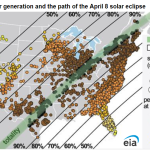
Monday’s solar eclipse will travel from Texas through the Midwest and up to New England, blocking out all direct sunlight for more than four minutes and obscuring the sun for more than two hours for those in the eclipse’s path of totality — where the moon will completely block the sun — but will diminish solar generation across the Lower 48, presenting challenges for power grids across the country.
Texas will lose the most solar generating capacity because most of the state is in the path that will lose 90%-99% of solar power (dark-red dots on map below) during the eclipse. Although most of California is in the 40%-59% partial reduction range (yellow dots), the state’s widespread use of utility-scale and small-scale solar capacity makes the eclipse’s impact more significant. (Both states were impacted by the "Ring of Fire" eclipse in October 2023; for more on how those states managed the October eclipse and are preparing for the next one, see Total Eclipse of the Heart and I Don’t Care if the Sun Don’t Shine.)