

Amid the partisan schisms dominating political debate as Election Day approached, a dramatic shift in public opinion on a single issue drew bipartisan support: opposition to data centers. The unprecedented surge in state legislation and regulation to stall or ban future development included Texas Governor Greg Abbott’s moratorium on new data center grid connections, which his successor, Governor-elect Gina Hinojosa, is expected to continue. In today’s RBN blog, we review the disruption caused by the Texas moratorium, how it might change as the state moves into new leadership, and assess its potential impact on the multibillion-dollar, off-grid megaprojects in development by hyperscalers like Amazon and Microsoft.
Large-scale data center development began in the mid-2010s and accelerated late in the decade as cloud computing, or delivering applications through the web, took shape. However, it reached a “boom” phase in 2022 as AI workloads exploded. Initial public reaction was mildly positive, focused on general benefits such as tax revenue and job growth, but it turned sharply negative. State lawmakers across the U.S. introduced data center legislation at unprecedented levels as public opposition intensified. According to The Washington Post, more than 375 bills mentioning data centers have been introduced in 2026 — exceeding the combined total from the previous three years. There were 41 measures related to data centers on the ballot November 3 across 13 states, with nearly all proposals designed to block or restrict development headed for passage, according to Ballotpedia, most by wide margins.
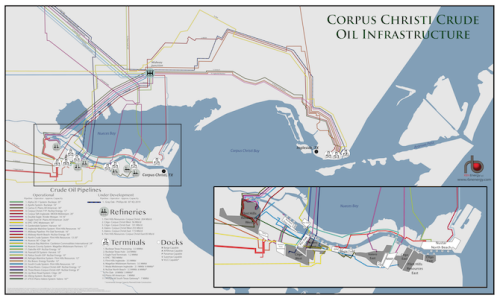
Gain insight and clarity into one of the United States’ most strategic Crude Oil Export Markets with RBN Energy’s Corpus Christi Crude Oil Infrastructure wall map.
Amid the shift in public sentiment, New York Governor Kathy Hochul enacted a one-year moratorium on new large-scale data centers in July, while major restrictions were imposed by states with significant past development, including Illinois, Pennsylvania, Virginia and West Virginia. However, the most significant may be the moratorium on new data center grid connections in Texas, the largest and fastest-growing data center market (see God Blessed Texas), as projected demand surged. Abbott sent a letter to the Electric Reliability Council of Texas (ERCOT) on August 3, in which he directed the agency to perform a data center audit and pointed to “recent legislative hearings and public meetings” that “raised important questions regarding the impact of data centers on the grid and on the local communities in which they operate or seek to operate.”
The shift in policy came after an intense lobbying push against data center development in the state, including a contentious 15-hour public hearing. Concerns have been amplified because the reliability of the Texas grid has been challenged during major severe weather events in recent years, most notably 2021’s Winter Storm Uri, which led to efforts to strengthen the grid’s reliability while also balancing costs. The governor, who was seeking a fourth term, had previously hailed Texas as “the epicenter of AI development” after Google announced a $40 billion investment in the state.
Under the new directive, ERCOT’s audit will examine whether data centers are providing their own power or depending on the grid; their use of water; and which data centers are utilizing state or federal assistance such as tax incentives, grants or abatements. “Any data center project that fails to comply with the verification and audit process to protect the reliability and resilience of the Texas electric grid must be denied,” the governor said in his letter.
Abbott followed the August announcement with a September 21 directive to the Texas Commission on Environmental Quality (TCEQ) to halt all permits sought by data centers until ERCOT completes its audit of proposed projects. ERCOT is expected to release two reports on December 10. One would list the projects that qualify for its Batch Zero process (more on that below); the other would cover the impact of medium- and large-sized data centers on local communities, with an open meeting of the Public Utility Council of Texas (PUCT) to follow on December 17.
Hinojosa’s platform during the campaign went a step further. The governor-elect called for Abbot to impose the moratorium in July and said in October that she would ban all data center approvals until the Texas Legislature passed laws to address concerns in several areas, including protections for power and water resources, enhanced control for communities impacted by data center developments, provisions to ensure that developers cover infrastructure costs without increasing households’ electricity or water bills, and an end to tax incentives. The Legislature’s next session begins January 12 and runs through May 31. Hinojosa will be sworn in as governor on January 19.
(We should note that Keisha Lance Bottoms and Amy Acton, Democrats that were elected governor in Georgia and Ohio, respectively, on November 3 also proposed moratoriums during the campaign, with differing conditions. Both states are major data center hubs. Georgia ranks third nationally in planned facilities, while Ohio ranks fourth in operating facilities, according to a Pew Research Center analysis earlier this year.)
Data Centers and ERCOT
According to the most recent ERCOT report, large-load interconnection requests total about 466 GW, which is more than 5X Texas’s highest record peak electricity demand. Approximately 90% of the new power requests are related to data centers (blue bar segments in Figure 1 below), with much smaller shares related to cryptocurrency (orange bar segments), industrial sites (gray bar segments) and other facilities (yellow bar segments). The large-load queue has soared over the last year, more than tripling from 136 GW in Q3 2025 to 466 GW in Q3 2026. The number of data center-focused projects has more than quadrupled, from 98 (72% of the total) to 421 (90% of the total) over the same period.

About the song
“Get Off of My Cloud” was written by Mick Jagger and Keith Richards and appears as the first song on side two of The Rolling Stones’ fifth American studio album, December’s Children (And Everybody’s). The band recorded it at RCA Studios in Hollywood as a follow-up single to the mega-hit “(I Can't Get No) Satisfaction.” The Dylan-esque rapid-fire lyrics in the song address frustration and the desire for personal space and freedom. There are no guitar solos presented, but the interplay between Keith Richards’ and Brian Jones’ rhythm guitar parts is worth noting. Released as a single in September 1965, it went to #1 on the Billboard Hot 100 Singles chart. Personnel on the record were: Mick Jagger (lead vocals). Keith Richards (guitar, backing vocals), Brian Jones (guitar), Bill Wyman (bass), Charlie Watts (drums) and Ian Stewart (piano).
December’s Children (And Everybody’s) is primarily a collection of different tracks released by The Rolling Stones up until that point. It features the hit song “Get Off of My Cloud,” along with their version of the Jagger/Richards-penned Marianne Faithful hit, “As Tears Go By.” The tracks were recorded at RCA Studio in Hollywood, Decca and IBC in London, and Chess in Chicago, and produced by Andrew Loog Oldham. The album was released in November 1965 and went to #4 on the Billboard 200 Albums chart. It has been certified Gold by the Recording Industry Association of America. Two singles were released from the LP.
The Rolling Stones are an English rock band formed in London in 1962 by vocalist Mick Jagger, guitarists Keith Richards and Brian Jones, bassist Bill Wyman, drummer Charlie Watts, and pianist Ian Stewart. Stewart was relegated to a session player on Rolling Stones records by their manager, Andrew Loog Oldham, in May 1963. After six decades, the Rolling Stones are one of the most influential rock bands still playing and recording. They have released 27 studio albums, 39 live albums, 28 compilation albums, three EPs, and 125 singles. They have sold over 250 million records worldwide. They have won a Billboard Music Award, five Grammy Awards, three MTV Video Music Awards, and a World Music Award. They are members of the Rock and Roll Hall of Fame, UK Music Hall of Fame, Grammy Hall of Fame, and they have a Grammy Lifetime Achievement Award. Mick Jagger was knighted in December 2003. Eight members have passed through the band since its formation. Brian Jones died in 1969. Ian Stewart, who played an important part in the band early on but was never an official member, died in 1985. Charlie Watts died in 2021. Bill Wyman retired from the band in 1993. Mick Taylor left the group in 1974. Jagger, Richards and Ron Wood continue to record and tour as The Rolling Stones. Their latest album, Foreign Tongues, was released in July.
"About the Song" -- written by Mickey McMahan , RBN Director of Musicology