


In the three years since the deadly electrical outages caused by Winter Storm Uri, the Texas Legislature, the Public Utility Commission of Texas (PUCT), and the Electric Reliability Council of Texas (ERCOT) have been working overtime to design and implement changes to ensure a more reliable Texas power grid. But it hasn’t been easy. The state’s energy-only electricity market and its outsized reliance on intermittently available wind and solar power have forced policymakers, regulators and the electric-grid operator to develop a wide range of fixes aimed at maintaining a competitive atmosphere while at the same time incentivizing market players to have power available when it’s needed most. In today’s RBN blog, we look at what they’ve been up to.
Texas is the energy state. It produced 42% of the U.S.’s crude oil, 25% of its natural gas and more than 12% of its electricity in 2022 — tops among the states in all three categories. Given its large industrial base, Texas is also the largest energy-consuming state. The industrial sector comprises roughly a third of the nation’s refineries, three-quarters of basic U.S. chemical production capacity, and a growing number of semiconductor manufacturing plants. Texas industrials account for more than half of the state’s electricity consumption and 23% of the nation’s total industrial use. Maintaining a low cost of electricity is essential for these industries, making it more critical to the Texas economy — and jobs — than any other state. (For more on Texas and ERCOT, see Wind of Change and Which Way Does That Old Pony Run.)

The Natural Gas Master Class is a one-day online event focusing on understanding flow analysis, interpreting pipeline data and forecasting future flows. This course is designed to equip you with the knowledge and skills to effectively analyze the complexities of natural gas markets, flow analysis, and pipeline modeling. Join us online
October 21 | Online
ERCOT, which is responsible for about 90% of the state’s electricity service, is an energy-only wholesale market and does not have a capacity market, meaning that generators are only paid for the energy they provide to the grid. (In a capacity market — the dominant type of system in other organized power markets — generators are also paid a fixed fee for guaranteeing their power will be available when needed.) The PUCT has long relied on high scarcity pricing (i.e., occasional energy prices of hundreds or even thousands of dollars per megawatt-hour, or MWh) to help ensure that sufficient dispatchable, flip-on-a-switch generation is available during periods of high demand. However, between 2006 and 2011 — a period when peak demand increased by almost 8 gigawatts (GW), dispatchable generation in ERCOT decreased by roughly 3 GW — 7 GW of older natural gas-fired generation was closed, partially offset by roughly 4 GW of coal and nuclear additions.
ERCOT experienced rolling outages twice in 2011 during extreme weather events, first during an ice storm in February. Then, for two days that summer, ERCOT shed interruptible load and Austin Energy, the large municipal utility, implemented rolling blackouts for at least four hours. With the lights out at dusk but no critical issues with the power grid, many in the state capital took the opportunity to head outside with a glass of wine for an old-fashioned neighborhood gathering.
After the outages in 2011, the PUCT approved gradually increasing the systemwide offer cap — or the maximum price paid to generators during scarcity pricing — to $5,000/MWh in 2013, $7,000/MWh in 2014, and $9,000/MWh in 2015 to help ensure there would be enough dispatchable generation around to deal with demand spikes. But higher scarcity pricing failed to spur the development of additional gas-fired resources — between the winters of 2011-12 and 2021-22, thermal generation fell by an additional 3 GW, intermittent wind and solar capacity grew by leaps and bounds, and peak demand grew by more than 9 GW, leaving the ERCOT system increasingly vulnerable to extreme weather.
The deadly electrical outages during the Perfect Storm — Winter Storm Uri in February 2021 — created a political force prioritizing reliability in Texas. Outages in the ERCOT region spanning three days contributed to at least 210 deaths and more than $80 billion of financial losses as pipes burst in unheated homes and businesses and homes burned down as some residents even ignited furniture to stay warm. (For more about Uri’s impact, see Feed Me, Terminal Frost, and East is East, West is West, among others.) During the storm, the ERCOT grid almost collapsed as 28 GW of generating capacity from coal, natural gas and nuclear generation (black, blue and brown layers, respectively, in Figure 1 below) went offline — or about one-third of ERCOT’s total capacity of about 83 GW. Wind generation (green layer) also faced issues, with production falling to less than 10% of nameplate capacity on February 17 (dashed yellow oval) and solar performance (yellow layer) dropped to about 6%.
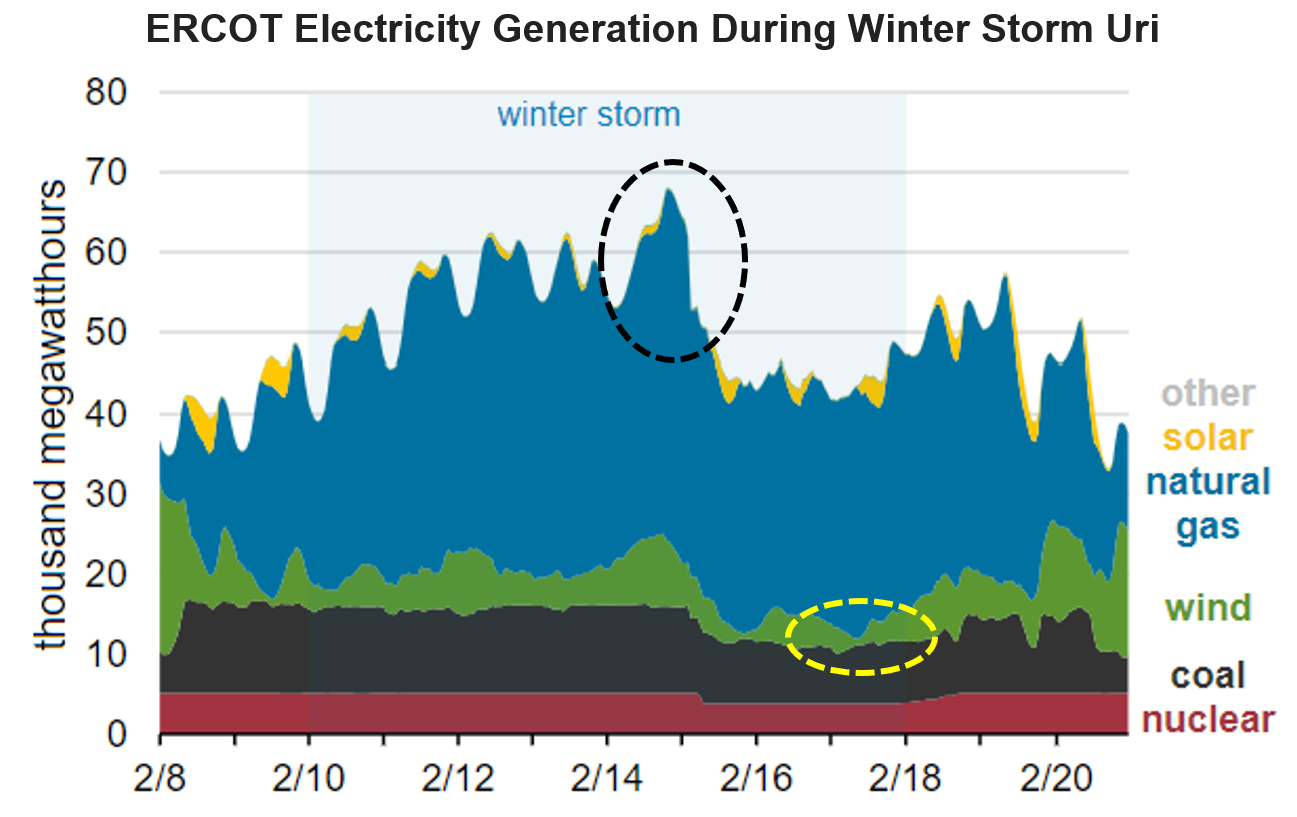
Figure 1. ERCOT Electricity Generation During Winter Storm Uri. Source: EIA
About the song
“Electric Avenue” was written by Eddy Grant and appears as the first song on Eddy Grant’s sixth studio album, Killer on the Rampage. Released as a single in early 1983 and buoyed by heavy video rotation on MTV, the song went to #2 on the Billboard Hot 100 Singles chart. Grant wrote the song in response to the 1981 Brixton riots in South London. In 1997 the Refugee Camp All-Stars released a cover of the song that went to #35 on the Billboard Hot 100 Singles chart.
Killer on the Rampage was recorded at Blue Wave Studios in Barbados and produced by Eddy Grant. It was released in late 1982 and went to #10 on the Billboard Top 200 Albums chart. It remains Grant’s best-selling album to date. Three singles were released from the LP.
Eddy Grant is a Guyanese-British singer, songwriter, multi-instrumentalist, and record producer. In 1965, Grant was a founding member of The Equals, the first interracial rock band in the UK. They released 11 studio albums and 26 singles. “Baby Come Back” was their biggest single, going to #32 on the Billboard Hot 100 Singles chart in 1968. The Clash covered Grant’s “Police on My Back” from The Equals’ Baby Come Back LP, and included it on their 1980 album, Sandinista! Grant has released 15 solo studio albums, one live album, 13 compilation albums, and 19 singles. He continues to record.





Comments
With population and industrial grwoth, addressing the demand side only is a fruitless "chasing your own tail" exercize. Until retail consumer incentives exist to reduce demand and the problem of resistive home heating is solved, extreme weather events will continue to stress the electrical infrastructure.
In reply to ERCOT by Stan Polak
While heating using natural gas is most efficient, resistive heat is stickier than one would think despite subsidies especially as more people rent.