There’s no doubt about it: California’s decade-long efforts to expand the use of solar, wind, and other renewable energy and improve energy efficiency have enabled the state to significantly reduce its consumption of natural gas for power generation. But the Golden State’s rapid shift to a greener, lower-carbon electricity sector — and its push to shut down gas-fired power plants — has come at a cost, namely an increased risk of rolling blackouts, especially during extended heat waves in the West when neighboring states have less “surplus” electricity to send California’s way. The main problem is that while solar facilities provide a big share of the state’s midday power needs, there’s sometimes barely enough capacity from gas plants and other conventional generation sources to take up the slack when the sun sinks in the late afternoon and early evening. Today, we discuss recent developments on the power front in the most populous state, and what they mean for natural gas consumption there.

Canadian crude output is rising, requiring new export routes. As traditional pathways face constraints, the U.S. Rockies—especially the Guernsey, WY hub—are emerging as key corridors for moving Canadian heavy crude to downstream markets, including the Gulf Coast.
The biggest news out of California these days, of course, is the wildfires that have devastated parts of the state and blanketed much of the region in an eerie orange haze. And there’s COVID-19 — no small matter. As if these weren’t enough, another leading concern of state officials, businesses, and individuals alike is the heightened potential for power interruptions. In the midst of a prolonged heat wave last month, the state’s electric grid operator, faced with sky-high power demand and insufficient power supply, ordered rolling blackouts for the first time since 2001. The impacts may not seem huge from the outside looking in — a few hundred thousand customers without electricity for an hour or two at a time — but tell that to the manager of an affected factory, Home Depot, or supermarket, or to parents wanting to prepare dinner on an electric range in their normally air-conditioned home when it’s 104° outside. More importantly, the rolling blackouts confirmed the fears of many that California’s plan to de-carbonize the power sector, while well-intentioned, may be too aggressive and may fail to adequately ensure grid reliability.
As shown in Figure 1, California’s electric utilities, independent power companies, and other power generators have reduced their consumption of natural gas by leaps and bounds over the past eight years as the state ratcheted up its efforts on energy efficiency and renewables. The state’s “power burn” — i.e., gas consumed by combined-cycle, peaking, and cogeneration plants to produce electricity — varies by season and by year, mostly due to weather and air-conditioning needs, but average gas consumption by the electric sector has been declining steadily. Since 2012, when California’s power burn averaged 2.34 Bcf/d in 2012 (blue bar to far left), the electric sector’s gas consumption there has fallen by more than one-third, averaging 1.58 Bcf/d in 2019 and 1.28 Bcf/d in the first half of 2020 (blue bar to far right).
About the song
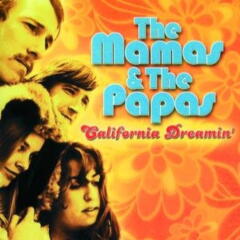
"California Dreamin'" was written by John and Michelle Phillips, and it appears as the first song on side two of The Mamas & The Papas’ debut studio album, If You Can Believe Your Eyes and Ears. A little-known fact about this song is that it was originally recorded and released by Barry McGuire, with The Mamas & The Papas singing backing vocals on it. After it failed to become a hit, producer Lou Adler, who worked with McGuire and The Mamas & The Papas, erased McGuire's vocals on the recording and added The Mamas & The Papas’ Denny Doherty singing the lead. After adding a guitar intro and alto flute solo, Adler re-released the song as a Mamas & Papas single in December 1965. If you listen closely to the song in headphones, on the left side, you can hear a snippet of McGuire's original lead vocal as the song begins. It went to #4 on the Billboard Hot 100 Singles chart and has been certified Gold by the Recording Industry Association of America (RIAA). The song was inducted into the Grammy Hall of Fame in 2001. Many artists have covered the song since its initial release. Personnel on the record were: Denny Doherty (lead vocals), John Phillips (backing vocals), Michelle Phillips (backing vocals), Cass Elliot (backing vocals), P.F. Sloan (guitar), Joe Osborn (bass), Hal Blaine (drums), Larry Knechtel (keyboards), Peter Pilafian (electric violin), and Bud Shank (alto flute).
If You Can Believe Your Eyes and Ears was recorded at Western Studios in Hollywood in late 1965 and early 1966. Produced by Lou Adler, the album was released in February 1966 and went to #1 on the Billboard Top 200 Albums chart. Four singles were released from the LP, which has been certified Platinum by the RIAA.
The Mamas & The Papas were an American folk rock vocal group formed in Los Angeles in 1965. They have sold more than 40 million records worldwide and have released five studio albums and 17 singles — six of the singles made the Top 10. The Mamas & The Papas are members of the Rock and Roll Hall of Fame and the Vocal Group Hall of Fame. The band officially broke up in 1969, with all four members going on to solo careers. Cass Elliot died in 1974, John Phillips in 2001, and Denny Doherty in 2007. Michele Phillips has continued to have a successful career as an actress.