


Two companies that own Jones Act tankers went through bankruptcy in recent years as the charter business declined following the Great Recession. They are Overseas Shipping Group (OSG) that own two US flag tankers and manage another ten and the smaller US Shipping Corp that owns three Jones Act tankers. These days the surge in US crude production has created strong demand for Jones Act tankers and record charter rates for owners. Now tankers once dedicated to the Alaska trade between Valdez and the West Coast are being considered for crude shuttle duty around the Lower 48. Today we continue our review of US Flag fleet owners.
In the first episode in this series we described the regulations of the Jones Act that restricts marine transport between US inland and coastal ports to US Flag vessels (see The Jones Act Coastal Trade). Just 42 self propelled tanker vessels – the majority of which carry about 300 MBbl of refined products or crude oil ply US coastal waters. In episode two we began a deep dive look at the Jones Act tanker fleet and its ownership. This time we round out coverage of the Jones Act tanker fleet owners with a look at Overseas Shipping Group and the ExxonMobil, BP and Conoco Alaska fleets.
Overseas Shipping Group (OSG)
OSG is a publically traded crude and refined product transportation company that owns and manages vessels in the international and US Flag markets. The company is currently in Chapter 11 Bankruptcy proceedings (since November 2012) but continues to operate while its debts are restructured. The company manages ten Jones Act tankers and owns two – a business that is now highly profitable – thanks to surging demand for US domestic crude transport and a limited supply of qualified vessels. As we pointed out in the first episode of this series, charter rates for Jones Act tankers have doubled since the start of 2012 to over $100,000/day. OSG manages 10 Medium Range (MR) tankers for American Shipping Company (AMSC) under an “Evergreen” long-term bareboat charter that does not expire until 2019. The bareboat charter terms involve a fixed $88 million annual payment from AMSC to OSG plus 50 percent of additional charter profits over operating costs.
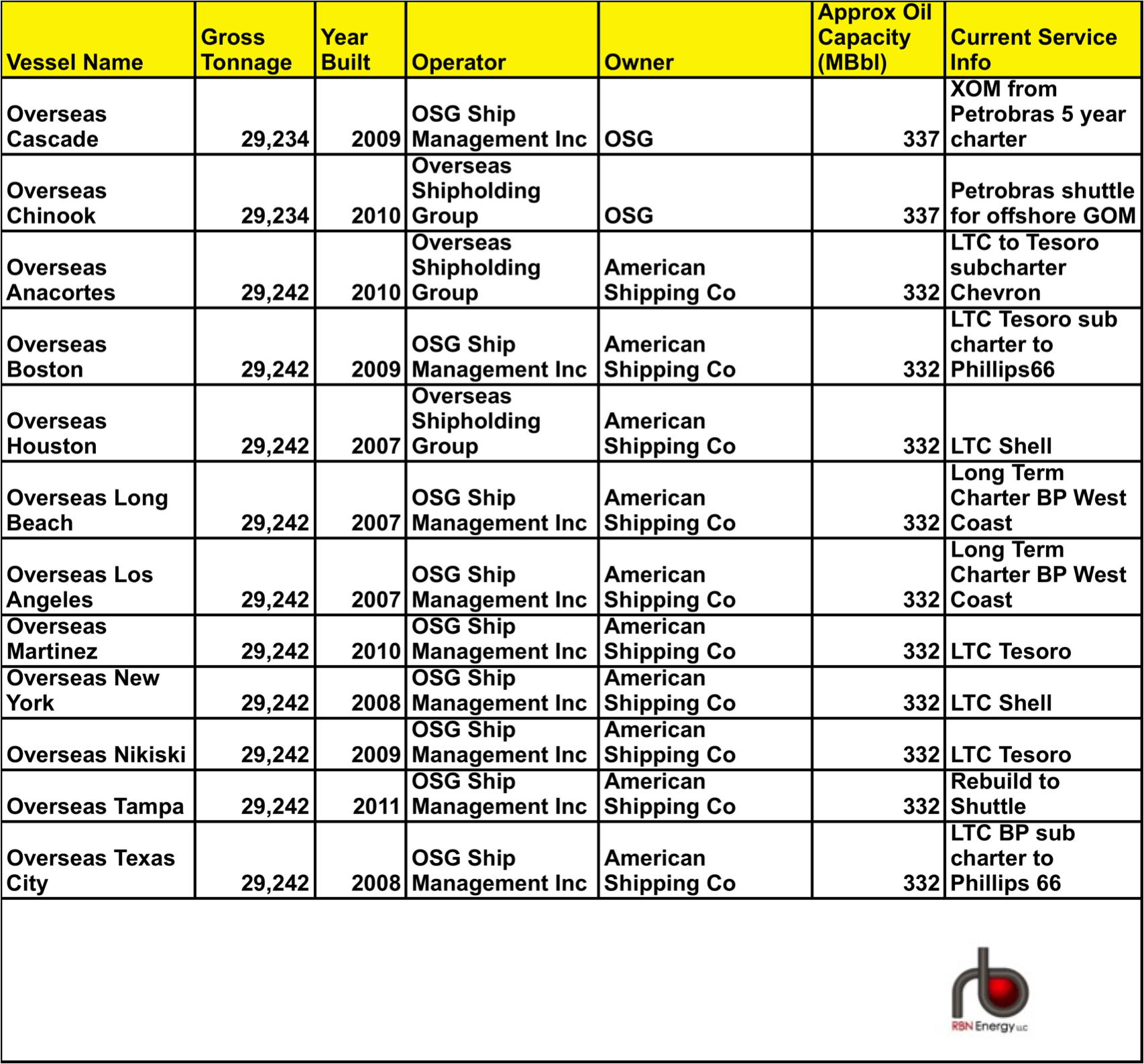
The table below shows the OSG and AMSC fleet. OSG own two MR Jones Act tankers – the Overseas Cascade and Overseas Chinook that are under long term charter to Brazilian national oil company Petrobras serving as shuttle tankers for that company’s offshore Gulf of Mexico (GOM) oil rigs. According to a Reuters story in December 2013, Petrobras has chartered the Overseas Cascade for two successive six month terms – the last time for $110,000/day. If that is the case then we guess Petrobras are managing without one of these tankers in the GOM in order to cash in on high demand for its use in the coastal crude trade. The ten vessels that OSG manage for AMSC (indicated in the “owner” column on the table all have the same capacity (332 MBbl) and are under long term charter (LTC) to oil companies Shell, BP and Tesoro that originally used them to move refined products along the West Coast. Two of the vessels, the Overseas Texas City and Overseas Boston have been sub chartered to Phillips 66 that uses them to ship crude from the Eagle Ford in South Texas to their Bayway refinery in Linden New Jersey.
Source: RBN Energy





Comments
"there’s a huge hunger for yield and a perception that U.S shipping can provide, it reflects in some way the situation" -Andy Dacy, JP Morgan
"In July 2011, the company ordered two new “liberty Class” crude oil tankers to be built at Aker Philadelphia Shipyard, due to be delivered in 2014, to replace the Kodiak and Sierra that were built 35 years ago."
Does anyone know if Kodiak and Sierra will be retired and taken out of service? Or will they be sold to another operator?
Kodiak and Sierra are to be send to the breaker. (35 years of services) = no residual value because you can't recuperate the Jones Act title and transfer it to a new ship.
The only way I see to get a JA is this exception, you recover a foreign flag vessel in the U.S Waters and it is a "constructive total loss", you then fix it in a U.S yard so you can make it US with all Jones Act privileges. I hope my answers will help you.Simon Jones Act and Freight and Energy Markets http://jacquessimon506.wordpress.com/2013/04/21/jones-act-the-impacts-on-freight-and-energy-markets/