


In December 2013 US Midstream giant Kinder Morgan agreed to spend nearly $1 Billion to get into the oil tanker business by buying two companies that own 5 US registered “Jones Act” vessels and are in the process of building 4 more. These tankers are part of an exclusive fleet of just 42 self propelled ocean going vessels that deliver oil or refined products between US ports. Booming US crude production along with constrained onshore delivery infrastructure have increased demand for tankers that can ship oil along coastal waters. Long-term charter rates for these tankers jumped to over $100,000/day in 2013 compared to an average of $56,000/day in 2012. Today we begin a blog series looking at the US flagged tanker fleet and plans to expand it by 35 percent in the next 2 years.
We posted a blog about the terms of the 1920 Merchant Marine Act – known by the industry as the Jones Act - back in October 2012 (See The Sea and Mr. Jones). The Jones Act is a federal statute that regulates maritime commerce in U.S. waters and between U.S. ports. Section 27 deals with cabotage (coastal shipping) and requires that all goods transported by water between U.S. ports have to be carried in U.S.-flag ships, constructed in the United States, owned by U.S. citizens, and crewed by U.S. citizens and U.S. permanent residents. The bottom line is that Jones Act vessels can be 2.7 times more expensive to operate as non-flag alternatives (source: US Maritime Administration (MORAD) study 2011) because of the regulations. And that has a big impact on shipping costs to move crude or petroleum products by water between US ports. In addition a shortage of available Jones Act vessels due to the small size of the fleet also imposes higher costs on shippers due to the tight supply of ships.
All of which has become a lot more significant over the past three years as burgeoning US crude production has encouraged producers and shippers to turn to inland and coastal waterway transport to bypass congestion on dry land. In addition to oceangoing vessels the Jones Act also covers inland barge movements that are increasingly being used to deliver crude oil from rail offloading terminals located in the Midwest and on the Gulf Coast to refineries. We described the two main barge markets – along inland waterways that support smaller 10 MBbl to 30 MBbl barges – and coastwise barges that range in size from 30 MBbl to large 185 MBbl articulated barge (ATB) vessels in our “Good Year For the Barges” series (see Part 1 and Part 2).
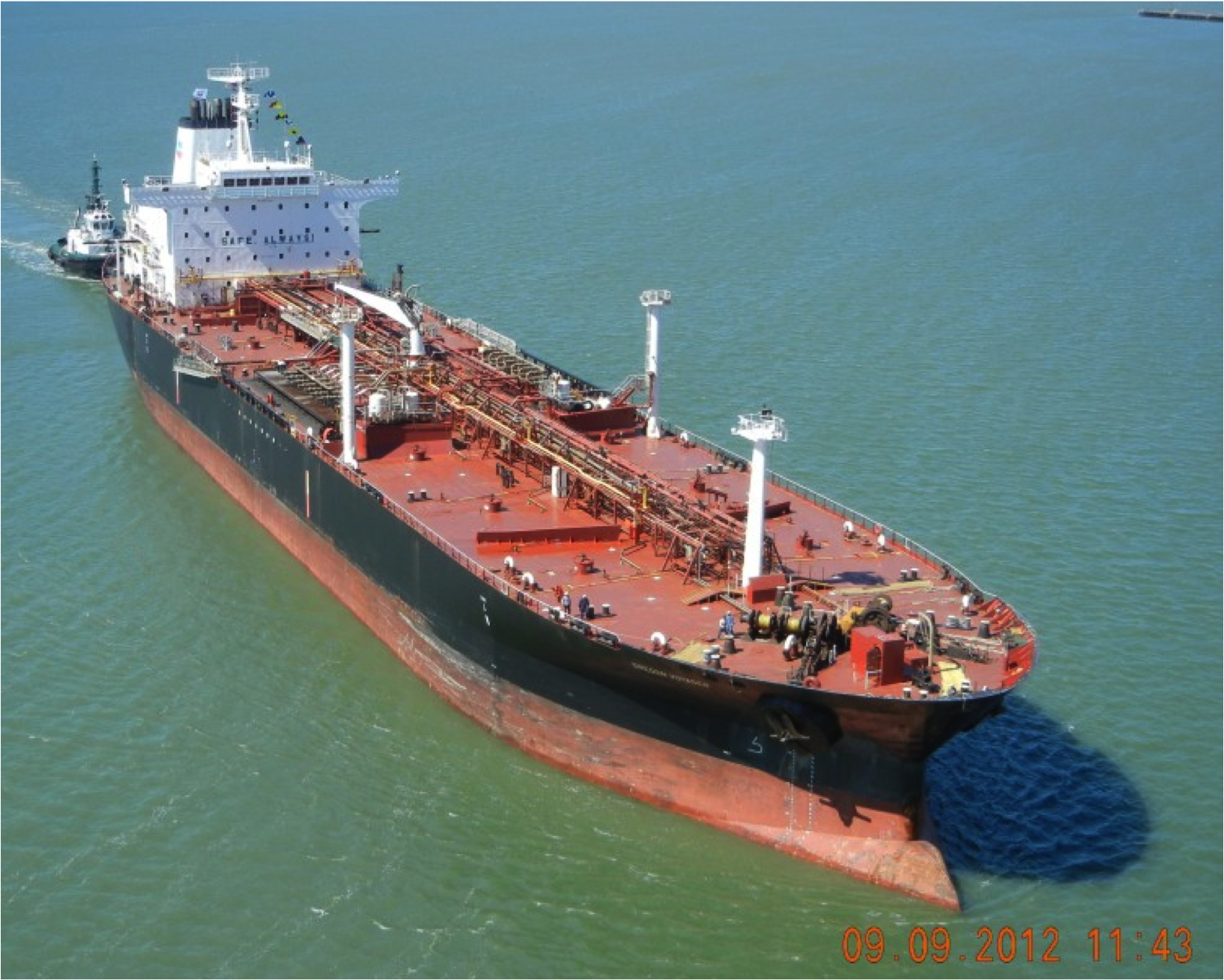
This blog series provides a deeper dive into the Jones Act coastal tanker fleet that currently consists of just 42 large vessels capable of carrying crude oil or refined products over longer distances along US Coastal waters. There are two types of vessels involved in this coastal trade – first are the 42 tankers - that operate under their own power and can carry anywhere from 200 MBbl to 1.3 MMBbl of crude oil or refined products. The picture below is of the Oregon Voyager – a typical Medium Range (MR) 340 MBbl tanker that is longer than two football fields and is operated by a crew of 29. There are 31 medium range tankers in the Jones Act fleet. The second vessel type used for large ocean going movements are about 18 large articulated barges (ATB) that are pushed by tug boats and carry over 180 MBbl. We look first at the tankers and will get back to the ATB’s later in the series.
Source: www.shipspotting.com
Until three years ago, Jones Act tankers were primarily used to carry refined petroleum products between US ports on the East and West Coasts. Only the eleven largest tankers carried crude oil and those operated exclusively between Valdez, Alaska and the US West Coast, delivering Alaska North Slope (ANS) crude to Washington State and California refineries (see After the Oil Rush). Now a growing number of the Medium Range (MR) vessels have been profitably switched from moving refined petroleum products to carrying crude oil. As a result of this new interest, tanker charter rates have been on a tear and are expected to continue their upward momentum. The chart below shows data from American Shipping Company (ASC – they operate 10 Jones Act tankers) for historical and projected time charter rates. The charter rates are shown in $’000/day and were around $70,000/day at the end of 3Q 2013 up from $50,000 at the start of 2012 and expected to rise to $90,000/day by 2019. However Reuters reported in June 2013 that Exxon Mobil (XOM) chartered the 339 MBbl American Phoenix from Koch for 2 years at $100,000/day and in December the 337 MBbl Overseas Cascade from Petrobras for 6 months at $110,000/day – suggesting that the ASC rates are conservative. Fuel costs add another $25,000/day to the charter costs.
About the song
"Rock the Boat," written by Wally Holmes, was a track on the Hues Corporation's 1973 RCA debut album, Freedom for the Stallion. "Rock the Boat" was released with very little airplay or sales activity until hip New York City DJs started giving it heavy rotation on turntables at dance clubs in the city. It soon rocketed to popularity, ending up at #1 on both the Billboard Hot 100 and the Cash Box Top 100. It also reached #5 on Billboard's U.S. Dance Club Songs. It is arguably the first disco song to hit #1 in the U.S., and has sold over two million copies to date.
The Hues Corporation — their name a pun on billionaire Howard Hughes’s aircraft company — was formed in Santa Monica, CA, in 1969. The vocal trio got their start as an opening act in Las Vegas for artists such as Frank Sinatra, Milton Berle, Nancy Sinatra and Glen Campbell. The group first recorded a single called “Goodfootin’” for Los Angeles label Liberty Records in 1970; it failed to make the charts. Their next break came with an appearance in the 1972 horror film, "Blacula." The group had three songs in the movie and on the RCA soundtrack, which led to them signing a record deal with RCA. The personnel on their first album included Hubert Ann Kelly, St. Clair Lee, and Fleming Williams. Williams, who provided the lead vocal on "Rock the Boat," left the group shortly after the album was recorded.





Comments
In my opinion, the Jones act is an outdated anachronism that impedes the US competitive pposition in world markets. Any movement to modify or repeal the Jones Act?
In reply to Jones Act by Jeffrey Miller
Many agree that the Jones Act is outdated but it has broad support in Congress and is therefore unlikley to be changed
In reply to Jones Act by Jeffrey Miller
It's not archaic or unfair if you consider that EVERY OTHER mode of freight transportation must be US registered and pay US taxes: airlines, rail, trucking, etc. These industries support Jones Act because it ensures low cost, foreign subsidized ships don't unfairly compete with their domestically-restrained routes.
What is your source for this datapoint?
"...US flagged tanker fleet and plans to expand it by 35 percent in the next 2 years."
In reply to What is your source for this by Matthew Blair
Expansion plans from company announcements. These will be detailed later in the blog series.
I am maritime consultant and sometime pundit based in New York area. Several datapoints- disagreement is encouraged since any convo re Jones Act is usually more opinion than fact. Also, good debate is educational for participants and for other readers. Points are in no particular order 1) regarding "American Phoenix" (Koch to Exxon Mobil) and "Overseas Cascade" Petrobras to Exxon Mobil, these are the two $100K vessel fixtures. Both, if they actually happened, were short term like 6 months (though I think both allegedly had options for additional periods). But one shipping buddy close to the scene told me that both failed on subjects, ie they were never consumated. Hearsay from both sides of the ledger. 2) An excellent source of good info about the Jones Act oil trades is the "Industry Section" of the prospectus for the American Petroleum Tankers. A big constraint on Jones Act capacity is simply that there is insufficient yard capacity to build very many of these 3) You guys on here are more oil experts than me but I have the impression that Jones Act tankers are a small part of oil co supply programs. 4) High prices of gasoline in Northeast are based on world oil markets, not on cost of Jones Act ships. To wit, in second half of 2013, the time of the alleged $100K Jones Act fixtures (see above), gasoline prices DROPPED from circa $4.10/gallon to around $3.50/gallon, around New York suburbs. 5) Re extra Jones Act vessels, APT prospectus reveals that five plus four are all on long term charters (ie already spoken for). Two of them come free in 2017. 6) As far as the APT deal, since there is limited upside (view ships on charter per previous point) this deal would be silly for an investor who wanted big big Jones Act upside. Most savvy investors read the charter part of the prospectus. For Kinder Morgan, the deal is perfect, fits their drip drip slow and steady cash flow model, the tanker biz would be perfect for a future MLP- Kinder Morgan as the GP. Send me some units- I would buy it. 7) Being an East Coast guy, I am ignorant re West Coast happenings, but the Panama Canal widening will change the movements. Looking for some of the Alaska ships to move to the Atlantic (Philly could take "Suezmax" size and Bayway could take a light loaded Suezmax). Also product moves from US Gulf out to West Coast would not be out of the question- -- - - - - Anyway, looking for both sweet potatoes and rotten tomatoes from other readers. Barry Parker (on Twitter as "freightboy1" and various other places on the maritime internet
Now check this I believe that Cali have these choices:
1.U.S Flags can haul crude from Permian at a cost of $5-6/bbl.
2.Haul Bakken sweet by rail to Cali @ $18/bbl
3. Haul Permian light by rail to Cali @ $10/bbl
If ANS/Permian is only +8, what is the utility of crude-by-rail.
Many of you are familiar with the graphs of supply and demand.to complement the discussions I would like to suggest this graph. http://jacquessimon506.files.wordpress.com/2013/12/ja-tankers-demand-functions.png?w=1329For Barry's Point 4) also because gasoline is made of many components(coming from so many sources, origins).I just think when a hydrocracker unit get nuts and they must cover contracts HOGB on the spot in NY harbor. USEC retail gasoline markets are an enigma but Freight costs determine back-to-back margins not in the retail markets but at the cargo game level. Simple: when freight is greater than price differential, don't expect a trader to bid. Valero is shipping Permian Crude to Canada, refined it than and ship it back to New York (on foreign vessels). I don't know if during peacetimes JA makes senses but sometimes regulations create oppportunities and you can make money from them.
Simon @tradax01
Thanks for the good info Barry and Simon
With the recent announcemant that Enbridge has received approval for its Line 9B reversal project, New England residents have become even more concerned that a reversal of the Portland Montreal Pipeline is in the works. If that comes to fruition, how would Canadian crude delivered to Portland be viewed when it comes time to ship it to Northeast U.S. refineries? Is the commodity still "Canadian" on arrival in Portland and if so, does transportation of a foreign-owned commodity from one U.S. port to another still require a Jones Act tanker?