For the past few years, demand for U.S.-sourced ethane has been on the rise as petrochemical companies in the U.S. and abroad developed new, ethane-only steam crackers and retrofitted existing crackers to allow more ethane to be used as feedstock. U.S. NGL production was increasing too, of course, alongside growth in crude oil-focused plays like the Permian and “wet” gas plays like the Marcellus/Utica. But recently, drilling-and-completion activity has slowed to a crawl and NGL production has been leveling off, which means that less of the ethane that comes out of the ground with oil and gas will be “rejected” into natural gas and more will be separated out at fractionation plants. Today, we conclude a series on ethane exports with a look at U.S. NGL production, ethane supply and demand, ethane exports, and ethane prices.
Among the many extraordinary results of the Shale Revolution is that the U.S. has emerged as by far the leading exporter of liquefied petroleum gases (LPG; propane and normal butane) and pretty much the only exporter of ethane. (Norway exports small volumes.) In fact, the U.S. now exports ethane to steam crackers in eight other countries: Canada, India, the UK, China, Norway, Mexico, Brazil, and Sweden. As we said in Part 1, the U.S. produced a record 2.2 MMb/d of ethane in July 2020, according to the Energy Information Administration (EIA), and we estimate that around a million additional barrels per day on average this year has been rejected into the natural gas stream at processing plants and sold (at the price of gas) for its Btu value (see Turnin’ Natgas into Gold). About 290 Mb/d, or 13% of total U.S. ethane production, is currently being sent to other countries, with about one-third of the exports being piped to Canada and the rest being shipped to other foreign lands. About 80% of the shipped volumes is being sent out of Enterprise Products Partner’s Morgan’s Point export terminal on the Houston Ship Channel and the balance sets sail from the Energy Transfer’s Marcus Hook facility near Philadelphia.
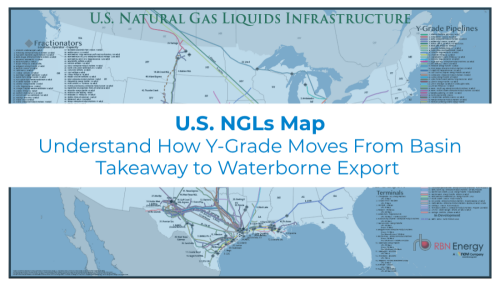
Visualize the infrastructure behind U.S. NGL movement.
The U.S. NGLs Map provides a comprehensive view of the transport, processing, and export networks moving NGLs across the U.S.
We described the Marcus Hook Industrial Complex (ethane export capacity, 70 Mb/d) and the Morgan’s Point Ethane and Ethylene Export Terminal (ethane export capacity, 200 Mb/d) in some detail in Part 2. We also discussed the long-term supply agreements that account for the vast majority of the ethane being exported. In Part 3, we turned our attention to the new, 180-Mb/d Orbit Ethane Export Terminal in Nederland, TX, which holds a long-term contract to supply as much as 150 Mb/d of ethane to two planned ethane-only steam crackers in China. Energy Transfer, which co-developed the Orbit terminal with Satellite Petrochemical, the U.S. subsidiary of a Chinese petrochemical company, also is seeking to line up customers for the 30 Mb/d of ethane-export capacity that is still available at Orbit.
About the song
"It Takes Two" was written by William Stevenson and Sylvia Moy, and appears as the first song on side one of Marvin Gaye and Kim Weston's duet album, Take Two. Produced by co-writer William Stevenson, who was Kim Weston's husband at the time, it was released as a single in December 1966. The song went to #4 on the Billboard Soul Singles Chart, and #14 on the Billboard Hot 100 Singles chart. Personnel on the record were: Marvin Gaye (vocals), Kim Weston (vocals), The Funk Brothers (instrumentation), and The Detroit Symphony Orchestra (orchestration). The song was also released as a duet single with Rod Stewart and Tina Turner, off of Stewart's 1990 Vagabond Heart album. Pepsi used this version in a nationwide television ad campaign in 1990. Hip hop artists Rob Base and DJ E-Z Rock had a hit record with a different song by the same name in 1988. Written by Robert Ginyard (Rob Base), Rob Base and DJ E-Z Rock's "It Takes Two" went to #3 on the Billboard Dance Club Songs, and #36 on the Billboard Hot 100 Singles charts. The single was certified Platinum by the Recording Industry Association of America.
Take Two, the Motown duet album by Marvin Gaye and Kim Weston, was recorded at Hitsville USA in Detroit in 1964-66, with Harvey Fuqua and William Stevenson producing. The LP was released in August 1966. Weston left Motown shortly after the release of the album, over a dispute about royalties from the company.
Marvin Gaye was an American soul singer, songwriter, and record producer. He released 25 studio albums, four live albums, 24 compilation albums, one soundtrack album, and 83 singles. He is a member of the Rock and Roll Hall of Fame, Songwriters Hall of Fame, Rhythm and Blues Hall of Fame, and has a Grammy Lifetime Achievement Award. Gaye died in 1984 at the age of 44. Kim Weston is an American soul singer. She has released nine studio albums, four compilation albums, and 10 singles. She is a member of the Rhythm and Blues Hall of Fame. Weston is retired and lives in Detroit.