The combination of rising Western Canadian crude oil production, little-to-no available pipeline takeaway capacity and setbacks for pipeline projects appear to be breathing new life into crude-by-rail (CBR) activity. CBR played an important supporting role earlier this decade, helping address incremental takeaway needs until new pipelines came online. And there would seem to be plenty of CBR capacity at hand this time around — the region saw some serious over-building of crude-loading terminals in 2014-15. But there may be challenges in getting some of that CBR capacity back online quickly. Today, we continue our series on Western Canadian crude, this time focusing on the crude-by-rail factor.
This is the sixth episode in this series. In Part 1, we looked at the recent collapse in the price of Western Canadian Select (WCS) versus West Texas Intermediate (WTI) and the 12-day shutdown of the Keystone Pipeline in November 2017 — events that highlighted the fact that rising production in the Western Canadian Sedimentary Basin (WCSB) is bumping up against the capacity of takeaway pipelines. Part 2 examined the historical and projected growing volume of crude oil produced in the WCSB. In that supply assessment, we noted that crude oil volumes in the region had grown from around 2.5 MMb/d in 2010 to roughly 4.0 MMb/d in 2014. Although the crash in WCS crude oil prices in 2014 slowed the pace of investment in new oil sands projects, production volumes in Western Canada are still projected to reach 5.0 MMb/d by 2025, raising the questions of where all this crude will go and how will it get there.
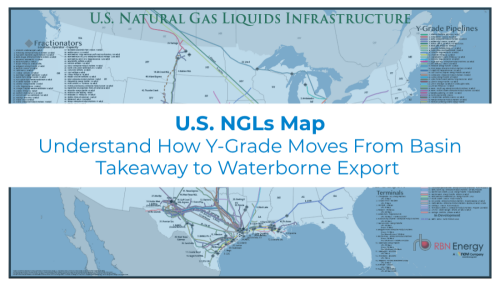
Visualize the infrastructure behind U.S. NGL movement.
The U.S. NGLs Map provides a comprehensive view of the transport, processing, and export networks moving NGLs across the U.S.
In Part 3, we discussed current refinery demand within the WCSB and the existing crude oil pipelines out of the region. In sum, we put oil refinery demand at just above 550 Mb/d, and predicted it will grow to nearly 600 Mb/d when the first phase of the new Sturgeon Bitumen Refinery northeast of Edmonton, AB, becomes fully operational this year. As for takeaway pipelines, their capacity totals about 3.5 MMb/d, including about 2.8 MMb/d on the all-important Enbridge Mainline System, which consists of six pipelines (Lines 1, 2, 3, 4, 65 and 67) that run from Alberta or Manitoba to Minnesota or Wisconsin. Other key pipes include TransCanada’s Keystone, Enbridge’s Express Pipeline System, and Kinder Morgan’s Trans Mountain.

About the song
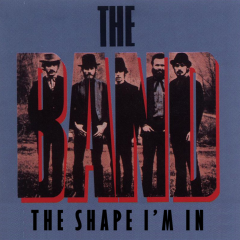
“The Shape I’m In” is among the most popular songs by The Band, the Canadian-American roots rock group that was formed in Toronto in 1968. The song, written by Robbie Robertson, is from The Band's 1970 third album, entitled Stage Fright. Richard Manuel sings lead vocals and plays the unique Clavinet keyboard part of the song. “The Shape I'm In” was a featured song in many of The Band's live performances, and also appears on their live albums Rock of Ages, Before the Flood and The Last Waltz.
The Band ended its touring career in 1976 in a performance filmed for Martin Scorsese’s highly praised documentary, “The Last Waltz.” The Band entered the Canadian Music Hall of Fame in 1989, and the Rock and Roll Hall of Fame in 1994. Rolling Stone Magazine ranked them #50 on its 100 Greatest Artists of All Time list in 2004. In 2008, they received a Grammy Lifetime Achievement Award.