Producers in the Western Canadian Sedimentary Basin (WCSB) are in a bind. Crude oil output in the WCSB has risen by more than 50% over the past seven years to about 4 MMb/d and is expected to increase to 5 MMb/d by the mid-2020s. But there has been only a modest expansion of refinery capacity within the region and pipeline capacity out of the WCSB, and lately takeaway constraints have had a devastating effect on the price relationship between benchmark Western Canadian Select (WCS) and West Texas Intermediate (WTI). What’s ahead for WCSB producers and WCS prices? Today, we continue our series on Western Canadian crude and bitumen markets, this time focusing on WCSB refinery capacity and existing pipelines out of the region.
In Part 1, we looked at the recent collapse in the price of WCS versus WTI and the 12-day shutdown of the Keystone Pipeline in November 2017, both of which put the spotlight on a major issue: Alberta production in particular is rising, pipeline takeaway capacity out of the province has not kept pace, and pipes are running so full that some owners have been forced to apportion access to them. We noted that while WCS had been selling at a steady $10/bbl discount to WTI earlier in 2017, the pricing differential collapsed later in the year to as much as $25/bbl. While the leak and subsequent shutdown of the Keystone Pipeline in November was the spark that ignited the most recent decline in WCS prices, the fundamentals behind the widening gap between WCS and WTI prices were already in place.
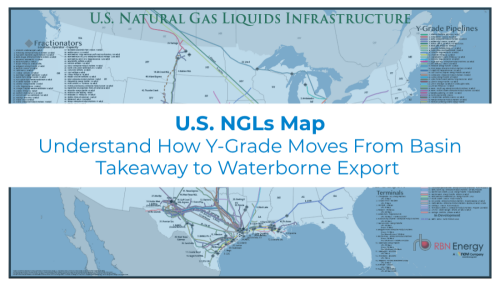
Visualize the infrastructure behind U.S. NGL movement.
The U.S. NGLs Map provides a comprehensive view of the transport, processing, and export networks moving NGLs across the U.S.
In Part 2, we examined the historical and projected growing volume of crude oil produced in the WCSB. In that supply assessment, we noted that crude oil volumes in the region had grown from around 2.5 MMbbl/d in 2010 to roughly 4.0 MMbbl/d in 2014. Although the crash in WCS crude oil prices in 2014 slowed the pace of investment in new oil sands projects, production volumes in Western Canada are still projected to reach 5.0 MMbbl/d by 2025. Where will all this growing crude oil supply go? Today, we’ll dive into the current local demand for crude oil in the WCSB and the existing crude oil pipeline takeaway capacity.

About the song
“The Shape I’m In” is among the most popular songs by The Band, the Canadian-American roots rock group that was formed in Toronto in 1968. The song, written by Robbie Robertson, is from The Band's 1970 third album, entitled Stage Fright. Richard Manuel sings lead vocals and plays the unique Clavinet keyboard part of the song. “The Shape I'm In” was a featured song in many of The Band's live performances, and also appears on their live albums Rock of Ages, Before the Flood and The Last Waltz.
The Band ended its touring career in 1976 in a performance filmed for Martin Scorsese’s highly praised documentary, “The Last Waltz.” The Band entered the Canadian Music Hall of Fame in 1989, and the Rock and Roll Hall of Fame in 1994. Rolling Stone Magazine ranked them #50 on its 100 Greatest Artists of All Time list in 2004. In 2008, they received a Grammy Lifetime Achievement Award.