The weeks-long shutdown at Syncrude Canada’s oil sands production facility in northeastern Alberta will alleviate pipeline takeaway constraints that have significantly widened the price spread between Western Canadian Select (WCS) and West Texas Intermediate (WTI) crude oil. But when Syncrude returns later this summer, there’s every reason to believe that the constraints will too, as will the need for significantly more crude-by-rail shipments. Railed volumes out of Western Canada have been increasing in recent months, but not by enough to avert WCS-WTI differential blowouts to $25 and even $30/bbl. The catch is that most of the rail-terminal capacity built a few years ago is mothballed, and that railroads are reluctant to dedicate more locomotives and personnel unless shippers make one-, two- or even three-year commitments to take-or-pay for that logistical support. Today, we consider the ongoing challenges Western Canadian producers face in moving their crude to market.
The biggest news in the crude oil business the past few days was OPEC’s June 23 announcement that its members will be increasing their output by as much as 1 MMb/d. But the runner-up was likely the news that Syncrude’s 360-Mb/d operation may be offline through the end of July — a shutdown triggered by a power outage. Syncrude accounts for nearly 10% of Western Canadian production, and the suspension of flows from its production facility north of Fort McMurray, AB, opens up a lot of space on the region’s takeaway pipelines — pipelines that have been running at or very near capacity for months. Syncrude’s troubles and their effects on Western Canada’s takeaway constraints are very likely to be only temporary, though. The underlying problem — insufficient pipeline capacity and profit-sapping differentials — isn’t going away.

Two of the largest hydrocarbon production areas in North America — the Permian Basin in West Texas and southeastern New Mexico and the Western Canadian Sedimentary Basin (including the Alberta oil sands) — don’t have enough pipeline capacity to transport their crude to refineries and export markets. As we’ve blogged about extensively in recent months, these takeaway constraints have resulted in widening price spreads and a scramble among producers and shippers without committed pipeline space in hand to find takeaway alternatives — mostly crude-by-rail and trucks. Importantly, the takeaway constraints the Permian and the WCSB face are not short-term problems. As we said in our All Dressed Up With Nowhere to Go blog series, Permian crude production has been bouncing up against the region’s combined takeaway capacity for some time now — even Enterprise Products Partners’ new, 540-Mb/d Midland-to-Sealy pipeline (which came online in April 2018) proved to be only a temporary fix — and takeaway constraints are likely to continue until another, big greenfield pipeline or two (such as Plains All American’s Cactus II and the EPIC Crude Oil Pipeline) are completed in late 2019 or early 2020. Until then, we’ll see aggressive efforts to add incremental takeaway capacity out of the Permian in any way possible, including a mini-revival in crude-by-rail and long-haul trucking from West Texas to the Gulf Coast (see No Time).
About the song
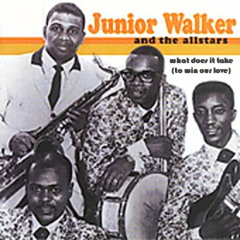
"What Does It Take (To Win Your Love)" was a hit for Junior Walker and the All Stars in 1969. Written by Johnny Bristol, Harvey Fuqua and Vernon Bullock and recorded at Motown's Hitsville U.S.A. studios in Detroit, the single went to #4 on the Billboard Hot 100, and #1 on the Billboard Hot Black Singles chart. It appears on the 1969 Junior Walker and the All Stars’ album, Home Cookin’, and has sold over a million copies to date. Walker's tenor sax intro and solo on this record is said to have influenced the sax stylings of David Sanborn, Clarence Clemons and Bobby Keys. The personnel on the recording were: Junior Walker (lead vocals and tenor sax), Johnny Bristol (harmony vocals), and The Andantes (backing vocals); various Funk Brothers — Motown house band members — provided backing instrumentation. Harvey Fuqua and Johnny Bristol produced the recording.
While playing the Detroit area in 1961, Junior Walker (real name: Autry DeWalt Mixon Jr.) was discovered by producer Johnny Bristol and Harvey record label owner Harvey Fuqua. When Fuqua's label was taken over by Berry Gordy, Walker became part of the Motown family. His first big hit for the label was the self-penned "Shotgun," which went to #4 on the Billboard Hot 100 in 1965. During his career, Walker released 37 singles and 23 albums, including three greatest hits LPs and one anthology collection. He was inducted into the Rhythm and Blues Foundation in 1995, and "Shotgun" was inducted into the Grammy Hall of Fame in 2002. Junior Walker passed away in Battle Creek, MI, on November 23, 1995.