There are widely differing views about how much U.S. demand for electricity may rise over the next few years due to the emergence of AI and large-scale data centers and how much that may impact demand for natural gas. But there’s across-the-board agreement that (1) the electric and gas sectors are more intertwined and interdependent than ever and (2) electric-grid reliability will suffer if more isn’t done to ensure gas-fired plants get the fuel they need when they need it. Now, after years of mostly tinkering around the edges, real action on gas-electric coordination looks to be at hand, thanks to a new push by Energy Secretary Chris Wright and the National Petroleum Council (NPC). In today’s RBN blog, we discuss highlights from a new NPC report and why we think it matters.

The Natural Gas Master Class is a one-day online event focusing on understanding flow analysis, interpreting pipeline data and forecasting future flows. This course is designed to equip you with the knowledge and skills to effectively analyze the complexities of natural gas markets, flow analysis, and pipeline modeling. Join us online
October 21 | Online
We’ll start with the big picture on power. The economics of coal- vs. gas-fired generation may still shift month to month and year to year, but natural gas is the undisputed king of power, accounting for well over 40% of the electricity produced in the U.S. in recent years (brown layer in Figure 1 below). Coal, with a roughly 16% share (teal layer) isn’t even #2 or #3 nowadays — those spots now go to hydroelectric and other renewables (blue and orange layers, respectively), with a combined 21%, and nuclear (light-green layer), with 18%. Petroleum (fuel oil/diesel; yellow layer) brings up the rear, with less than 1%. Contrast that with the U.S. generation split back in 2001, when coal accounted for 51% of total production, nuclear was the runner-up at 21% and gas finished third at only 17%.
U.S. Power Generation by Source
About the song
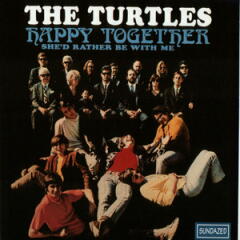
“Happy Together” was written by Gary Bonner and Alan Gordon and is the sixth cut on side one of The Turtles’ third studio album of the same name. The song was recorded in January 1967 at Sunset Sound in Hollywood, where Turtles lead vocalist Howard Kaylan said he recorded his vocal in one take. It was released as a single in February 1967, where it knocked The Beatles’ “Penny Lane” out of the #1 slot on the U.S. Billboard Hot 100 Singles chart. Turtles bassist Chip Douglas did the arrangement on the song, with Joe Wissert handling the production chores. It remains the biggest hit record for the band to date. Personnel on the recording were: Howard Kaylan (lead vocals), Mark Volman (vocals), Al Nichol (lead guitar, piano, backing vocals), Jim Tucker (rhythm guitar, backing vocals), Chip Douglass (bass, backing vocals, arrangement), John Barbata (drums, percussion) and Andy Cahan (organ). The single was certified 3x Platinum by the Recording Industry Association of America (RIAA).
The Happy Together LP was recorded between January 1966 and April 1967 at United Western Recorders and Sunset Sound in Hollywood. Produced by Joe Wissert and Bones Howe, it was released in April 1967 and went to #25 on the Billboard Top 200 Albums chart. It has been certified Gold by the RIAA. Three singles were released from the LP.
The Turtles were an American rock band formed in Westchester, CA. Led by vocalists Howard Kaylan and Mark Volman, the group started as a surf-rock band called The Crossfires in 1965 and changed their name to The Turtles after signing with White Whale Records in Los Angeles. Kaylan and Volman later joined Frank Zappa’s Mothers (formerly the Mothers of Invention) and also released records of their own as Flo & Eddie. The pair became the go-to guys for background vocals on over 100 albums; T. Rex's hit record Bang A Gong is one of the best-known ones. The Turtles released five studio albums, 20 compilation albums, seven EPs and 26 singles. Their previous group, The Crossfires, released two singles and a compilation album. For several years Kaylan and Volman appeared together as The Turtles on the Happy Together Tour, which featured various artists from the 1960s. Volman continued fronting The Turtles until shortly before his passing in September 2025 at 78. Guitarist Jim Tucker died in November 2020 at 74 and drummer John Barbata died in March 2024 at 79.
"About the Song" -- written by Mickey McMahan , RBN Director of Musicology