The natural gas market was roiled this week by the prospect of severe winter weather set to sweep across the country. The placid first half of January, with temperatures far above seasonal averages, now looks set to turn downright frigid from Friday through Sunday. The storm, now known as Winter Storm Fern, is forecast to leave a swath of snow and ice across the middle of the U.S. from New Mexico to Delaware. This has sent futures soaring this week and triggered market memories of another storm with an even shorter name, Uri, that wreaked havoc on the gas market five years ago. In today’s RBN blog, we’ll discuss the market’s jump in advance of Fern’s arrival and whether its effects might rival the tremendous dislocations caused by Uri.

The Natural Gas Master Class is a one-day online event focusing on understanding flow analysis, interpreting pipeline data and forecasting future flows. This course is designed to equip you with the knowledge and skills to effectively analyze the complexities of natural gas markets, flow analysis, and pipeline modeling. Join us online
October 21 | Online
The natural gas futures market was still in the doldrums on Friday, January 16, when the front-month February contract settled at $3.103/MMBtu, 88 cents lower than where the contract was trading when it became the prompt month at the end of December. Bearishness was the norm in the first half of January due to the unseasonably warm weather. According to data from RBN’s U.S. NATGAS Billboard, the average national temperature was 47.2 degrees for the January 1-15 period, 4.3 degrees higher than the average for the prior 10 years. As we would expect, unseasonably high temperatures for a peak winter month led to lower-than-typical natural gas usage. Total U.S. demand for natural gas in the first half of January averaged a paltry 101.7 Bcf/d. (The same period in 2025 averaged 124.2 Bcf/d.) Only record-high LNG feedgas kept supply from exceeding demand during those weeks, signaling a very loose market for a period that normally sees high withdrawals from storage.
As of January 16, the general view was that the second half of January would be colder than the first half. At RBN, we had anticipated that the average national temperature would be 2.9 degrees below normal for the back half of the month — cold, but not enough to significantly alter the gas balance — and our forecasts showed the gas surplus to the 5-year average declining by only 11 Bcf through February 6 (left side of Figure 1 below). The gas market entered the long Martin Luther King Day holiday weekend in a tranquil state but forecast changes over those three days sent futures into a frenzy when trading resumed.
About the song
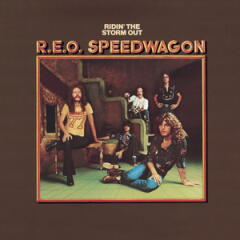
“Ridin’ the Storm Out” was written by Gary Richrath and appears as the first song on side one of R.E.O. Speedwagon’s third studio album of the same name. The song was written about an incident in which the band was stuck in a blizzard after a show in Boulder, CO, at a club called Tulagi. Personnel on the record were: Mike Murphy (lead vocals), Gary Richrath (guitar), Neil Doughty (keyboards), Gregg Philbin (bass), Alan Gratzer (drums), and Gloria Jones, Carolyn Willis and Oma Drake (backing vocals).
The album Ridin’ the Storm Out was recorded during the summer of 1973, with Bill Halverson producing. It is interesting to note that the album was almost complete, with lead vocals provided by Kevin Cronin, when Cronin decided to leave the band due to creative differences. All of the lead vocals were re-recorded by Cronin’s replacement, Mike Murphy. Released in December 1973, the LP went to #171 on the Billboard Top 200 Albums chart.
Four years later, with the release of R.E.O.’s double live album, Live: You Get What You Play For, “Ridin’ the Storm Out” was released as a single with Kevin Cronin on lead vocals. It went to #74 on the Billboard Hot 100 Singles chart and has since been certified Platinum by the Recording Industry Association of America. Live: You Get What You Play For would become R.E.O. Speedwagon’s first Platinum album. After the success of the live album, their third album, Ridin’ the Storm Out, also rose to Platinum status.
R.E.O. Speedwagon is an American rock band formed in Champaign, IL, in 1967. After years of touring as a popular Midwest bar band, they were signed by Epic Records in 1971. The band has released 16 studio albums, 10 live albums, 19 compilation albums and 34 singles. They have sold more than 40 million records worldwide and have had 13 charting Top 40 singles. Twenty-two members have passed through the ranks of R.E.O. Speedwagon band since its formation. Longtime guitarist and songwriter Gary Richrath died in 2015. Original member Neil Doughty, along with Kevin Cronin, Bruce Hall, Dave Amato, and Bryan Hitt continue to tour as R.E.O. Speedwagon.
"About the Song" -- written by Mickey McMahan , RBN Director of Musicology