It could be argued that no sector in the energy industry has seen more uncertainty the past three years than refining. In rapid succession, it experienced a historic collapse in demand, a shaky recovery, a run-up in crude oil and other feedstock prices, the disruption in Russian supply, and the wrath of the public and politicians alike when gasoline and diesel prices rocketed higher earlier this year. Prices at the pump may have sagged in recent months, but don’t think for a second that refining has reverted to anything resembling stability and normalcy — refiners still face a host of challenges and unknowns. For starters, what’s ahead for crack spreads, which have been spiking up and down lately? How quickly will electric vehicles (EVs) undermine demand for traditional motor fuels? And what about renewable diesel? New environmental regulations? More refinery closures? In today’s RBN blog, we look at the long list of challenges domestic and international refiners will face through the rest of the 2020s.

The key events of the 2020-22 period — the pandemic, a land war in Europe, and now, the threat of an economic downturn — shook or even undid a lot of energy-market expectations. Three years ago this month, before all hell broke loose, a major concern among many refiners was the impending implementation of IMO 2020, which threatened to throw the middle distillates market seriously out of kilter and result in major changes to crude differentials. (Neither of these happened in 2020, but are being felt now.) There were also growing worries about an impending transition to EVs and an allegedly looming “peak” in petroleum demand. COVID soon made 2019’s concerns seem quaint. Rather than simply having to deal with a shift toward lower-sulfur bunker in the global shipping industry or a slowdown in motor-fuel demand growth, U.S. refiners in March 2020 suddenly faced the steepest decline in gasoline, diesel and jet fuel demand ever (see Strange Brew). In response, refiners did all they could to ramp down their operations — some went offline entirely (see Baby Break It Down) and others shifted to renewable diesel, which had emerged as an economically viable alternative (see Where Are You Going?).
Even bigger changes were happening just beneath the surface — not just in the U.S. but internationally. In most places, demand for refined products eventually recovered to pre-pandemic levels, but three years of growth had been lost. A handful of new refineries came online (mostly in the Middle East and Asia), enabling global refining capacity to inch up by 315 Mb/d in the 2019-22 period (green arrow at center-top in Figure 1), but refining capacity in the Americas fell by 1.2 MMb/d (most of that decline coming in the U.S. — red arrows to left) and Europe’s capacity declined by 900 Mb/d. As RBN’s Refined Fuels Analytics practice sees it, another 2+ MMb/d of refining capacity is under threat worldwide, raising all kinds of questions about the sector’s ability to keep pace with (still) rising demand.

About the song
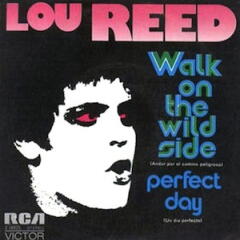
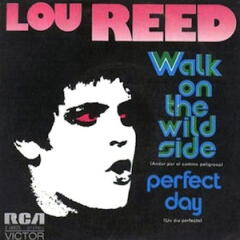
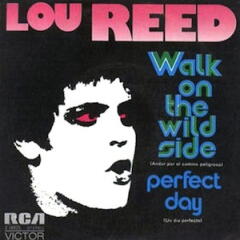
“Walk on the Wild Side” was written by Lou Reed and appears as the fifth song on side one of Lou Reed's second solo studio album, Transformer. Released as a double A-side single with “Perfect Day” in November 1972, “Walk on the Wild Side” went to #16 on the Billboard Hot 100 Singles chart. The song’s lyrics describe the misadventures of several of the “superstar” regulars at Andy Warhol’s New York City studio, The Factory. Lou Reed has said that Nelson Algren’s 1956 novel, “A Walk on the Wild Side,” was the launching point for the song. In 2013, The New York Times described the song as “an unlikely cultural anthem as a siren song bringing a generation of people to a New York so long forgotten as to seem imaginary.” Personnel on the record were: Lou Reed (lead vocals), Herbie Flowers (fretless Fender Jazz Bass), Ronnie Ross (baritone sax — Ross was David Bowie’s sax instructor during his childhood), David Bowie (acoustic guitar), Mick Ronson (string arrangements), and Dari Lalou, Karen Friedman, and Carey Synge (background vocals).
Transformer was recorded during August 1972 at Trident in London with David Bowie and Mick Ronson producing. Released in November 1972, it went to #29 on the Billboard 200 Albums chart. The album is considered an influential LP in the 1970s glam rock genre. The striking front cover picture is from a photograph of Reed by Mick Rock. Three singles were released from the LP.
Lou Reed was an American singer, musician, songwriter, and poet. He started playing music in doo-wop groups while in high school. After graduating from Syracuse University, he went to work for Pickwick Records in New York City, where he met fellow musician John Cale. Together with Sterling Morrison and Angus MacLise, they would form the original Velvet Underground band in 1965. They soon added Moe Tucker as their drummer and German singer/model Nico as their singer. In 1966 they started being managed by Andy Warhol and became the house band at The Factory. The Velvet Underground released their debut album in 1967. Ten different people passed through the group before its final breakup in 1996. Reed left the band in 1970 to pursue a solo career. As a solo artist, he released 21 studio albums, 15 live albums, 16 compilation albums, and 46 singles. Reed was inducted into the Rock and Roll Hall of Fame twice: as a member of the Velvet Underground in 1996 and posthumously as a solo artist in 2015. Reed died in New York City in October 2013 at the age of 71.