West Texas Intermediate (WTI) CME NYMEX crude futures settled up 92 cents/Bbl yesterday (January 28, 2016) at $33.22/Bbl and NYMEX Henry Hub natural gas futures settled up slightly at $2.182/MMBtu. The crude-to-gas ratio - meaning the crude price in $/Bbl divided by the gas price in $/MMBtu - was 15.22 X. For most of this year so far the ratio has been less than 15X On January 20, 2016 it dipped to 12.5 X – its lowest point since March 2009. Over the 5 years between 2010 and 2014 the ratio averaged 27X - reaching a high of 54X in April 2012. That lofty five year run for the crude-to-gas ratio was arguably responsible for much of the crude and natural gas liquids production boom since 2011 and a “Golden Age” of natural gas processing. Today we begin a two-part series discussing the ratio and the market implications if it stays low.
Crude Oil and Natural Gas Price Relationship
A pillar of RBN’s analysis of drill bit hydrocarbons (gas and liquids produced at the wellhead) is our belief that the relationship between crude oil, natural gas and natural gas liquids (NGLs) has become far more significant in the shale era than it was a generation ago. Back then oil, gas and NGL markets tended to lead separate lives and participants rarely crossed each other’s paths. This new hydrocarbon reality is one of the underlying themes in Rusty’s recently published book “The Domino Effect”. Now what happens in oil markets has an impact on gas and NGL such that understanding their interrelationships is important. This is particularly true of the relationship between crude and natural gas prices – known as the crude-to-gas ratio. The ratio measures the relative value of hydrocarbons in a liquid form (crude oil – based on the CME/NYMEX U.S. crude benchmark WTI price) and hydrocarbons in a gaseous form (natural gas – based on the CME/NYMEX U.S. natural gas benchmark Henry Hub, LA contract). We track the crude-to-gas ratio every day on our website in the RBN Spot check graphs – you can learn more about Spot Check here. There are typically two ways to express the crude-to-gas ratio – the rule of thumb method that is simply crude price divided by natural gas price or the BTU ratio method that is gas price divided by (crude price /5.8) where 5.8 is the number of MMbtu in a barrel of crude. RBN Energy sticks to the rule of thumb method since it is more intuitive.
As we begin 2016, with oil prices plunging to new depths below $30/Bbl and then recovering somewhat and natural gas bumping along just above $2/MMBtu we’ll start our analysis by briefly recapping the history of the crude-to-gas ratio over the past few years. Prior to the Great Recession in 2008 crude and gas prices tended to move in sync – following the same general pattern – largely in response to international factors. Then between 2009 and June 2014, oil and gas prices headed in opposite directions. Gas prices stayed low because a surplus of domestic shale production was not met by any major new sources of demand. At the same time, oil prices increased to over $100/Bbl even as U.S. shale crude output was surging after 2011. That was because new U.S. crude production mostly replaced imported barrels - meaning that production growth had less of an impact on overall prices during an era of rising world crude demand. During this period of “Great Divide” between oil and gas, the ratio of WTI to Henry Hub natural gas averaged 27X - reaching an all-time high of 54X in April 2012. These ratio levels dwarfed historical norms before 2008 of around 7.5X and the “true” BTU ratio of WTI crude to natural gas of 5.8 MMBtu/Bbl. The high ratio during the Great Divide placed a premium on liquids over gas - leading many U.S. shale producers to move away from drilling for dry gas towards wet gas (containing lots of NGLs) and crude plays. The high crude-to-gas ratio also underpinned a "Golden Age” of natural gas processing - marked by high margins for extracting gas liquids from the natural gas stream (more about NGLs in Episode 2). Since the latter part of June 2014 both crude and natural gas prices have been in retreat. Although they have shown little sign of synchronized action the weakness in both hydrocarbons has principally been caused by oversupply. And because crude prices have fallen harder and faster than natural gas the ratio between them has fallen as well. We last looked at the crude-to-gas ratio in December 2014 – at the end of a year that had seen oil prices drop by 50% from their highs over $107/Bbl in June 2014 to average $59/Bbl in December 2014 and natural gas was down from a high of $4.76/MMBtu in June 2014 to average $3.50/MMBtu in the same month – a ratio just under 17X (see Crude And Natural Gas After The Crash).

About the song
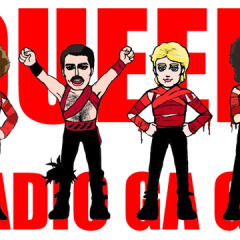
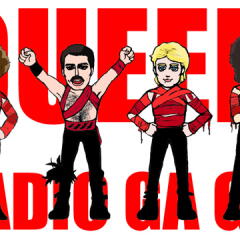
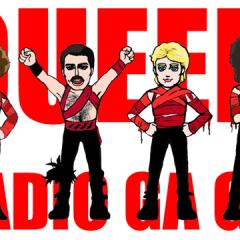
"Radio Ga Ga" was written by Roger Taylor, and appears as the first cut on Queen's 11th studio album, The Works. The song was released as the first single from the album in February 1984, and went to #16 on the Billboard Hot 100 chart. The inspiration for the song came to Taylor when he heard his three-year-old son say "radio ca-ca" when referring to the music playing on the radio. The song's lyrics became a reminiscence for when radio was the go-to place for hearing exciting new music at a time when music videos were taking over. As a side note, Lady Ga Ga (Stefani Germanotta) came up with her name when her producer, Robert Fusari, told her she reminded him of the Queen song, "Radio Ga Ga." Personnel on the record were: Freddie Mercury (lead vocal, backing vocals, synthesizer), Roger Taylor (drum programming, synthesizer, backing vocals), Brian May (electric guitar, slide guitar, backing vocals), John Deacon (bass) and Fred Mandel (synthesizer).
The Works was recorded between August 1983 and January 1984 at The Record Plant in Los Angeles and Musicland Studios in Munich, Germany. The LP, produced by Queen and Reinhold Mack, was released in February 1984 and went to #23 on the Billboard Top 200 Albums chart. Four singles were released from the album. The Works was certified Gold by the Recording Industry Association of America.
Queen is a British rock band formed in London in 1970. The group’s classic line-up was: Freddie Mercury (lead vocals, piano), Brian May (guitars, backing vocals), John Deacon (bass) and Roger Taylor (drums, backing vocals). Queen has released 15 studio albums, 10 live albums, two soundtrack albums, 15 compilation albums, seven EPs and 72 singles. The band has won five Brit Awards and four Ivor Novello Awards. Queen is a member of the Rock and Roll Hall of Fame, Songwriters Hall of Fame, UK Music Hall of Fame and Grammy Hall of Fame. The band also has a Grammy Lifetime Achievement Award. Freddie Mercury died in November 1991, and John Deacon retired from the band in January 1997. Original members Brian May and Roger Taylor have continued to tour under the Queen banner with supplemental touring musicians. Paul Rodgers was the featured vocalist for the band from 2004 to 2009. Adam Lambert has been the featured vocalist since 2011. The Queen and Adam Lambert Rhapsody Tour will begin in Europe in May 2020.