


West Texas Intermediate (WTI) CME NYMEX crude futures settled yesterday at $55.93/Bbl, down 52% since June 2014 and NYMEX Henry Hub natural gas futures settled at $3.619/MMBtu. The crude-to-gas ratio of these two energy commodities - meaning the crude price in $/Bbl divided by the gas price in $/MMBtu - was just over 15X. We have not seen a crude-to-gas ratio at this level since June 2010. Over the past 4 years the ratio has been far higher - averaging 27X and reaching a high of 54X In April 2012. That lofty four year run for the crude-to-gas ratio has arguably been responsible for much of the crude and natural gas liquids production boom since 2011 and a “Golden Age” of natural gas processing. Today we begin a two part series on the implications of a lower crude-to-gas ratio.
Crude Oil and Natural Gas Price Relationship
A pillar of RBN’s analysis of drill bit hydrocarbons (gas and liquids produced at the wellhead) is our belief that the relationship between crude oil, natural gas and natural gas liquids (NGLs) has become far more significant during recent years than it was a generation ago. Back then oil, gas and NGL markets tended to lead separate lives and participants rarely crossed each other’s paths. Now what happens in oil markets has an impact on gas and NGL such that understanding the interrelationships between them is important. This is particularly true of the relationship between crude and natural gas prices. As we near the end of 2014, with oil prices crashing around our ears, it is instructive to revisit the relationship between crude and natural gas since before the shale revolution. We start with the absolute price relationship and get to the ratio in a minute. Figure #1 shows prices for WTI nearby futures contracts on the CME NYMEX – the benchmark for U.S. domestic crude in $/Bbl against the left axis (blue line on the chart) and prices for CME NYMEX Henry Hub, LA natural gas nearby futures contracts – the benchmark for domestic gas in $/MMBtu against the right axis (red line) since 2007.

Figure #1
Source: CME NYMEX data from Morningstar (Click to Enlarge)
Note that between 2007 and early 2009, price movements in crude and natural gas were generally synchronized (green dotted oval). In this period U.S. production of both oil and gas was declining. The U.S. was already a big importer of crude oil – needing to meet 50% of requirements from overseas. Domestic natural gas supplies were also supplemented by imports during periods of high demand and plans were well underway to build out a network of liquefied natural gas (LNG) terminals to increase imports. Then from the start of 2009, oil and gas prices started to move in different directions (black arrows on the chart). That “Great Divide” as we have called it, was caused by dramatic changes in the supply and demand for gas and crude – brought about by the shale revolution – that led to gas and crude prices to heading in opposite directions.
About the song
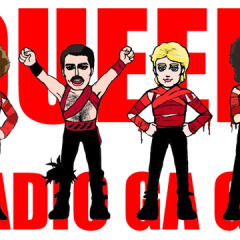
"Radio Ga Ga" was written by Roger Taylor, and appears as the first cut on Queen's 11th studio album, The Works. The song was released as the first single from the album in February 1984, and went to #16 on the Billboard Hot 100 chart. The inspiration for the song came to Taylor when he heard his three-year-old son say "radio ca-ca" when referring to the music playing on the radio. The song's lyrics became a reminiscence for when radio was the go-to place for hearing exciting new music at a time when music videos were taking over. As a side note, Lady Ga Ga (Stefani Germanotta) came up with her name when her producer, Robert Fusari, told her she reminded him of the Queen song, "Radio Ga Ga." Personnel on the record were: Freddie Mercury (lead vocal, backing vocals, synthesizer), Roger Taylor (drum programming, synthesizer, backing vocals), Brian May (electric guitar, slide guitar, backing vocals), John Deacon (bass) and Fred Mandel (synthesizer).
The Works was recorded between August 1983 and January 1984 at The Record Plant in Los Angeles and Musicland Studios in Munich, Germany. The LP, produced by Queen and Reinhold Mack, was released in February 1984 and went to #23 on the Billboard Top 200 Albums chart. Four singles were released from the album. The Works was certified Gold by the Recording Industry Association of America.
Queen is a British rock band formed in London in 1970. The group’s classic line-up was: Freddie Mercury (lead vocals, piano), Brian May (guitars, backing vocals), John Deacon (bass) and Roger Taylor (drums, backing vocals). Queen has released 15 studio albums, 10 live albums, two soundtrack albums, 15 compilation albums, seven EPs and 72 singles. The band has won five Brit Awards and four Ivor Novello Awards. Queen is a member of the Rock and Roll Hall of Fame, Songwriters Hall of Fame, UK Music Hall of Fame and Grammy Hall of Fame. The band also has a Grammy Lifetime Achievement Award. Freddie Mercury died in November 1991, and John Deacon retired from the band in January 1997. Original members Brian May and Roger Taylor have continued to tour under the Queen banner with supplemental touring musicians. Paul Rodgers was the featured vocalist for the band from 2004 to 2009. Adam Lambert has been the featured vocalist since 2011. The Queen and Adam Lambert Rhapsody Tour will begin in Europe in May 2020.





Comments
It will be interesting to see what will happen with nat gas if oil production decreases foilowing the price crash. A lot of associated gas will not be prodeced.
Thanks for this very interesting post. The relationship between natural gas oil prices affects both energy consumers and providers, especially by influencing their incentives to invest in inventories or different types of energy using equipment. Energy market traders also are interested to know whether there is a tendency for the relative prices of different energy commodities to return to a partcular value, since such a tendency exists it might form the basis of a trading strategy.