The province of Alberta has lifted its cap on crude oil production, oil-sands producers are implementing plans to increase their output through the 2020s, and new pipeline capacity from Western Canada into the central U.S. is being added on the all-important Enbridge Mainline system. With those stars aligning, the next big push by midstream companies will be expanding their ability to move Canadian barrels south to the Cushing hub in Oklahoma, the Patoka hub in Illinois, and refineries and export docks along the Gulf Coast. As a group, these new and expanded lines — plus a major pipe reversal — will represent one of the biggest midstream build-outs in the U.S. of this coming decade. Today, we begin a blog series about these projects and what’s driving their development.
It’s been a difficult few years for producers of conventional oil and bitumen in Western Canada. As production in the Alberta oil sands in particular grew quickly through the 2010s, the pipelines that transport most of that supply south to U.S. markets filled up. That forced some midstreamers to apportion access to their pipelines, and prompted many producers and shippers to turn to more expensive crude-by-rail as an alternative delivery method. The pipeline constraints and increased use of rail crushed prices for Western Canadian Select (WCS) and other regional blends — by the fall of 2018, the spread between WCS and WTI prices had ballooned to more than US$40/bbl. In January 2019, Alberta’s provincial government implemented a production cap to ease takeaway constraints and shrink the WTI/WCS price spread. The spread did shrink to a more acceptable level, and as it did production curtailments were eased through the remainder of 2019 and into 2020. Just as it seemed that things were returning to normal, COVID-19 reared its ugly head, sharply reducing demand for oil and spurring nearly 1 MMb/d in production cuts in Western Canada as a whole — the vast majority of the cuts occurring in Alberta. The only good news was that as production fell, pipeline constraints evaporated and crude-by-rail volumes dropped to their lowest level in years.
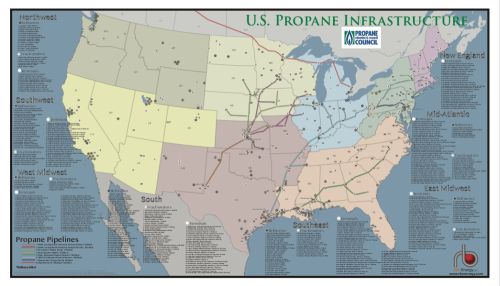
The RBN Energy U.S. Propane Infrastructure map provides a comprehensive view of the propane supply network in the lower 48 states.
More recently, Western Canadian oil production has been rebounding, albeit hesitantly, and oil-sands producers are proceeding with plans to gradually expand production over the next few years with a combination of entirely new oil sands projects and “bolt-ons” to existing projects. Producers and shippers also are anticipating — maybe even praying a little — that sufficient incremental pipeline capacity out of the region will be developed in time to handle the increasing production. Three main efforts have been under way to add out-of-Alberta takeaway capacity, one to the Vancouver, BC, area and two to — and into — the central U.S.:

About the song
"Girl from the North Country" was written by Bob Dylan and originally appeared as the second song on side one of Dylan's second studio album, The Freewheelin' Bob Dylan. The song was recorded in April 1963 at Columbia Studio A in New York City, with John Hammond and Tom Wilson producing and Dylan providing the vocals and playing the guitar and harmonica. Dylan re-recorded the song as a duet with Johnny Cash in February 1969. This version was the opening number on Dylan's Nashville Skyline album, which was released in April 1969. In 2017, a musical featuring Dylan songs ran on Broadway, titled Girl from the North Country.
The Freewheelin' Bob Dylan was recorded between April 1962 and April 1963. Released in May 1963, the album went to #22 on the Billboard Top 200 Albums chart. Several songs on Dylan's sophomore album have been considered some of his best work, including: “Blowin' in the Wind,” “Don't Think Twice, It's All Right," and "A Hard Rain's Gonna Fall." The LP has been certified Platinum by the Recording Industry Association of America.
Bob Dylan is an American singer, songwriter, musician, author, and visual artist. His career has spanned nearly six decades, and he is widely regarded as one of the best songwriters in the history of popular music. He has released 39 studio albums, 12 live albums, 20 compilation albums, seven soundtrack albums, 26 EPs, and 94 singles, and has sold over 100 million records worldwide. Dylan’s songs have been covered by many artists of different genres in popular music. He has won one Academy Award, one Golden Globe Award, 10 Grammy Awards, and a MusiCares Person of the Year Award. Dylan is a member of the Rock and Roll Hall of Fame, the Songwriters Hall of Fame, and the Nashville Songwriters Hall of Fame. He has been awarded the Nobel Prize in Literature, the Presidential Medal of Freedom, the Prince of Asturias Award, and the Legion d'honneur from the government of France. Dylan's archives will be housed in the Bob Dylan Center, which is located next to the Woody Guthrie Center in Tulsa and due to open in late 2021. In December 2020, Dylan sold the rights to his entire songwriting catalog to Universal Music Publishing Group for an undisclosed sum in what is said to be the largest acquisition deal ever. (One estimate put the price at north of $300 million.) The singer continues to record and tour.