For most of the past few years, crude oil producers in Alberta have dealt with pipeline constraints that often forced them to sell their crude at steep discounts. While the constraints eased somewhat earlier this year as producers reduced their output due to cratering oil demand and oil prices, production more recently has been rebounding, resulting in the return of takeaway concerns. The big hope is that long-planned pipeline projects like the Trans Mountain Expansion (TMX) and Keystone XL will finally be built and commissioned, but they still face legal and regulatory hurdles before being completed. Lately, a different option has gained momentum focusing on a proposed rail line linking Alaska to the immense oil sands region of northern Alberta, potentially creating another corridor for the export of oil sands crude. Today, we describe recent developments in a bold plan to build a rail line from Alberta, across northern Canada, and into Alaska.
Living in Alaska or northern Canada may offer the advantage of being closer to Santa Claus, but it has the clear disadvantage of being remote and isolated. Rugged terrain and bitter cold conditions for a good portion of the year make the transportation of goods even more challenging in such regions (unless you have flying reindeer and a sleigh). For these reasons, an intercontinental railway connecting Canada to Alaska has been kicked around since the late 1960s as a means to foster economic development by transporting the mineral and energy resources Western Canada and the north have to offer.

The Crude Oil Billboard keeps readers at the forefront of the U.S. crude oil market by offering access to data and information moments after its release. Say goodbye to PDF reports that come out after the market has already moved on.
On its own, the state of Alaska has been dabbling in railroads since the early 20th century and currently operates the Alaska Railroad (ARR) on a dual-track line (dotted black line in Figure 1) connecting Anchorage, Fairbanks, and North Pole (sadly, not the one that’s Santa’s hometown). There is also a regular rail-to-barge service that links Anchorage to the west coast of Canada and to Seattle, WA. However, there is no overland rail connection between Alaska and Western Canada. Studies evaluating such an idea were conducted in the early 2000s; the Alaska legislature did enact laws allowing for the link-up of the ARR at Fairbanks or North Pole to any prospective overland Canadian rail line that might come into existence.
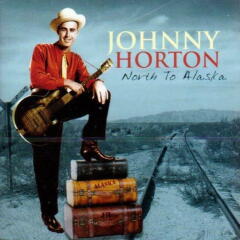
About the song
"North to Alaska" was written by Johnny Horton and Tallman Franks. The song appeared in the opening sequences of the 1960 feature film of the same name starring John Wayne, Stewart Granger, and Ernie Kovacs. It also appeared as the first track on Johnny Horton's Greatest Hits album, released in 1961. Produced by Don Law, "North to Alaska" was released as a single in August 1960. It went to #1 on the Billboard Hot Country Songs chart and #4 on the Billboard Hot 100 Singles chart. Sadly, Johnny Horton died in a car wreck just eight days before the film's release and as the single was climbing the charts. Known personnel on the record were: Johnny Horton (lead vocals) and Rusty Goodman (bass vocals).
Johnny Horton (The Singing Fisherman) was an American country music, honky-tonk, and rockabilly singer and musician. He started performing in his hometown of Los Angeles in the early 1950s, later relocating to Shreveport, LA, where he appeared regularly as a star on Louisiana Hayride, a country music radio and TV show. He released 11 studio albums and 34 singles; has a Grammy Award and a Grammy Hall of Fame Award; and he is a member of the Rockabilly Hall of Fame and the Louisiana Music Hall of Fame. Horton’s biggest hit record was "The Battle of New Orleans," which went to #1 on the Billboard Hot 100 Singles chart after its release in April 1959. Horton died in a car wreck traveling back to Shreveport after a concert at the Skyline Club in Austin, TX, in November 1960. He was 35 years old.